How Do Currency Exchange Rates Actually Move?
Posted On - July 17, 2026 | By - FXProfitBuilder | Categories - Forex Basics for Beginners
Introduction

Have you ever wondered why the value of the Euro rises one day and falls the next? Or why the US Dollar strengthens against the British Pound during certain market conditions?
These price changes are known as currency exchange rate movements, and they are what create trading opportunities in the Forex market.
For beginners, exchange rates may seem unpredictable. In reality, currency prices move because of a combination of economic events, market sentiment, supply and demand, and global financial activity.
At FXProfitBuilder, our analysts study these market influences every day using advanced research, support and resistance analysis, volume indicators, and proprietary mathematical models to provide members with high-quality Forex trading signals.
What Is a Currency Exchange Rate?

A currency exchange rate is the value of one currency compared to another.
For example:
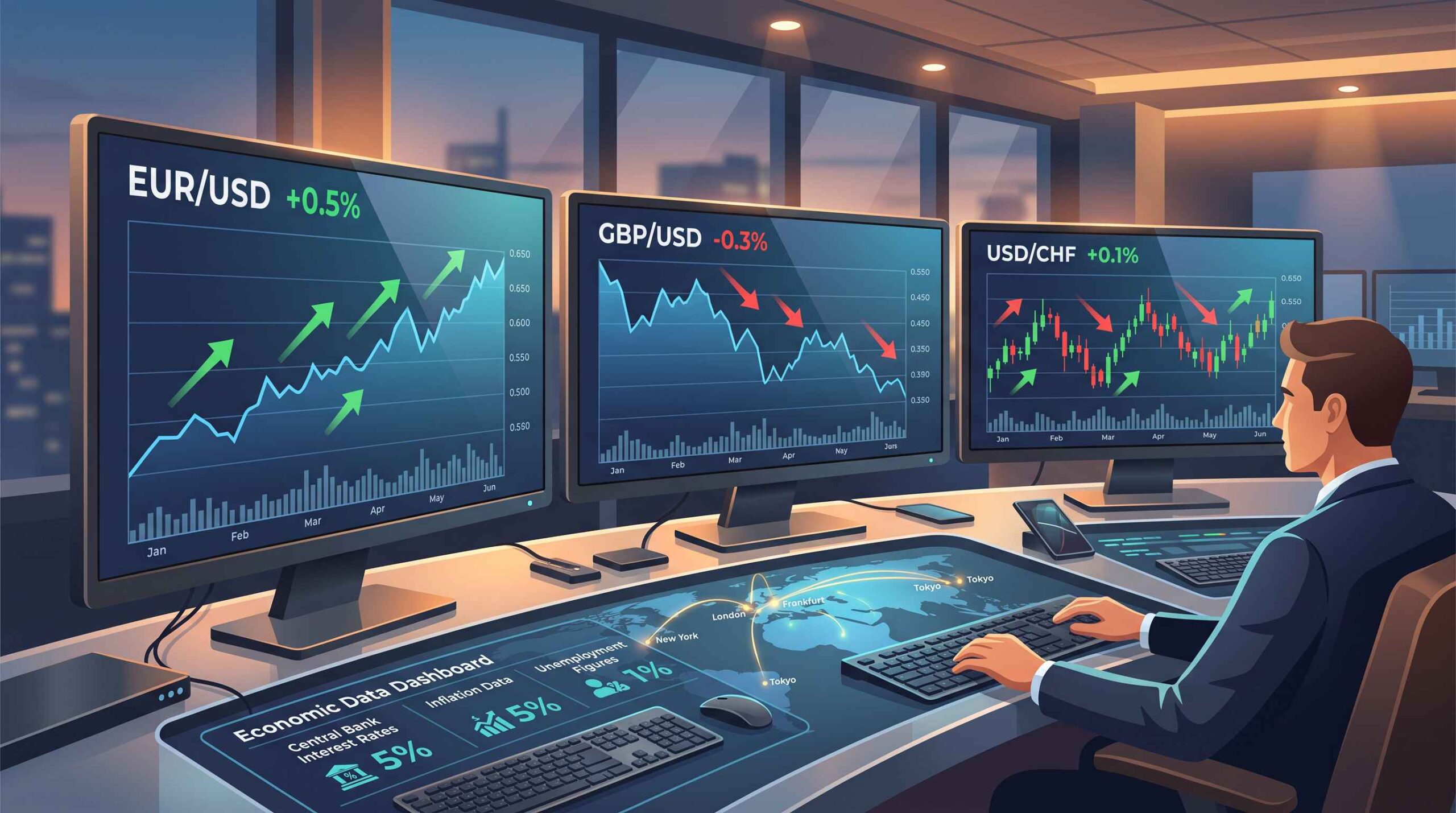
- EUR/USD shows how many US Dollars are needed to buy one Euro.
- GBP/USD compares the value of the British Pound with the US Dollar.
- USD/CHF compares the US Dollar with the Swiss Franc.
If the exchange rate changes, the value of one currency has either strengthened or weakened against the other.
These movements create opportunities for Forex traders.
Why Do Currency Exchange Rates Move?

Currencies are constantly bought and sold around the world.
Like any market, prices change because of supply and demand.
When demand for a currency increases, its value often rises.
When demand decreases, its value may fall.
However, many factors influence this supply and demand.
1. Economic Data

Economic reports play an important role in Forex markets.
Examples include:
- Employment reports
- Inflation data
- Economic growth figures
- Retail sales
- Manufacturing data
Strong economic performance can increase confidence in a country’s currency, while weaker data may reduce demand.
Professional traders closely monitor these releases because they often lead to increased market activity.
2. Interest Rates

Interest rates are one of the biggest drivers of currency values.
When interest rates rise, a country’s currency may become more attractive to investors seeking better returns.
When interest rates fall, demand for that currency may decrease.
Interest rate decisions often create significant movement in major currency pairs.
3. Market Sentiment

Not every market movement is caused by economic reports.
Sometimes prices move simply because traders expect future events.
This overall attitude is known as market sentiment.
If traders become optimistic about a country’s economy, its currency may strengthen.
If confidence declines, the currency may weaken.
4. Global Events

Major global events can influence exchange rates, including:
- Political developments
- Elections
- International conflicts
- Natural disasters
- Major financial news
These events can increase uncertainty and create periods of higher market volatility.
5. Supply and Demand

Ultimately, every Forex price is determined by buyers and sellers.
If more traders want to buy a currency than sell it, its value generally rises.
If more traders want to sell than buy, its value usually falls.
This constant balance between buyers and sellers causes exchange rates to change every second during market hours.
Why Prices Never Stay Still

The Forex market is one of the most active financial markets in the world.
Banks, financial institutions, businesses, governments, and individual traders continuously exchange currencies.
Because new information enters the market throughout the day, exchange rates constantly adjust to reflect changing conditions.
This continuous movement creates opportunities for traders.
Why Beginners Shouldn’t Try to Predict Every Move

Many new traders believe they must understand every market movement before placing a trade.
In reality, even professional traders cannot predict every price change.
Instead, successful traders focus on:
- High-probability setups
- Risk management
- Consistency
- Following a structured trading plan
Trying to predict every market move often leads to emotional decisions.
How FXProfitBuilder Analyzes the Market
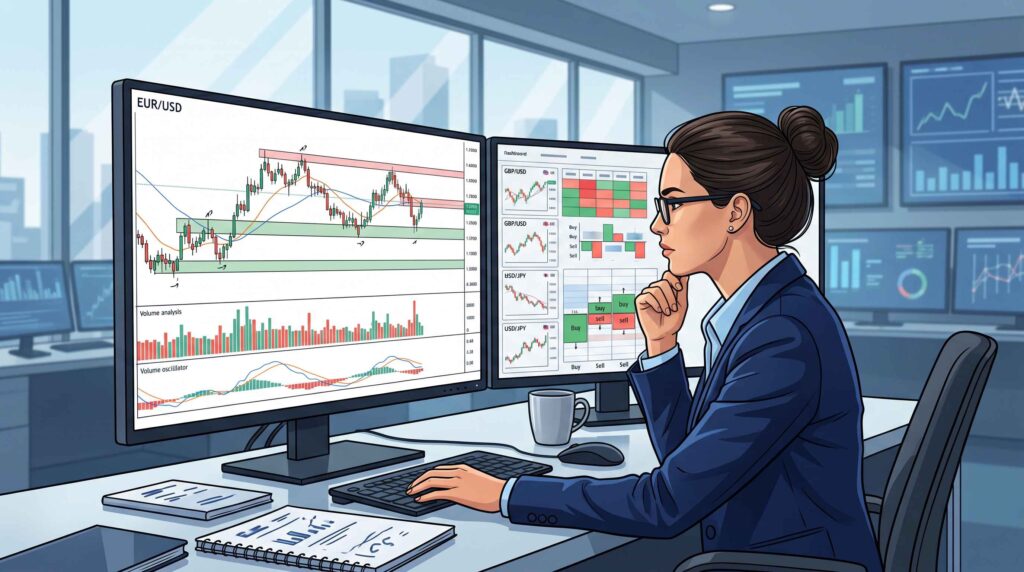
Rather than relying on guesswork, FXProfitBuilder combines multiple forms of professional analysis.
Our analysts use:
- Volume indicators
- Support and resistance studies
- Proprietary mathematical models
- Statistical research
- Market structure analysis
This research is then converted into clear daily trading signals with defined entry points and exit targets.
Members don’t need to spend hours analyzing charts because much of the technical work has already been completed.
Why We Focus on Three Major Currency Pairs

FXProfitBuilder provides signals for:
- EUR/USD
- GBP/USD
- USD/CHF
These major currency pairs offer:
- High liquidity
- Strong trading volume
- Consistent market activity
- Competitive trading conditions
By concentrating on three carefully selected pairs, traders can develop a better understanding of market behavior without becoming overwhelmed.
The Importance of Risk Management

Even with professional analysis, no market prediction is guaranteed.
This is why successful traders always combine analysis with proper risk management.
Good risk management helps traders:
- Protect trading capital
- Reduce emotional trading
- Handle losing trades professionally
- Stay focused on long-term consistency
At FXProfitBuilder, structured trade management is an important part of every trading signal.
Final Thoughts

Currency exchange rates move because of a combination of supply and demand, economic data, interest rates, market sentiment, and global events.
While these movements may seem complex at first, traders don’t need to predict every price change to become successful.
By following a structured trading system, managing risk responsibly, and using professional market analysis, traders can approach the Forex market with greater confidence.
At FXProfitBuilder, we simplify this process through daily Forex signals, ongoing education, and nearly two decades of market experience, helping traders focus on disciplined decision-making rather than market speculation.
FAQ

1. What causes currency exchange rates to change?
Exchange rates move because of supply and demand, economic data, interest rates, market sentiment, and global events.
2. Why do Forex prices change so frequently?
The Forex market operates continuously during the trading week, with buyers and sellers around the world constantly exchanging currencies.
3. Do interest rates affect currency values?
Yes. Changes in interest rates can influence investor demand for a currency and often lead to significant market movements.
4. Which currency pairs does FXProfitBuilder provide signals for?
FXProfitBuilder provides daily trading signals for EUR/USD, GBP/USD, and USD/CHF.
5. Do I need to understand every market movement before trading?
No. Successful traders focus on following a structured strategy, managing risk, and making informed decisions rather than trying to predict every price movement.
6. How does FXProfitBuilder analyze the Forex market?
Our analysts use volume indicators, support and resistance analysis, proprietary mathematical models, statistical research, and market structure analysis to identify high-probability trading opportunities.
👉 Start your journey today—subscribe to our forex pip tips service and see the difference for yourself! Sign Up to get Exclusive Offers