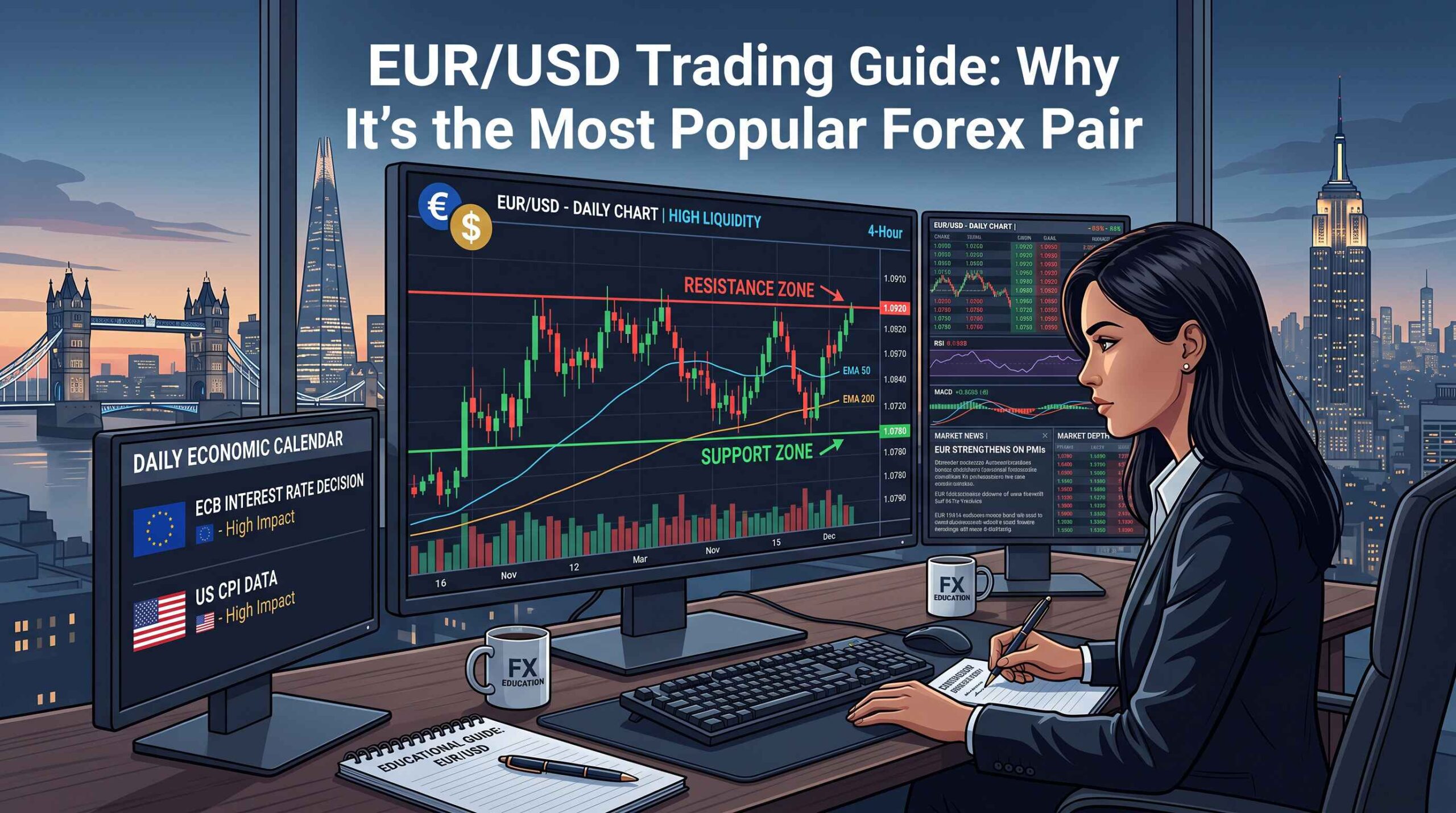
EUR/USD Trading Guide: Why It’s the Most Popular Forex Pair
Posted On - October 24, 2026 | By - FXProfitBuilder | Categories - Currency Pairs (EUR/USD, GBP/USD, USD/CHF)
Introduction

If you’ve spent any time learning about Forex trading, you’ve probably come across one currency pair more often than almost any other: EUR/USD.
Known as the euro-dollar pair, EUR/USD represents the exchange rate between the euro and the US dollar. It is widely followed by retail traders, banks, financial institutions, businesses and investors around the world.
But why is EUR/USD so popular? Is it simply because the euro and the dollar are two major currencies, or are there practical reasons traders pay so much attention to this market?
The answer involves liquidity, trading costs, economic news, market participation and the relationship between the European and US economies.
In this guide, we’ll explain how EUR/USD works, why traders choose it, what moves its price, when it is most active, and how beginners can approach trading it with a structured strategy and sensible risk management.
Whether you’re learning Forex for the first time or exploring currency pairs for your trading routine, understanding EUR/USD is a useful place to start.
What Is EUR/USD in Forex Trading?
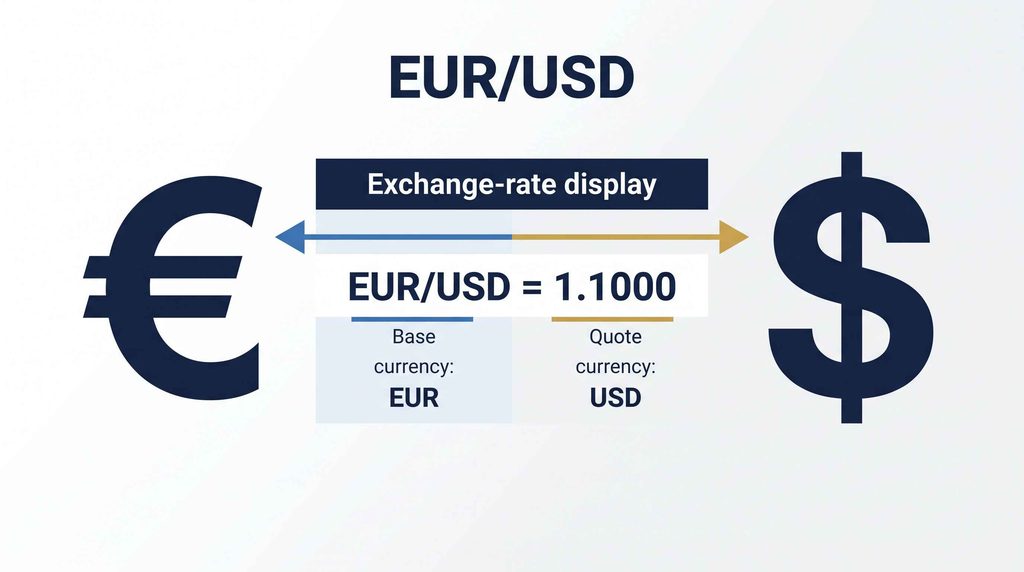
EUR/USD is a currency pair that shows the value of the euro relative to the US dollar.
The euro is the base currency, while the US dollar is the quote currency.
For example, suppose EUR/USD is trading at 1.1000.
This means one euro is worth 1.10 US dollars at that quoted exchange rate.
The pair can move in either direction:
- EUR/USD rises: The euro strengthens against the US dollar, or the dollar weakens against the euro.
- EUR/USD falls: The euro weakens against the US dollar, or the dollar strengthens against the euro.
When traders buy EUR/USD, they are taking a position that benefits if the euro strengthens relative to the dollar. When they sell EUR/USD, they are taking a position that benefits if the euro weakens relative to the dollar.
Actual trading results also depend on the entry and exit prices, position size, spread, commissions, financing costs and any other applicable charges.
A simple EUR/USD example
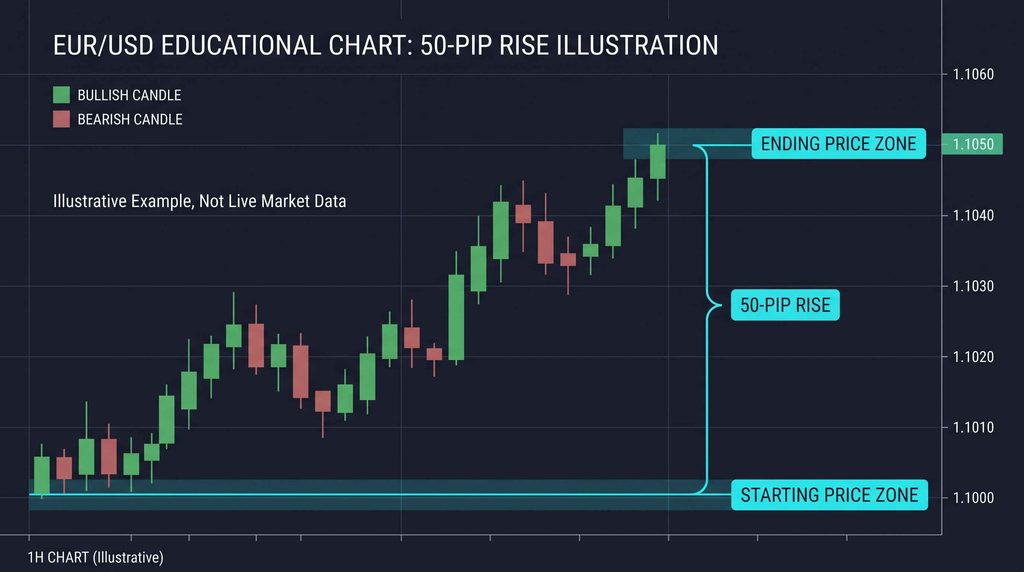
Imagine you buy EUR/USD at 1.1000 and later close the position at 1.1050.
The price has increased by 50 pips under the standard four-decimal pip convention used for this pair.
For a standard lot of 100,000 euros, one pip is typically worth approximately $10 when the quote currency is USD. A 50-pip favourable move would therefore represent approximately $500 before transaction costs.
However, if the price moves against your position by 50 pips, the same approximate amount would be lost before costs.
Your actual result depends on your position size, entry and exit prices, and trading conditions. This example illustrates how pip movements work; it is not a prediction of future performance.
Why Is EUR/USD the Most Popular Forex Pair?

EUR/USD consistently attracts more trading activity than any other individual currency pair. Several factors help explain its popularity.
1. High Trading Volume and Liquidity
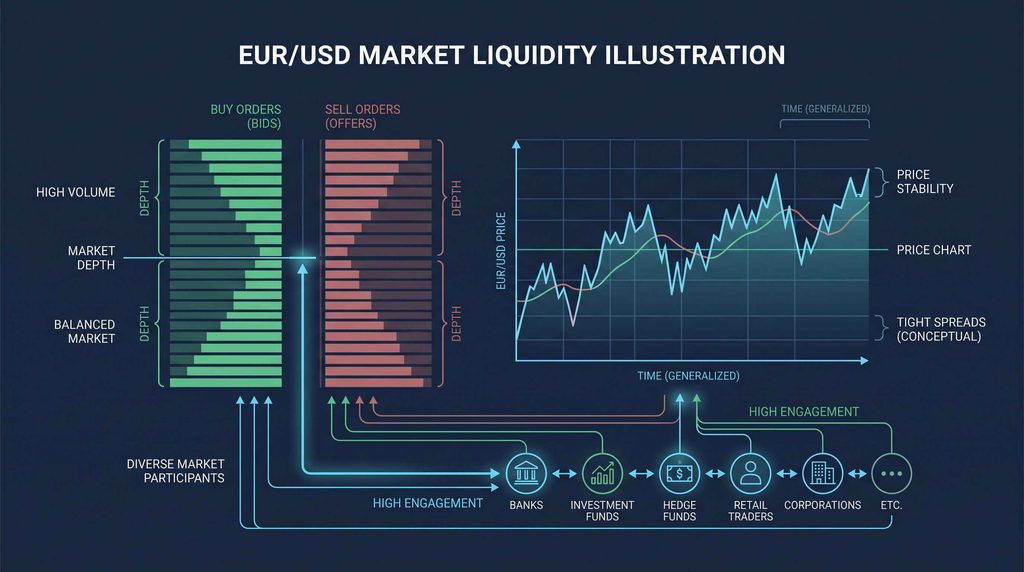
One of the biggest reasons traders choose EUR/USD is its exceptionally high level of market activity.
The Bank for International Settlements’ 2025 Triennial Central Bank Survey reported that global over-the-counter foreign exchange turnover averaged approximately $9.6 trillion per day in April 2025. The US dollar was on one side of 89.2% of reported transactions, reinforcing its central role in global currency markets. EUR/USD remained the leading individual currency pair by turnover. (Source: BIS, 2025 Triennial Survey.)
High trading activity generally supports deep liquidity in EUR/USD.
Liquidity refers to how easily a financial instrument can be bought or sold without causing a substantial change in its price.
For traders, deeper liquidity can offer several practical advantages:
- More buyers and sellers participating in the market.
- Generally competitive bid-ask spreads.
- Potentially better order execution under normal conditions.
- More opportunities to enter and exit positions throughout active sessions.
However, liquidity is not constant. Spreads can widen and execution can deteriorate during major economic announcements, unexpected news or periods of market stress.
2. Competitive Trading Costs
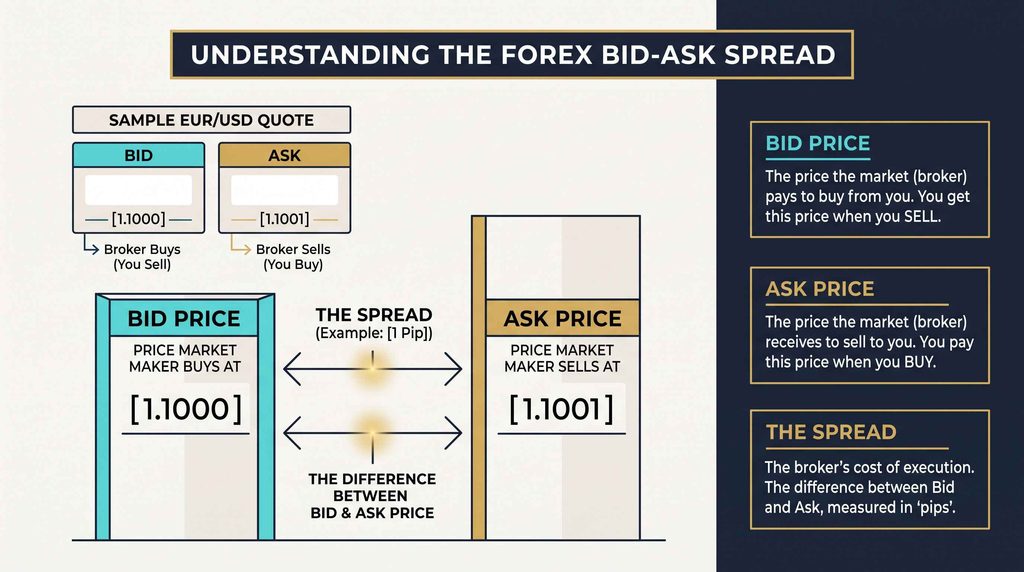
EUR/USD is often available with relatively tight spreads compared with many less-traded currency pairs.
The spread is the difference between the buying price and selling price quoted by a broker.
For example, if the bid price is 1.1000 and the ask price is 1.1001, the spread is one pip under the standard pip convention.
A smaller spread can reduce the initial cost of entering a trade, which is particularly relevant for traders who make frequent transactions.
Nevertheless, spreads vary by broker, account type, time of day and market conditions. Some accounts also charge commissions, so compare the total cost of trading rather than looking at the spread alone.
3. Two Major Economic Regions

EUR/USD connects two of the world’s most important economic areas: the euro area and the United States.
The euro is influenced by economic developments across countries that use the shared currency. The US dollar is affected by the performance of the American economy and its position in global finance.
Because the pair reflects both regions, traders can follow a broad range of economic information, including:
- Inflation data.
- Employment reports.
- Economic growth figures.
- Central bank interest rate decisions.
- Manufacturing and services activity.
- Consumer spending and business confidence.
This continuous flow of information gives traders several ways to analyse potential price movements.
4. Extensive Market Information

EUR/USD is one of the most widely analysed currency pairs.
Economic calendars, financial news services, market commentary and trading education frequently cover its movements.
This makes it easier for beginners to find explanations of major price changes and learn how economic events may influence exchange rates.
However, widely available information does not make market movements easy to predict. Different traders may interpret the same data differently, and prices can move in unexpected directions.
5. Active Participation From Different Market Participants

EUR/USD is traded by a wide range of market participants, including banks, investment firms, multinational businesses, hedge funds and individual traders.
Some trade to manage currency exposure arising from international business. Others trade to speculate on exchange rate movements or manage broader investment portfolios.
This variety of participants contributes to the pair’s deep market and continuing activity.
What Moves the EUR/USD Exchange Rate?
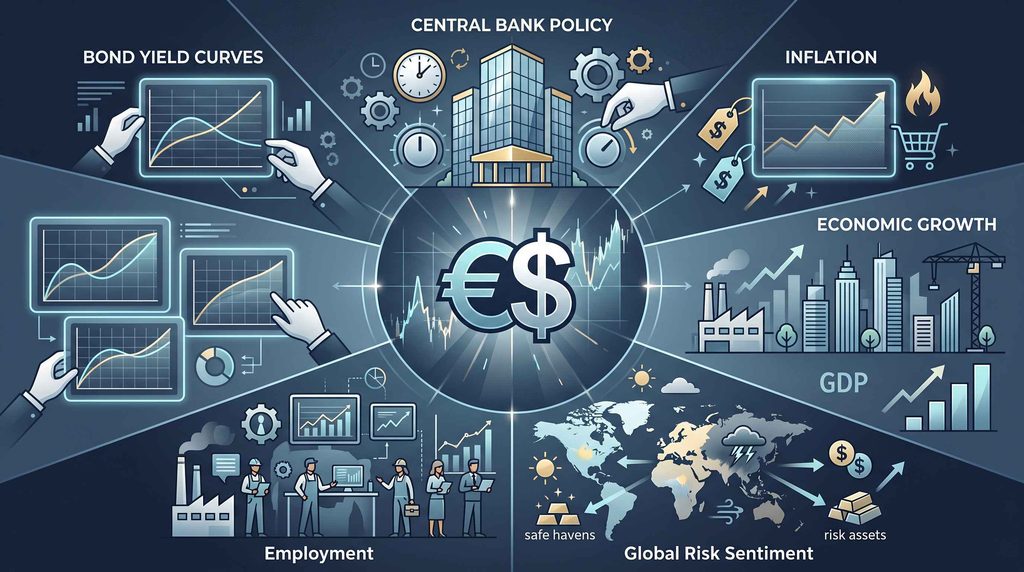
Understanding EUR/USD means understanding the factors that influence both the euro and the dollar.
The pair does not move because of one indicator or news event alone. Exchange rates reflect changing expectations about interest rates, economic performance, inflation, financial conditions and global risk.
1. European Central Bank Interest Rates

The European Central Bank (ECB) sets monetary policy for the euro area.
When markets expect European interest rates to rise relative to US rates, the euro may strengthen against the dollar, all else being equal. Expectations of lower European rates relative to US rates can have the opposite effect.
However, the market often reacts to the difference between actual decisions and what traders already expected.
For example, an interest rate increase might fail to strengthen the euro if investors had anticipated an even larger increase.
2. US Federal Reserve Decisions

The US Federal Reserve plays an important role in EUR/USD movements.
Changes in US interest rates influence borrowing costs, bond yields, investment decisions and demand for dollar-denominated assets.
If the Federal Reserve signals that interest rates may remain higher for longer than markets expected, the dollar may strengthen. If markets anticipate easier US monetary policy, the dollar may weaken.
These relationships are not automatic. Economic conditions, risk sentiment and expectations about European policy can change the outcome.
3. Inflation Reports

Inflation data helps markets assess whether central banks may raise, maintain or reduce interest rates.
Important releases include euro-area inflation figures and US consumer price inflation.
Consider this hypothetical example:
- US inflation comes in above expectations.
- Traders anticipate that the Federal Reserve may maintain restrictive monetary policy.
- US yields rise relative to comparable European yields.
- The dollar strengthens, putting downward pressure on EUR/USD.
This is only one possible scenario. If the result was already priced into the market or other information points in the opposite direction, the reaction may differ.
4. Employment and Economic Growth

Employment reports, retail sales, GDP figures and business surveys can influence expectations about future interest rates.
Stronger-than-expected US economic data may support the dollar if it changes expectations for Federal Reserve policy. Weak European economic data may pressure the euro if it suggests slower growth or easier ECB policy.
Traders should consider both economies rather than interpreting every report in isolation.
5. Geopolitical Events and Market Sentiment

Political uncertainty, international conflicts, financial instability and changes in global risk appetite can also influence EUR/USD.
During periods of heightened uncertainty, demand for the US dollar can increase because it plays a major role in global trade and finance. However, dollar movements depend on the circumstances, and the euro can also strengthen during certain market events.
The key is to assess the event’s likely economic impact rather than assuming that every crisis will produce the same currency reaction.
What Are the Best Times to Trade EUR/USD?
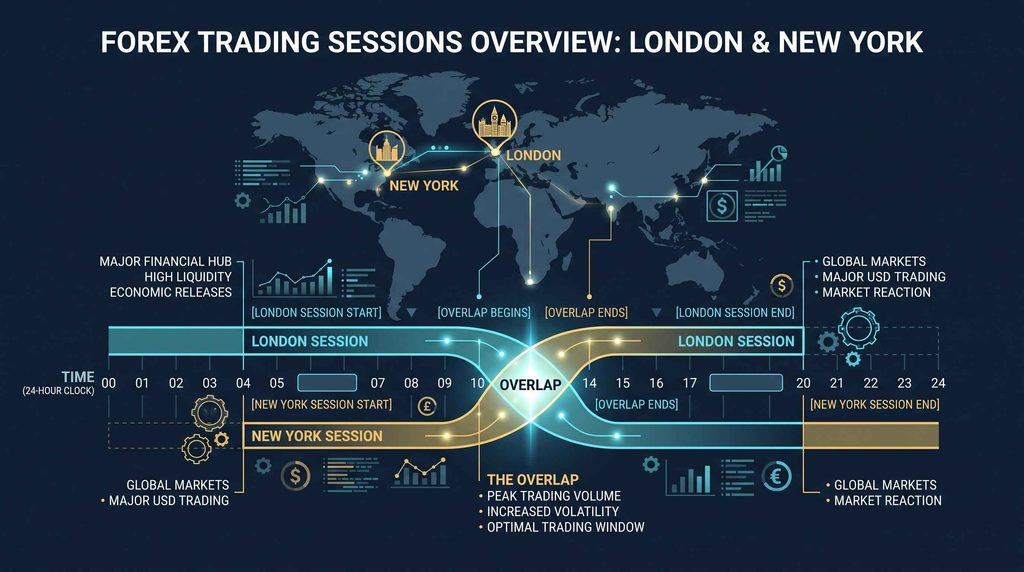
Forex trading operates across global financial centres, and EUR/USD can be traded during most of the working week through the retail Forex market.
However, trading activity is not equally distributed throughout the day.
The pair is often particularly active during European market hours and when European and US trading sessions overlap.
The London Session
The London session attracts significant trading activity because London is a major global foreign exchange trading centre.
During European hours, traders respond to euro-area economic releases, European market developments and changing expectations about ECB policy.
This session may offer useful opportunities for traders who focus on price action, breakouts, trends or support and resistance levels.
The New York Session
The New York session brings additional activity from US banks, institutions and traders.
US economic releases can cause substantial changes in EUR/USD, especially when figures differ from market expectations.
Traders should check the economic calendar before opening positions during major announcements.
The London–New York Overlap
The overlap between the London and New York sessions is often one of the busiest periods for EUR/USD because participants from both major trading regions are active at the same time.
Higher activity can create opportunities, but it can also mean faster price changes and greater risk.
The overlap’s exact hours depend on daylight-saving changes in the United States and Europe. Traders should check the current session times in their own time zone rather than relying on fixed year-round schedules.
Which session should beginners choose?
There is no universally best session for every trader.
A beginner should consider their availability, experience, trading style and ability to monitor positions.
A period with higher activity is not automatically more profitable. It can also produce sharp reversals, false breakouts and slippage.
How to Analyse EUR/USD Before a Trade
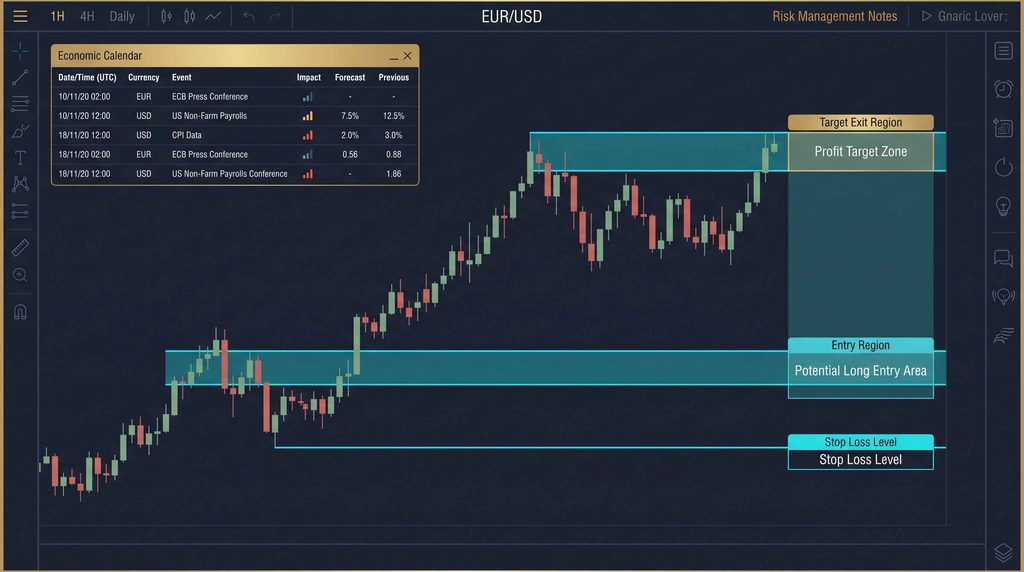
A structured analysis process can help traders avoid making decisions based on guesswork or emotion.
Consider combining the following methods.
1. Check the Economic Calendar
Before analysing a potential trade, identify upcoming events that could influence the euro or US dollar.
Pay particular attention to:
- ECB and Federal Reserve announcements.
- Inflation releases.
- US employment data.
- GDP figures.
- Major business surveys.
You do not necessarily need to trade every announcement. Sometimes the more sensible choice is to wait until the market reaction becomes clearer.
2. Identify the Market Trend
Look at the price chart to determine whether EUR/USD appears to be trending upward, trending downward or moving sideways.
A trader might use multiple timeframes to assess the broader direction before examining a shorter timeframe for a potential entry.
For example, a four-hour chart may show the broader trend while a fifteen-minute chart provides a closer view of a possible setup.
These timeframes are illustrative. Their suitability depends on the trading strategy and how long the trader intends to hold positions.
3. Mark Support and Resistance
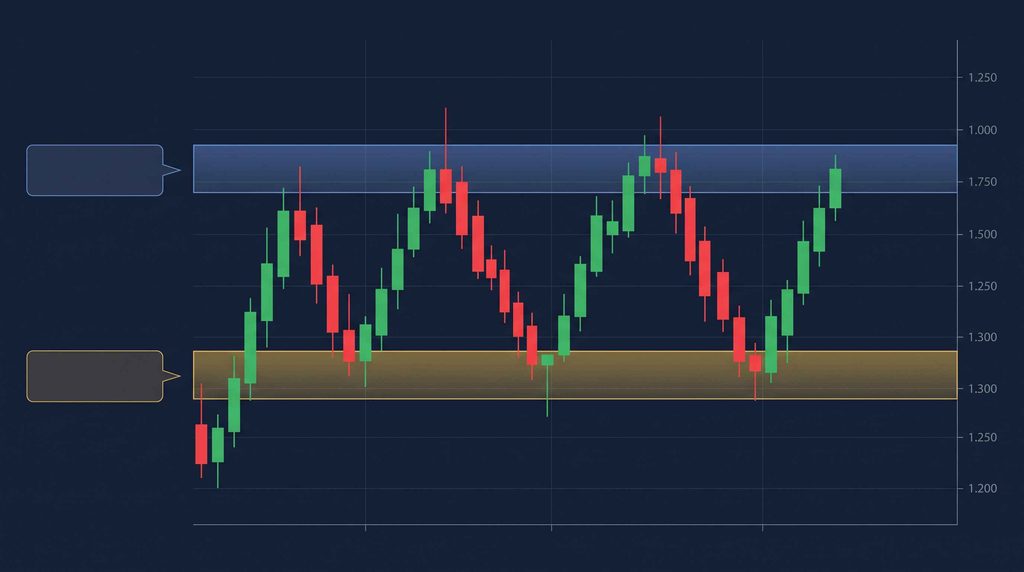
Support is an area where buying interest has previously emerged. Resistance is an area where selling pressure has previously appeared.
These are zones rather than guaranteed turning points.
If EUR/USD approaches a support zone, a trader may look for evidence that buyers are returning. If it approaches resistance, the trader may look for signs of selling pressure or a possible breakout.
A price level should not be treated as reliable solely because it worked in the past. Markets can break through support and resistance when new information changes expectations.
4. Consider Momentum and Volume Information
Technical indicators can help traders study momentum, volatility and potential changes in market behaviour.
However, spot Forex is decentralised, so there is no single central exchange reporting the complete trading volume for the entire market. Volume indicators on retail spot Forex platforms may represent broker-specific tick activity rather than total global traded volume.
This distinction matters when evaluating signals that rely on volume analysis.
5. Define the Entry and Exit Before Trading
Before placing an order, decide:
- Where the trade will be entered.
- Where the trade idea would be invalidated.
- Where profits might be taken.
- How much capital is at risk.
- Whether the potential reward justifies that risk.
This process helps establish a plan before emotions influence the decision.
Understanding EUR/USD Signals
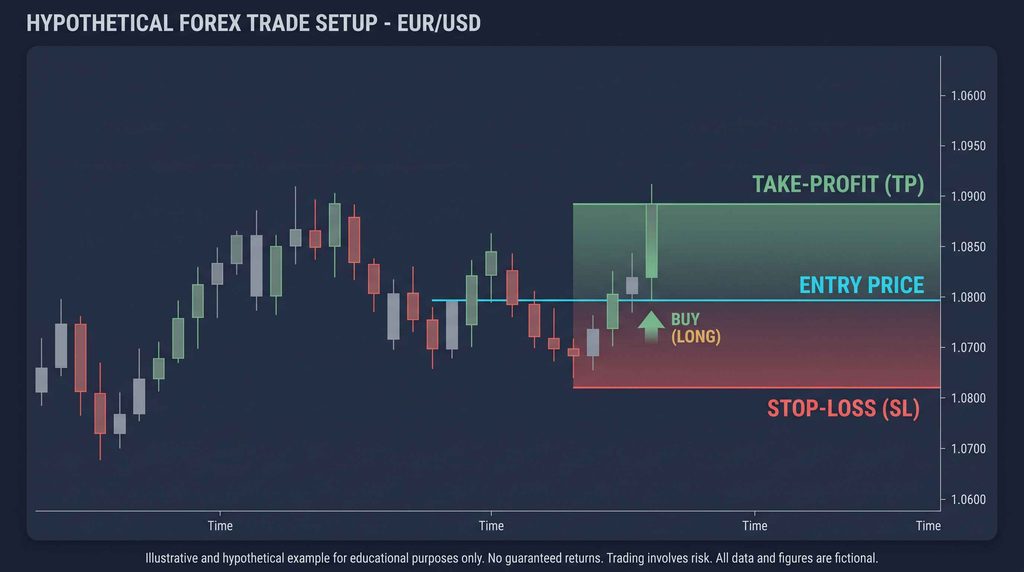
Some traders conduct all their own market analysis, while others use trading signals as one source of information.
A typical EUR/USD signal may include:
- Currency pair: EUR/USD
- Direction: Buy or Sell
- Entry level: The proposed price or entry zone
- Stop Loss: The level used to limit the planned loss if the market moves against the position
- Take Profit: The intended profit-taking level
- Trade updates: Instructions if the original trade plan changes
A signal should be evaluated as a trading idea, not a guarantee.
Before acting on any signal, understand the risk, confirm that the proposed position size is suitable, and consider whether the entry price is still relevant. Prices can change between the time a signal is issued and the time a trader receives it.
How FXProfitBuilder approaches EUR/USD

FXProfitBuilder provides Forex signals for EUR/USD, GBP/USD and USD/CHF.
The company describes its methodology as combining volume indicators, support and resistance analysis, and a mathematical model to identify potential trading opportunities. Its signals provide entry and exit guidance and can be followed manually or mechanically.
For traders researching a signal service, it is worth checking how the methodology is explained, what risk-management guidance is supplied, how trade updates are delivered and whether the service fits their trading routine.
You should also review the provider’s current information and terms before making a subscription decision. A provider’s description of its method should not be treated as independent proof of profitability.
Risk Management When Trading EUR/USD
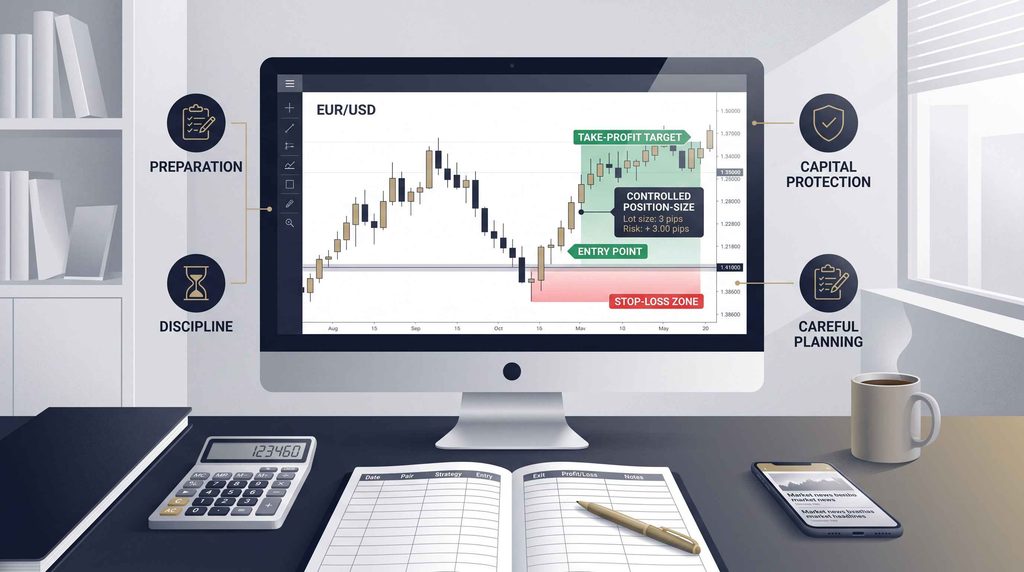
EUR/USD’s popularity does not make it risk-free.
The pair can move sharply during central bank announcements, unexpected economic releases and periods of market stress. Leverage can magnify both gains and losses.
Here are several principles to consider.
Use an Appropriate Position Size
Choose a position size based on the amount you can afford to risk, not on how confident you feel about a trade.
For example, a trader with a small account may need a much smaller position than someone with a larger account to keep the same percentage of capital at risk.
Use a Stop Loss Thoughtfully
A Stop Loss can help define where you intend to exit a losing trade. However, it does not guarantee the exact exit price in all circumstances. Gaps, slippage and rapid market movements can result in a worse fill.
Set the Stop Loss based on the trading setup and your risk plan rather than choosing an arbitrary distance.
Understand Leverage
Leverage allows traders to control a larger position relative to the money deposited. It can magnify gains, but it also magnifies losses.
Do not assume that a highly liquid pair makes high leverage safe.
Avoid Trading Every News Event
Major economic announcements can cause spreads to widen and prices to move quickly.
If you do not understand the risks of trading during these events, consider waiting until conditions become clearer.
Keep a Trading Journal
Record the reason for each trade, entry and exit, position size, risk level and outcome.
Over time, this can help you evaluate whether your approach is consistent and identify mistakes that need attention.
Common Mistakes Beginners Make With EUR/USD
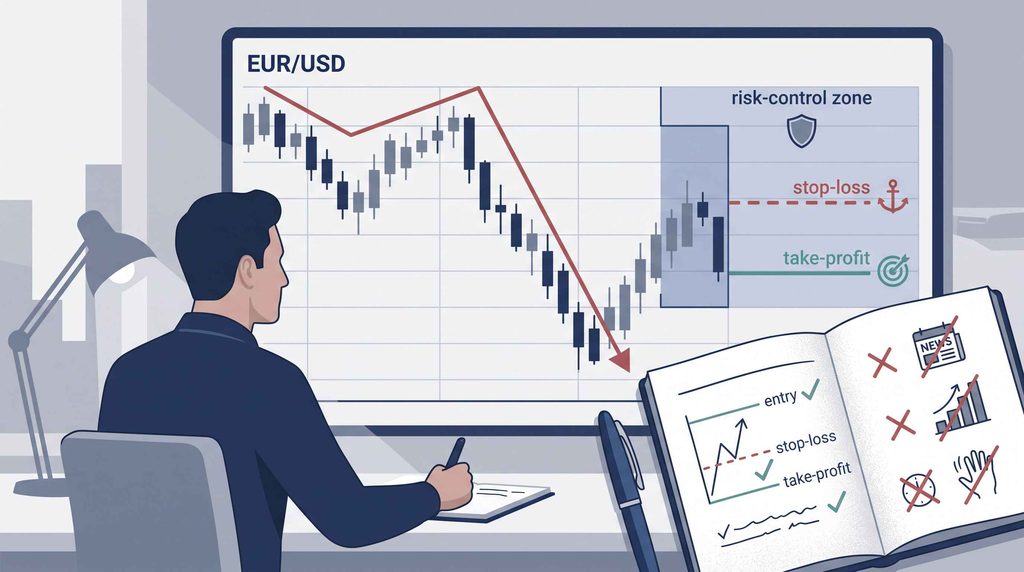
Even a widely traded currency pair can be difficult to trade well.
Mistake 1: Assuming High Liquidity Means Easy Profits
Liquidity can support competitive trading conditions, but it does not determine whether a position will be profitable.
The exchange rate can move against a trade regardless of how many participants are active.
Mistake 2: Ignoring Economic News
Technical patterns can change quickly when new economic information becomes available.
Check the calendar and understand the potential effect of major announcements on both currencies.
Mistake 3: Using Excessive Leverage
A small price movement can produce a substantial loss when the position is too large relative to the account.
Keep risk controlled and avoid increasing position sizes simply to recover previous losses.
Mistake 4: Entering Too Late
After a sharp movement, some traders enter because they fear missing out.
But the price may already have moved significantly, leaving less potential reward relative to the risk.
Wait for a clear setup instead of chasing every move.
Mistake 5: Changing the Trading Plan Emotionally
Moving a Stop Loss further away, abandoning a strategy after one loss, or taking impulsive trades can undermine consistency.
Establish your plan before entering and review results over a meaningful sample of trades rather than judging a strategy by one outcome.
EUR/USD Compared With Other Major Currency Pairs
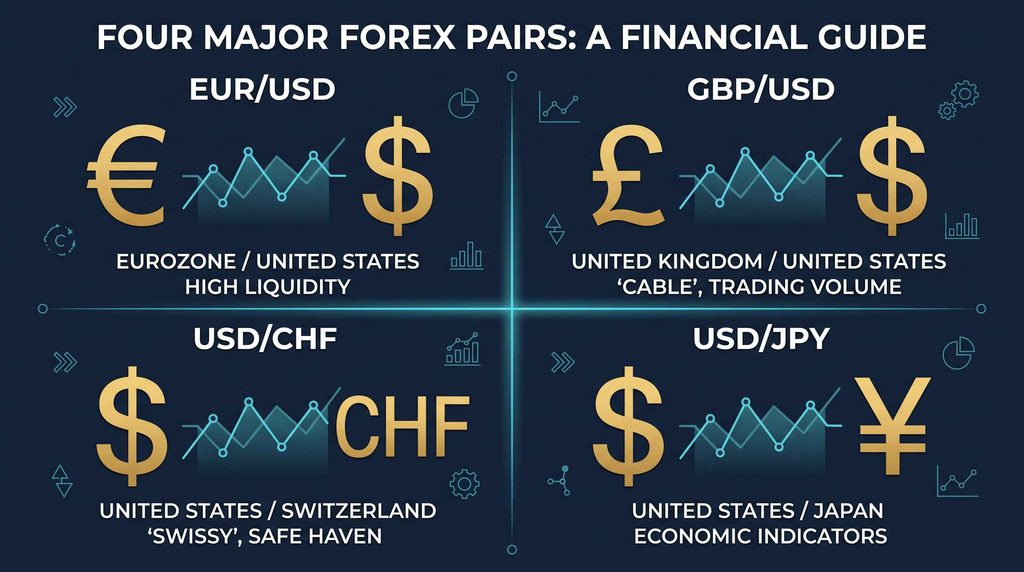
EUR/USD is not the only currency pair worth understanding.
| Currency pair | What it represents | Common influences |
| EUR/USD | Euro vs US dollar | ECB and Federal Reserve policy, euro-area and US economic data |
| GBP/USD | British pound vs US dollar | Bank of England and Federal Reserve policy, UK and US data |
| USD/CHF | US dollar vs Swiss franc | Federal Reserve and Swiss National Bank policy, risk sentiment |
| USD/JPY | US dollar vs Japanese yen | Federal Reserve and Bank of Japan policy, bond yields and market sentiment |
Each pair has its own behaviour and risk characteristics.
EUR/USD is popular partly because of its trading activity and the extensive amount of information available about the euro area and United States. But another pair may suit a trader’s schedule or strategy better.
The best choice is the market you can understand, monitor and manage responsibly not necessarily the one with the highest trading volume.
Is EUR/USD Suitable for Beginners?

EUR/USD can be a useful pair for learning about Forex because it is widely covered by financial news and trading education, and it often offers competitive spreads.
However, beginners should not mistake popularity for simplicity.
Before risking real money, consider practising on a demo account, learning how pips and position sizing work, understanding leverage and testing a clear trading plan.
It is also important to remember that demo trading does not fully reproduce the emotional pressure of trading with real money, and simulated results do not guarantee live performance.
A sensible learning process focuses on understanding the market and managing risk rather than trying to make quick profits.
Final Thoughts

EUR/USD is the most popular individual Forex pair for good reasons. It connects two major currencies, attracts substantial global trading activity, often offers competitive spreads, and is followed closely by traders and financial institutions around the world.
Its price reflects changing expectations about European and US interest rates, inflation, employment, economic growth and global market conditions.
For beginners, the pair offers plenty of educational material and opportunities to study how currency markets react to new information. But it still requires careful analysis, discipline and risk management.
FXProfitBuilder includes EUR/USD among its three covered currency pairs, alongside GBP/USD and USD/CHF. Traders considering its signals should review the current service details, understand the trading methodology and assess whether the approach suits their own circumstances.
Remember: the most popular Forex pair is not automatically the easiest or most profitable to trade. Focus on understanding the market, planning every trade and protecting your capital.
Forex trading involves significant risk, particularly when using leverage. Never risk money you cannot afford to lose, and remember that no strategy or signal service can guarantee profits.
FAQ

1. Why is EUR/USD the most popular Forex pair?
EUR/USD connects the euro and US dollar, two major global currencies. Its high trading activity, deep liquidity, generally competitive spreads and extensive market coverage contribute to its popularity.
2. What does EUR/USD mean?
EUR/USD shows how many US dollars are needed to buy one euro. The euro is the base currency, and the US dollar is the quote currency.
3. Is EUR/USD good for beginners?
It can be a useful pair for learning because there is extensive information and educational material available. However, it remains risky, particularly when using leverage. Beginners should learn risk management and consider demo practice before trading live.
4. What is the best time to trade EUR/USD?
The pair is often particularly active during European hours and the overlap between the London and New York sessions. Activity and spreads vary, so check the current economic calendar and session times.
5. What makes EUR/USD move?
Key influences include ECB and Federal Reserve policy, inflation, employment, economic growth, bond yields, geopolitical events and changing market sentiment.
6. Is EUR/USD less risky than other Forex pairs?
Not necessarily. Its high liquidity can support competitive trading conditions, but losses remain possible. Risk depends on market conditions, leverage, position size, trading costs and the strategy being used.
7. How much is one pip in EUR/USD?
For most EUR/USD quotes, one pip is 0.0001. For a standard lot of 100,000 euros, one pip is typically worth about $10 when the account’s profit-and-loss currency is USD. Pip value varies with position size and account currency.
8. Can I trade EUR/USD using Forex signals?
Yes. Some services provide EUR/USD signals with entry, Stop Loss and Take Profit information. Signals should be assessed carefully, and traders need to understand the risks rather than treating recommendations as guaranteed outcomes.
9. Does FXProfitBuilder provide EUR/USD signals?
Yes. FXProfitBuilder lists EUR/USD among the currency pairs covered by its Forex signals, alongside GBP/USD and USD/CHF. Check its current website for the latest service details and terms.
10. Can EUR/USD trading guarantee profits?
No. Exchange rates are unpredictable, and even a well-planned trade can lose money. No currency pair, trading strategy or signal provider can guarantee future profits.
👉 Start your journey today—subscribe to our forex pip tips service and see the difference for yourself! Sign Up to get Exclusive Offers