How Trading Multiple Pairs With Equal Risk Can Smooth Your Forex Trading Results
Posted On - November 14, 2026 | By - FXProfitBuilder | Categories - Currency Pairs (EUR/USD, GBP/USD, USD/CHF)

Many Forex traders concentrate on one currency pair or jump between dozens of markets looking for opportunities. Both approaches can create challenges. Trading only one pair may limit the opportunities available, while following too many pairs can make it difficult to maintain consistency and control risk.
An alternative is to focus on a small group of currency pairs and apply a consistent risk-management approach to each one.
Trading multiple pairs with equal risk can help create a more balanced trading routine. Instead of allowing one trade or one currency pair to dominate your account exposure, you establish clear risk limits across the markets you follow.
But does this approach really smooth trading results? And how can traders use it effectively?
Let’s explore how equal-risk trading works, why it matters, and what you should consider before applying it.
What Does Trading Multiple Currency Pairs With Equal Risk Mean?
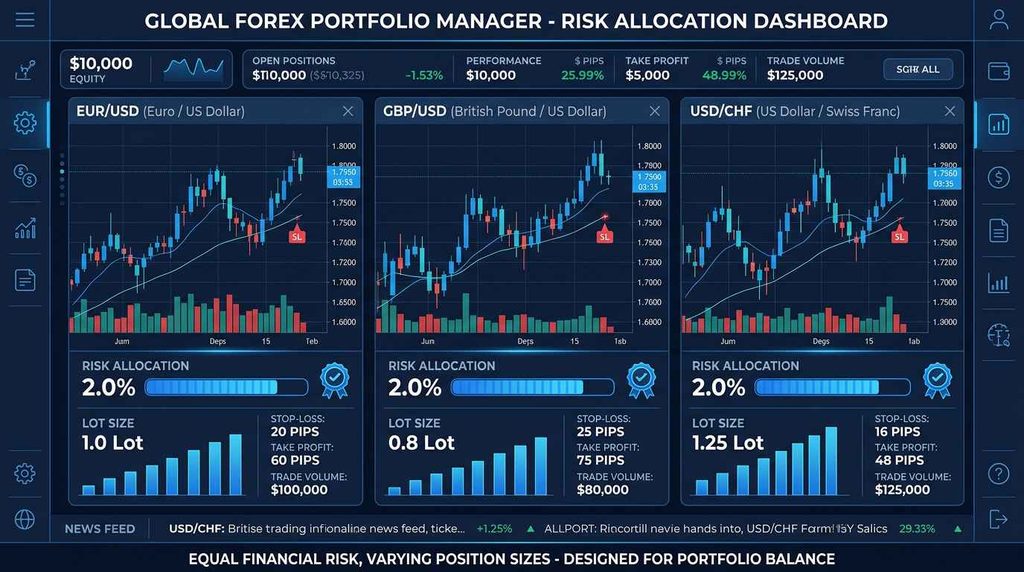
Trading multiple currency pairs with equal risk means allocating the same planned amount of account risk to each trade, regardless of which currency pair you are trading.
For example, imagine a trader has a £10,000 account and decides to risk 0.5% of the account on each trade.
That means the planned risk is £50 per trade.
If the trader identifies opportunities in EUR/USD, GBP/USD and USD/CHF, each position would be sized so that its potential loss at the stop-loss level is approximately £50.
The position sizes may be different because currency pairs have different prices, pip values and stop-loss distances. The important point is that the amount of money at risk remains consistent.
This is different from opening the same lot size on every pair. Equal lot sizes do not necessarily mean equal financial risk.
The objective is to create a repeatable framework in which every trade follows the same risk rules.
Why Trading Only One Currency Pair Can Be Limiting

Focusing on one currency pair can help beginners become familiar with its behaviour. However, it also means depending heavily on one market for trading opportunities.
Consider a trader who follows only EUR/USD.
There may be periods when the pair offers clear directional movement and suitable technical setups. At other times, the market may be moving sideways, producing uncertain signals or offering fewer attractive opportunities.
If the trader insists on trading every day, they may feel tempted to enter positions that do not meet their usual criteria.
Following a small selection of currency pairs can provide more opportunities without requiring the trader to monitor the entire Forex market.
For example:
- EUR/USD provides exposure to movements between the euro and US dollar.
- GBP/USD provides exposure to movements between the British pound and US dollar.
- USD/CHF provides exposure to movements between the US dollar and Swiss franc.
These pairs respond to different economic developments, central-bank decisions and market conditions. They can therefore present different trading setups at different times.
However, they are not completely independent markets. EUR/USD and GBP/USD, for example, can move in similar directions because both involve the US dollar.
That is why choosing multiple pairs should always go hand in hand with understanding correlation and combined exposure.
How Equal Risk Can Help Create More Consistent Trading

Equal risk does not make every trade profitable. Instead, it helps prevent inconsistent position sizing from becoming an additional source of risk.
Here are four important advantages.
1. It Prevents One Trade From Taking Too Much Risk
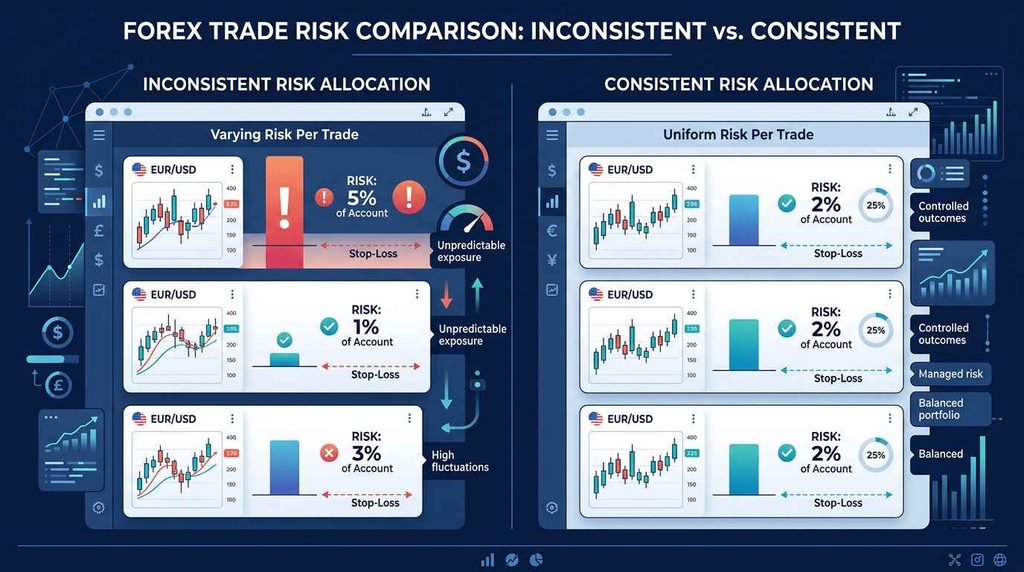
One common trading mistake is increasing position size because a particular setup looks especially attractive.
A trader might risk £30 on one trade, £100 on another and £200 on a third, even though all three opportunities are based on the same trading strategy.
This creates inconsistent exposure.
If the largest position happens to be the losing trade, it can have a disproportionate effect on the account.
With equal-risk trading, every position follows a predefined risk limit. A trader is less likely to let confidence, excitement or frustration determine how much money is placed at risk.
2. It Reduces Dependence on One Currency Pair
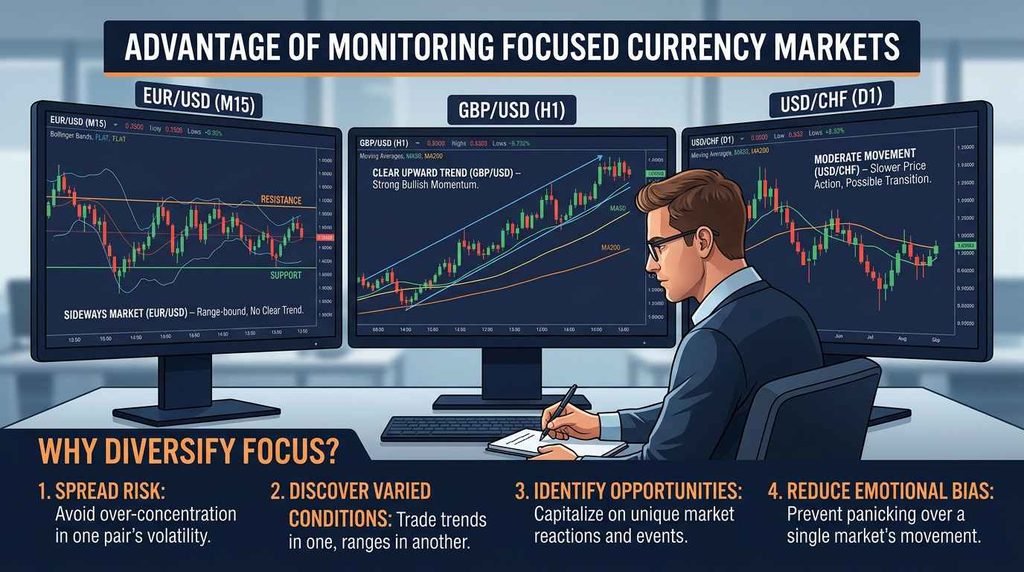
Trading a small selection of currency pairs gives traders more than one market to analyse.
Suppose EUR/USD is moving sideways, while GBP/USD is developing a clearer technical setup. The trader can evaluate the GBP/USD opportunity rather than forcing an entry on EUR/USD.
Likewise, a different market condition may create an opportunity in USD/CHF.
This flexibility can reduce the pressure to trade a single pair simply because it is the only market being monitored.
Of course, having more opportunities does not mean taking every available trade. Each position should still meet the trader’s entry and risk-management criteria.
3. It Makes Performance Easier to Measure

Consistent risk makes it easier to compare trading results.
For example, if every trade risks £50, a loss is approximately -1R and a profit of £100 is +2R. Here, R represents the amount initially risked on the trade.
This allows traders to evaluate performance without focusing only on the money gained or lost.
They can examine:
- How many trades reached their stop-loss?
- How many trades reached their profit targets?
- What was the average winning trade compared with the average losing trade?
- Which currency pair produced the strongest results?
- Did the overall strategy perform consistently over time?
This information can help identify weaknesses in a trading strategy and show whether one currency pair requires further attention.
4. It Encourages Better Trading Discipline

A predefined risk amount removes some of the guesswork from position sizing.
Instead of deciding how much to risk after seeing a promising setup, the trader already has a clear limit.
The same process can be applied across all selected currency pairs.
Over time, this may help develop a more disciplined routine because the trader is following a consistent framework rather than changing risk according to emotions or recent results.
A Practical Example: Trading Three Currency Pairs With Equal Risk
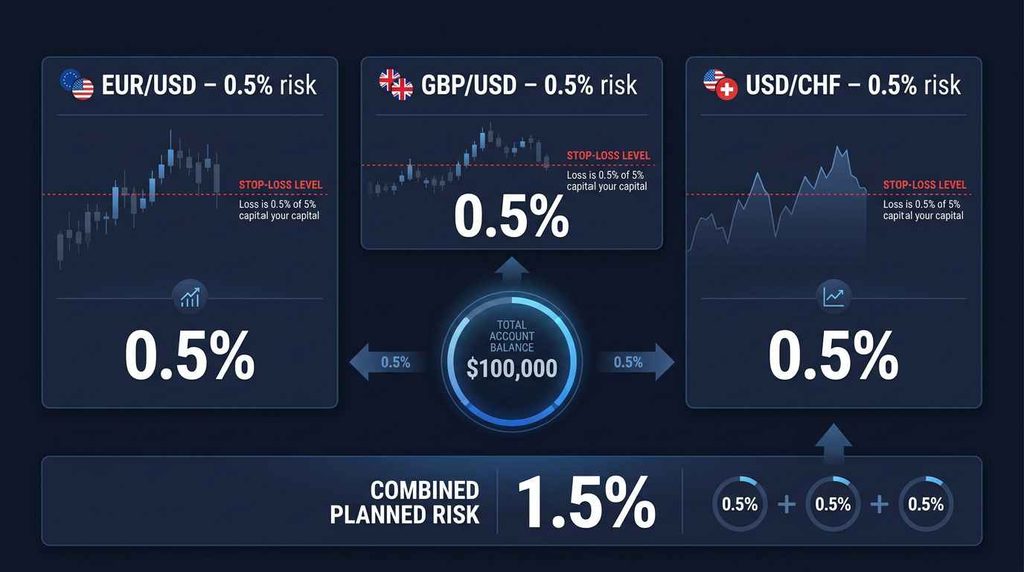
Let’s look at a simple example.
Assume a trader has an account balance of £10,000 and decides to risk 0.5% on each trade.
The planned risk per position is £50.
The trader identifies three opportunities:
| Currency pair | Planned risk | Potential loss at stop-loss |
| EUR/USD | 0.5% | £50 |
| GBP/USD | 0.5% | £50 |
| USD/CHF | 0.5% | £50 |
| Total | 1.5% | £150 |
If all three trades reach their stop-loss levels, the combined planned loss would be £150, equivalent to 1.5% of the initial account balance.
If only one trade loses, the planned loss would be approximately £50.
The example demonstrates how equal-risk allocation works. It also highlights an important point: equal risk per trade does not mean unlimited total exposure is safe.
If all three positions are open simultaneously, the trader must consider the combined risk across the account.
The figures are illustrative, not a recommended risk percentage. Actual position sizes should account for pip value, stop-loss distance, account currency, trading costs and broker contract specifications.
Why Currency Pair Correlation Still Matters
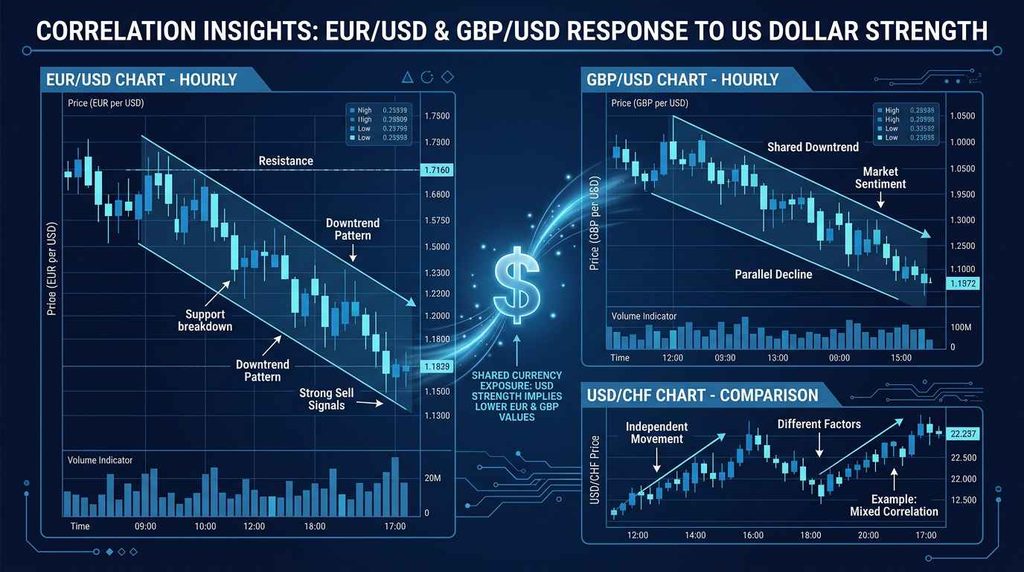
One of the biggest misunderstandings about trading multiple pairs is assuming that different currency-pair names automatically provide diversification.
This is not necessarily true.
Currency pairs can be positively or negatively correlated, meaning their prices may move in similar or opposite directions over a particular period.
For example, EUR/USD and GBP/USD often show positive correlation because both pairs have the US dollar as their quote currency.
If the US dollar strengthens significantly, both pairs may fall at the same time.
Imagine opening a £50-risk buy position on EUR/USD and another £50-risk buy position on GBP/USD. Although each trade has the same individual risk, both positions could be affected by the same broad US dollar movement.
The combined exposure may therefore be greater than it first appears.
Correlation is not fixed. It changes with market conditions, economic developments and the time period being measured.
Before opening several positions, traders should consider:
- Whether the currency pairs are currently moving in similar directions.
- Whether the trades depend on the same economic event.
- How much total account risk is already open.
- Whether multiple positions effectively create a larger exposure to one currency.
- Whether the overall risk remains within the trading plan.
The goal is not simply to trade more pairs. It is to understand how the positions work together.
Why FXProfitBuilder Focuses on Three Currency Pairs

Rather than asking traders to monitor dozens of currency pairs, FXProfitBuilder focuses on three major markets:
- EUR/USD
- GBP/USD
- USD/CHF
This approach keeps the selection focused while providing exposure to three widely followed currency markets.
Each pair has its own characteristics and can respond differently to economic announcements, central-bank decisions, market sentiment and technical developments.
FXProfitBuilder uses volume indicators, support and resistance analysis, and a mathematical model to identify potential trading opportunities and provide entry and exit levels.
The signals are designed to be followed manually or mechanically, depending on the trader’s preferred approach.
An important part of the strategy is maintaining equal risk across the three pairs rather than giving one pair a disproportionately large position.
This creates a more structured way to approach multiple markets. It also makes it easier to assess performance across the same risk framework.
However, traders should remember that EUR/USD and GBP/USD can be strongly influenced by the same US dollar movements. Trading all three pairs does not automatically eliminate concentration risk.
Does Equal-Risk Trading Guarantee Smoother Results?

No. This is an important point.
Equal-risk trading can help make position sizing more consistent, but it cannot guarantee smaller drawdowns, regular profits or a smoother equity curve.
There are several reasons why results can still fluctuate:
Market correlation: Multiple positions may lose together when they are exposed to the same underlying currency movement.
Changing volatility: A currency pair can become more volatile during economic announcements or unexpected market events.
Losing streaks: Even a properly managed strategy can experience several consecutive losing trades.
Execution costs: Spreads, commissions, slippage and overnight financing can affect actual results.
Strategy performance: Equal position risk cannot compensate for a trading strategy that does not have a sustainable advantage.
The purpose of equal-risk trading is to control how much is exposed to each trade, not to predict or prevent every loss.
Practical Rules for Trading Multiple Pairs With Equal Risk

If you want to apply this approach, consider following these basic rules:
- Choose a manageable number of pairs. Start with a small selection that you can understand and monitor properly.
- Set your risk limit in advance. Decide how much you are prepared to risk per trade before entering the market.
- Calculate position size correctly. Use the stop-loss distance and pip value rather than opening identical lot sizes.
- Monitor total open exposure. Three trades at 0.5% risk each represent 1.5% planned combined risk if all three stop out.
- Check currency correlation. Be aware when several positions depend on the same currency movement.
- Avoid forcing trades. If a pair does not offer a suitable setup, there is no need to open a position.
- Review performance regularly. Evaluate results across individual pairs and the overall strategy, including losing periods and trading costs.
Consistency comes from following a process, not from trading a fixed number of positions every day.
Final Thoughts

Trading multiple currency pairs with equal risk can provide a more organised approach to Forex trading. It helps traders avoid inconsistent position sizing, compare performance more effectively and look for opportunities across a focused selection of markets.
The key is to balance the benefits of following multiple pairs with the risks of correlation and combined exposure.
FXProfitBuilder’s focus on EUR/USD, GBP/USD and USD/CHF follows this principle: monitor a defined group of currency pairs and apply consistent risk management rather than spreading attention across the entire market.
Remember, equal risk does not guarantee equal outcomes. Every trade carries uncertainty, and protecting trading capital should remain a priority.
Risk Disclaimer: Forex trading involves substantial risk and is not suitable for every investor. You can lose some or all of your trading capital. Past performance does not guarantee future results. Always understand the risks, use appropriate position sizing and never trade money you cannot afford to lose.
FAQ
1. What does equal risk mean in Forex trading?
Equal risk means setting the same planned monetary risk for each trade. Position sizes may differ depending on the currency pair’s pip value and the distance to the stop-loss.
2. Is it better to trade multiple currency pairs or just one?
There is no universal answer. Trading multiple pairs can provide more opportunities, while focusing on one pair can make market analysis simpler. The right approach depends on your experience, strategy and ability to manage combined exposure.
3. Does trading three currency pairs reduce risk?
Not automatically. Multiple pairs can provide different opportunities, but they may also be correlated. If several positions move against you at the same time, losses can accumulate.
4. Why is equal risk important when trading Forex signals?
Equal risk helps traders maintain consistent position sizing across different signals. It prevents one trade from carrying significantly more planned financial risk than another simply because the trader feels more confident about it.
5. Which currency pairs does FXProfitBuilder focus on?
FXProfitBuilder focuses on EUR/USD, GBP/USD and USD/CHF. The approach is based on following these three selected markets and applying consistent risk management across them.
6. Can equal-risk trading guarantee consistent profits?
No. Equal risk is a position-sizing and risk-management method. It cannot guarantee profitable trades or prevent losing streaks. Results still depend on market conditions, strategy performance, execution and overall risk control.
👉 Start your journey today—subscribe to our forex pip tips service and see the difference for yourself! Sign Up to get Exclusive Offers