Best Currency Pairs for Beginners to Start Trading
Posted On - October 31, 2026 | By - FXProfitBuilder | Categories - Currency Pairs (EUR/USD, GBP/USD, USD/CHF)
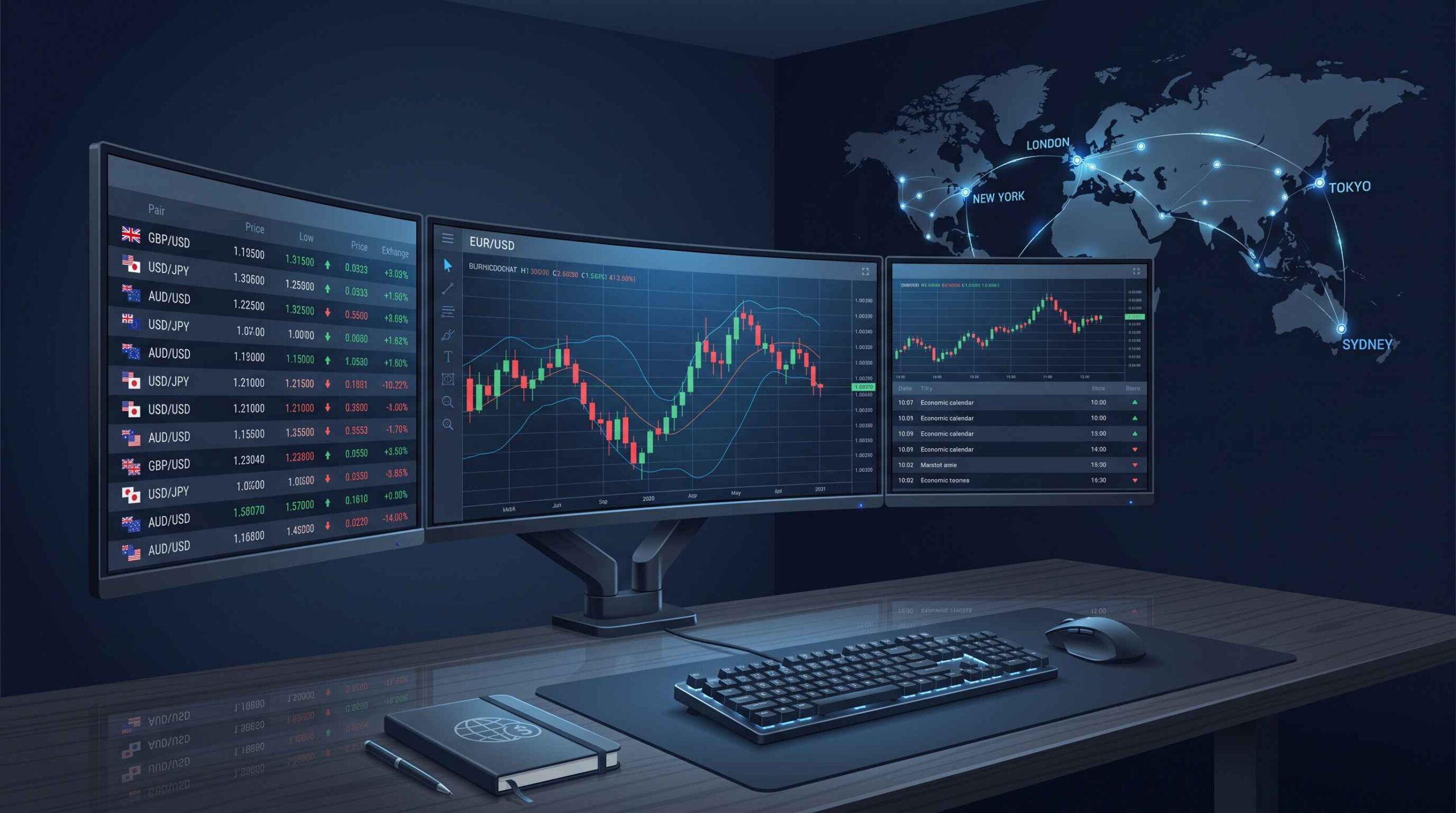
Starting forex trading can feel overwhelming. Open a trading platform for the first time and you may find dozens of currency pairs, each showing different prices, charts and market movements. So, which ones should you learn first?
The good news is that beginners do not need to monitor every available currency pair. A sensible starting point is to focus on a few major pairs that are widely traded, have plenty of market information available and are relatively straightforward to research.
Popular choices include EUR/USD, USD/JPY, GBP/USD, AUD/USD and USD/CHF. These pairs connect major currencies and are widely followed by traders around the world.
However, the best currency pair for you also depends on your trading hours, experience, strategy and ability to manage risk. No currency pair is guaranteed to be easy or profitable.
In this guide, we explore some of the best currency pairs for beginners, what influences their prices and how to choose a suitable market when starting your forex journey.
1. What Makes a Currency Pair Suitable for Beginners?

Before choosing a pair, it helps to understand the characteristics that can make one market easier to study than another.
High liquidity
Liquidity refers to how easily a currency pair can be bought or sold without causing a significant change in its price.
Highly traded pairs generally have more market participants. This can support smoother execution and more competitive spreads, although conditions vary depending on the broker, trading session and market events.
Competitive spreads
The spread is the difference between the buying price and selling price quoted by a broker.
A narrower spread generally means a lower immediate transaction cost. Beginners should compare the spreads offered by their broker rather than assume every major pair has the same trading cost.
Understandable market influences
A currency pair is affected by economic conditions and monetary policy in both countries or currency areas.
For example, EUR/USD is influenced by economic developments in the euro area and United States. Following a smaller number of relevant economic calendars can make market research more manageable.
Suitable volatility
Volatility describes how much and how quickly prices move.
A pair that moves sharply may create opportunities, but it can also increase the risk of unexpected losses. Beginners should understand how much a pair typically moves and avoid assuming that larger movements are automatically better.
Convenient trading hours
A pair may be highly liquid, but that does not mean its most active trading period fits your daily schedule.
2. EUR/USD – A Popular First Currency Pair

EUR/USD (Euro/US Dollar) is often one of the first pairs beginners study. It represents the value of one euro in US dollars and is the most actively traded currency pair in the global foreign exchange market.
Its popularity means that traders can find extensive educational material, market commentary, economic analysis and technical research.
What moves EUR/USD?
Several factors can influence this pair:
- Federal Reserve interest-rate decisions.
- European Central Bank monetary policy.
- Inflation and employment figures in the US and euro area.
- Economic growth and business activity.
- Political developments and changes in market sentiment.
For example, if US economic data is stronger than expected, traders may reassess their expectations for Federal Reserve policy. This can influence demand for the US dollar and consequently move EUR/USD.
Why beginners consider EUR/USD
- High trading activity in global forex markets.
- Extensive educational and analytical resources.
- Widely followed economic announcements.
- Generally competitive spreads during liquid market conditions.
EUR/USD can be a practical first pair to study because of its market coverage and available information. However, major economic announcements can still cause rapid price movements.
3. USD/JPY – A Pair to Study for Asian Market Activity

USD/JPY (US Dollar/Japanese Yen) measures how many Japanese yen are required to buy one US dollar.
It is another widely traded major pair and can be particularly interesting for traders who want to understand how interest rates, government bond yields and central bank policies influence exchange rates.
What moves USD/JPY?
Important influences include:
- Federal Reserve decisions.
- Bank of Japan monetary policy.
- Differences between US and Japanese interest rates.
- Government bond yields.
- Japanese economic data.
- Changes in global risk sentiment.
For instance, changing expectations about US and Japanese interest rates can influence demand for both currencies.
Why beginners may consider USD/JPY
USD/JPY is widely followed and has substantial market activity. It can also offer trading opportunities during Asian market hours, making it worth studying for traders whose schedules suit that session.
However, central bank announcements and sudden changes in bond yields can produce significant movements. Beginners should learn how these events affect the pair before trading it.
4. GBP/USD – A Popular Pair with Strong Price Movements

GBP/USD (British Pound/US Dollar) is commonly known as Cable. It compares the value of the British pound with the US dollar.
This pair attracts considerable attention because it responds to economic and political developments in both the United Kingdom and the United States.
What moves GBP/USD?
Some of its main influences include:
- Bank of England interest-rate decisions.
- Federal Reserve policy.
- UK and US inflation figures.
- Employment and economic growth data.
- Government announcements and political developments.
- Changes in global investor sentiment.
Why beginners may consider GBP/USD
GBP/USD is widely traded, and there is plenty of market information available. It can be useful for learning how economic announcements influence currency prices.
However, it can experience sharp price movements, particularly around important news releases. Beginners should avoid increasing their position size simply because the pair appears to offer larger movements.
It may be sensible to study EUR/USD first and then add GBP/USD once you understand basic chart analysis and risk management.
5. AUD/USD – A Pair Influenced by Commodity Markets

AUD/USD (Australian Dollar/US Dollar) compares the Australian dollar with the US dollar.
The Australian economy has important links to international commodity markets and trade with countries such as China. As a result, this pair can respond to developments beyond traditional interest-rate announcements.
What moves AUD/USD?
Common influences include:
- Reserve Bank of Australia decisions.
- Federal Reserve policy.
- Australian employment and inflation figures.
- Commodity prices and export demand.
- Chinese economic developments.
- Global risk appetite.
Why beginners may consider AUD/USD
AUD/USD can help traders learn how commodity-related developments and global economic conditions influence currencies.
It also attracts trading activity during the Asian session, which may suit people who prefer those hours.
However, its movements can be influenced by several interconnected factors. Beginners should take time to understand these relationships instead of relying on a single indicator or headline.
6. USD/CHF – A Pair for Understanding Safe-Haven Currencies

USD/CHF (US Dollar/Swiss Franc) measures the value of one US dollar in Swiss francs.
The Swiss franc is often described as a safe-haven currency because investors have historically shown demand for it during periods of uncertainty. However, this behaviour is not guaranteed, and the US dollar can also attract safe-haven demand.
What moves USD/CHF?
Important influences include:
- Federal Reserve monetary policy.
- Swiss National Bank decisions.
- US and Swiss inflation data.
- Interest-rate expectations.
- Global financial uncertainty.
- Changes in investor risk appetite.
Why beginners may consider USD/CHF
USD/CHF is a recognised major pair with substantial market coverage. Studying it can help beginners understand how central bank policy and market uncertainty influence currency prices.
It also provides an opportunity to learn about the relationship between two currencies that can both attract safe-haven demand.
Beginners should remember that this pair is not necessarily calmer or safer than other major pairs. Its price can move sharply when economic expectations or market sentiment change.
7. Quick Comparison: Which Pairs Should Beginners Study?

Here is a practical comparison of five widely followed major pairs.
| Currency pair | Main market influences | Beginner consideration |
| EUR/USD | ECB, Fed, euro-area and US data | A common first pair because of extensive market coverage |
| USD/JPY | Fed, Bank of Japan, bond yields | Worth studying for Asian-session activity |
| GBP/USD | Bank of England, Fed, UK and US data | Popular, but can experience sharp movements |
| AUD/USD | RBA, Fed, commodities, Chinese growth | Useful for understanding commodity-related influences |
| USD/CHF | SNB, Fed, safe-haven demand | Useful for studying central banks and risk sentiment |
These are general educational comparisons, not fixed volatility rankings or guarantees of trading costs. Actual spreads and price movements change with market conditions and broker pricing.
For a complete beginner, EUR/USD is a reasonable first pair to study. You can then compare it with another major pair once you understand how currency prices, spreads and economic announcements work.
8. Which Currency Pairs Should Beginners Avoid at First?

Not every pair is equally suitable when you are learning the basics.
Some less commonly traded pairs can have wider spreads, lower liquidity or sudden price movements. These characteristics may make it more difficult for a beginner to manage trading costs and risk.
Exotic currency pairs
Exotic pairs combine a major currency with a currency from an emerging or smaller economy.
Examples include:
- USD/TRY – US Dollar/Turkish Lira.
- USD/ZAR – US Dollar/South African Rand.
- USD/MXN – US Dollar/Mexican Peso.
These pairs can be influenced by local political developments, economic uncertainty, monetary policy and changes in market liquidity. They may also have wider spreads than popular major pairs.
Highly volatile crosses
Some currency crosses can experience substantial price movements. GBP/JPY, for example, is often watched for its volatility.
Large movements are not automatically opportunities. Without suitable position sizing and a clear stop-loss plan, they can expose inexperienced traders to considerable losses.
Why starting with majors can help
Major pairs generally have more market information available and often offer more competitive trading conditions during active sessions.
That does not make them risk-free. It simply gives beginners a practical group of markets to research while learning the fundamentals.
9. How Many Currency Pairs Should a Beginner Start With?

A beginner does not need to trade five or ten pairs immediately.
Starting with one pair can help you understand how its price responds to economic news, technical levels and changes in market sentiment.
A gradual approach may look like this:
Stage 1: Learn one pair
Start by studying EUR/USD. Learn how currency quotes work, what pips and spreads mean, and how to identify basic support and resistance.
Stage 2: Compare a second pair
Once you understand the basics, study another pair such as GBP/USD or USD/JPY. Compare how it reacts to economic announcements and how its active trading hours differ.
Stage 3: Expand only when justified
You can consider adding another pair if you have enough time to analyse it and a clear reason for including it in your strategy.
Remember that different pairs can share the same currency. Trading several USD pairs at once can create overlapping exposure, so always assess your combined risk.
This approach also connects with our guide on why traders may focus on three currency pairs instead of twenty.
10. How FXProfitBuilder Approaches Currency Pair Selection

Choosing a currency pair is only the beginning. Traders also need a method for analysing the market, identifying potential entry and exit levels, and managing risk.
FXProfitBuilder focuses on three major currency pairs:
- EUR/USD: Euro against the US dollar.
- GBP/USD: British pound against the US dollar.
- USD/CHF: US dollar against the Swiss franc.
Its stated methodology combines volume indicators, support and resistance analysis, and a mathematical model to identify potential trading levels.
Signals can be followed manually or mechanically, depending on the trader’s preferred approach and setup. This gives traders a defined group of markets to monitor rather than requiring them to follow dozens of currency pairs.
For someone learning forex, a focused approach can make it easier to become familiar with selected markets. However, beginners should first understand how signals work, what each trade’s risk involves and how to manage their account.
You can learn more in our guides to how forex signals work and what makes a reliable forex signal provider.
Conclusion: Start Small and Learn Your Chosen Currency Pairs

Choosing the right currency pairs is an important early step in forex trading. While there are many markets available, beginners do not need to follow all of them.
EUR/USD is a common starting point because of its extensive market coverage and educational resources. USD/JPY can be useful for studying Asian-session activity and interest-rate differences, while GBP/USD offers another widely followed market. AUD/USD and USD/CHF provide further opportunities to understand different economic influences.
The most important thing is to choose pairs you can research properly, understand their economic drivers and practise a consistent strategy.
Start with one or two markets, learn how they behave and expand only when you are ready. Good trading habits, realistic expectations and careful risk management matter much more than the number of currency pairs on your screen.
Forex trading involves substantial risk, particularly when leverage is used. This article is for educational purposes only and is not financial advice. You can lose some or all of your trading capital.
FAQ
1. What is the easiest currency pair for beginners to trade?
EUR/USD is often considered a practical first pair to study because it is heavily traded and has extensive market information available. However, no currency pair is inherently easy or guaranteed to produce profits.
2. Is EUR/USD better than GBP/USD for beginners?
EUR/USD is often a more straightforward starting point for learning because of its high trading activity and extensive market coverage. GBP/USD is also popular but can experience sharp price movements. The best choice depends on your experience, strategy and risk tolerance.
3. Is USD/JPY suitable for new forex traders?
USD/JPY can be suitable for beginners who take time to understand its market drivers. Federal Reserve policy, Bank of Japan decisions, bond yields and economic data can all influence its price.
4. How many currency pairs should I trade as a beginner?
Starting with one or two pairs is a sensible way to learn. It allows you to concentrate on understanding price movements, spreads, economic announcements and risk management before expanding your watchlist.
5. Are major currency pairs safer than exotic pairs?
Major pairs often have higher liquidity and more competitive spreads, particularly during active trading sessions. However, they are not risk-free. All currency pairs can experience sudden price movements and losses, especially when leverage is involved.
6. What is the best time to trade EUR/USD?
EUR/USD is generally most active during the overlap between the London and New York trading sessions. However, liquidity and volatility can change around economic announcements, holidays and other market events.
7. Should beginners trade all three FXProfitBuilder currency pairs?
Not necessarily. FXProfitBuilder focuses on EUR/USD, GBP/USD and USD/CHF, but a beginner should first understand how each pair works and how to manage risk. Learning one pair at a time can be a more manageable starting point.
8. Can I trade forex with only one currency pair?
Yes. You can build and test a trading approach using just one pair. Trading more pairs is not a requirement for becoming a disciplined trader. What matters is having a clear strategy and managing risk consistently.
👉 Start your journey today—subscribe to our forex pip tips service and see the difference for yourself! Sign Up to get Exclusive Offers