How Are Forex Signals Generated? Indicators and Price Levels
Posted On - August 21, 2026 | By - FXProfitBuilder | Categories - Understanding Forex Signals

Introduction
When traders receive a Forex signal, they may wonder what happens behind the scenes before that signal is sent.
Where does the entry price come from? Why is a particular currency pair selected? How are Stop Loss and Take Profit levels determined?
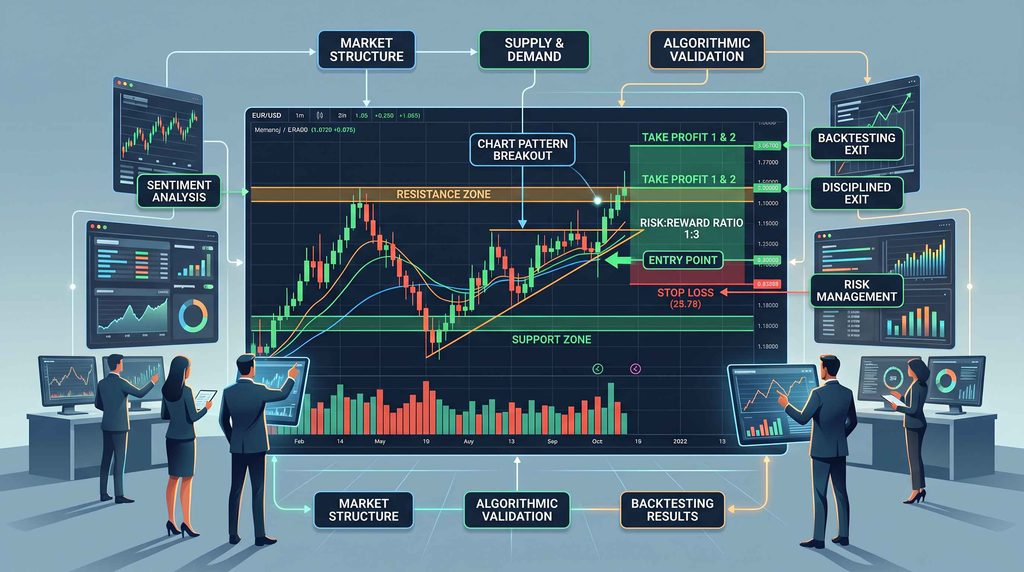
Forex signals are generally created through a combination of market analysis, technical indicators, price levels, statistical research, and trading rules.
At FXProfitBuilder, our analysts use various tools and techniques to analyse the Forex market before producing daily signals. The goal is to simplify the results and provide traders with clear entry and exit points rather than requiring them to perform all the research themselves.
In this guide, we’ll look at how Forex signals can be generated and explain some of the key indicators and price levels involved.
What Is a Forex Signal?
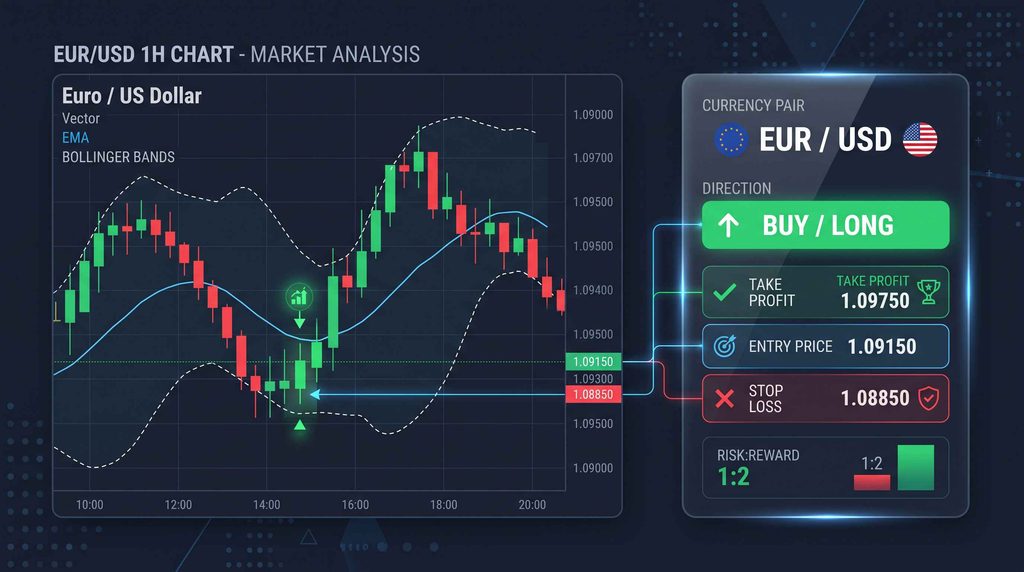
A Forex signal is a trading recommendation that identifies a potential opportunity in a currency pair.
A signal may include:
- Currency pair
- Buy or Sell direction
- Entry price
- Stop Loss
- Take Profit
- Trade management instructions
For example, a signal might identify an opportunity in EUR/USD and provide a specific price at which the trade should be entered, along with predefined risk and profit levels.
The signal is the final result of the analysis not the analysis itself.
How Are Forex Signals Generated?
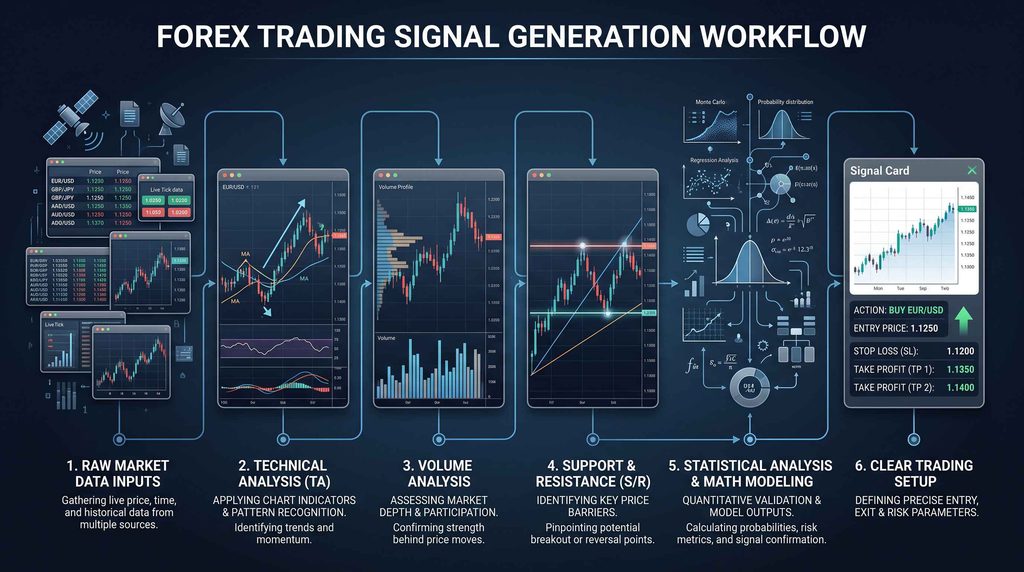
The exact process varies between providers, but professional Forex signals can involve several stages.
Step 1: Select the Currency Pair
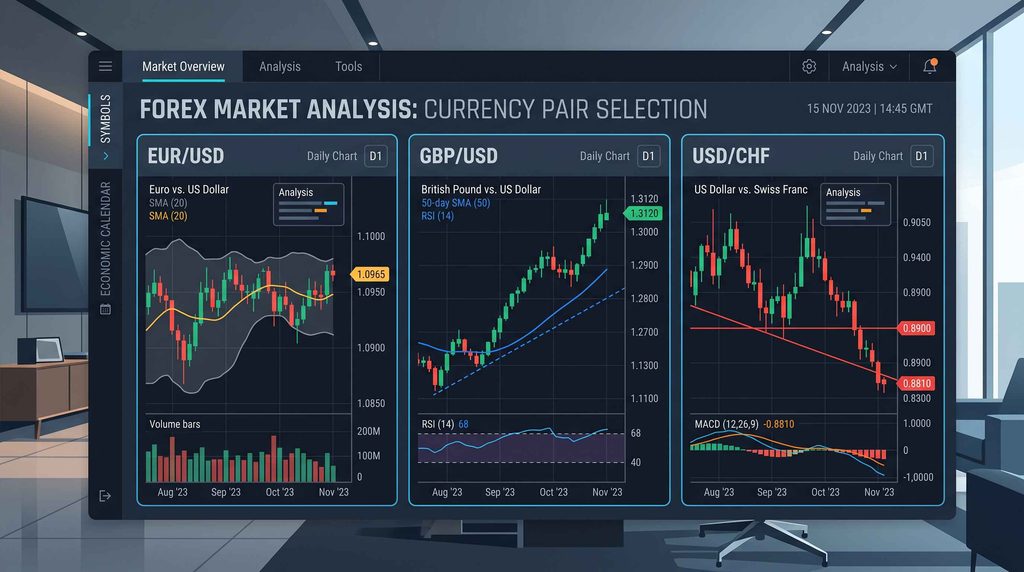
The analyst first determines which currency pairs are being monitored.
FXProfitBuilder provides daily signals for:
- EUR/USD
- GBP/USD
- USD/CHF
These pairs are analysed using the FXProfitBuilder trading methodology.
Step 2: Analyse Market Conditions
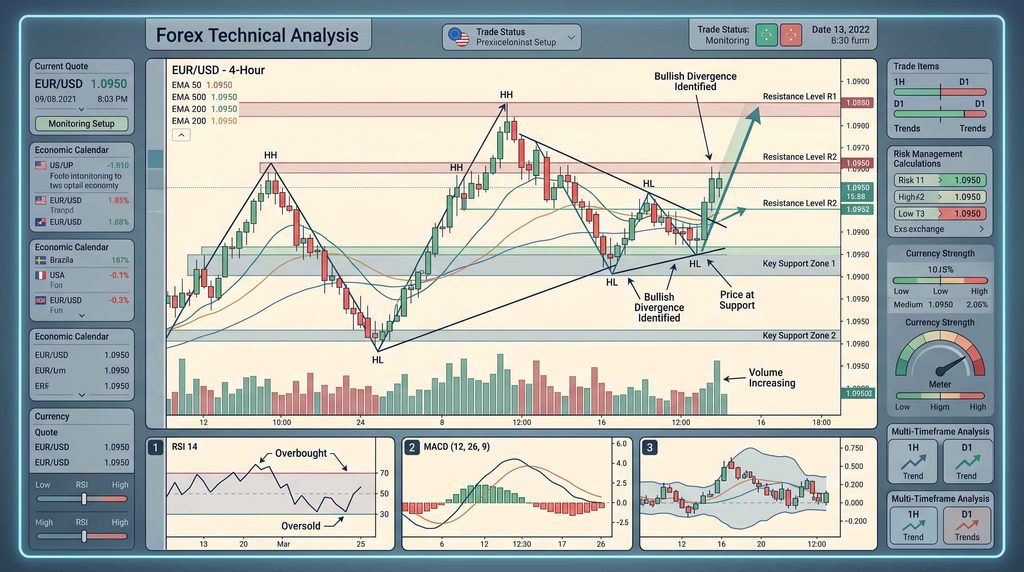
The next step is understanding what is happening in the market.
Analysts may examine:
- Price movements
- Trading volume
- Market trends
- Support and resistance
- Market structure
- Technical indicators
- Statistical patterns
The objective is to identify conditions that may create a potential trading opportunity.
Step 3: Identify Potential Entry Levels
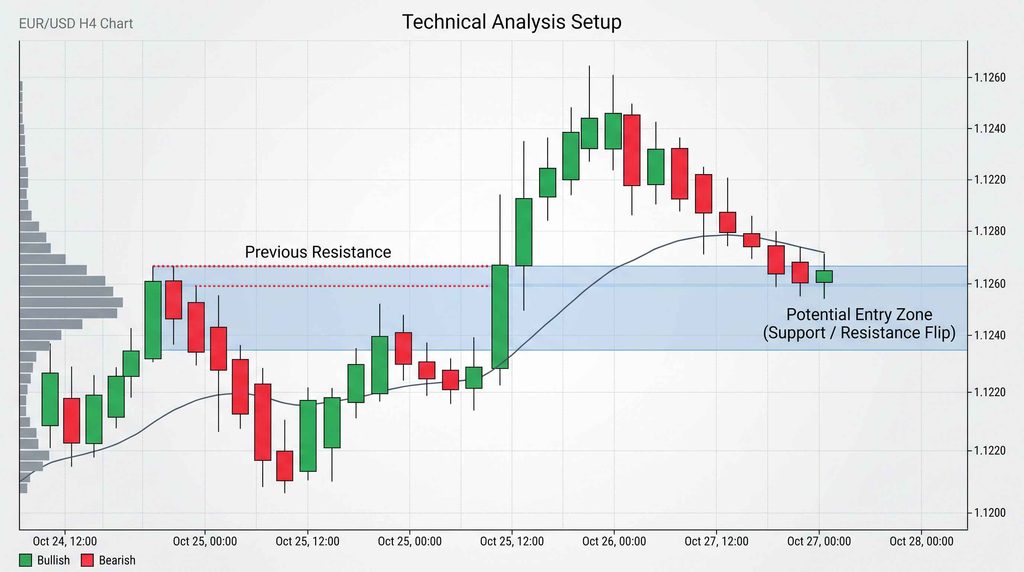
Once an opportunity has been identified, the analyst determines a suitable entry price.
This is an important part of a Forex signal because entering at the wrong price can change the characteristics of the entire trade.
A clearly defined entry level gives traders a specific point to follow rather than asking them to decide when to enter themselves.
Step 4: Determine Risk and Profit Levels
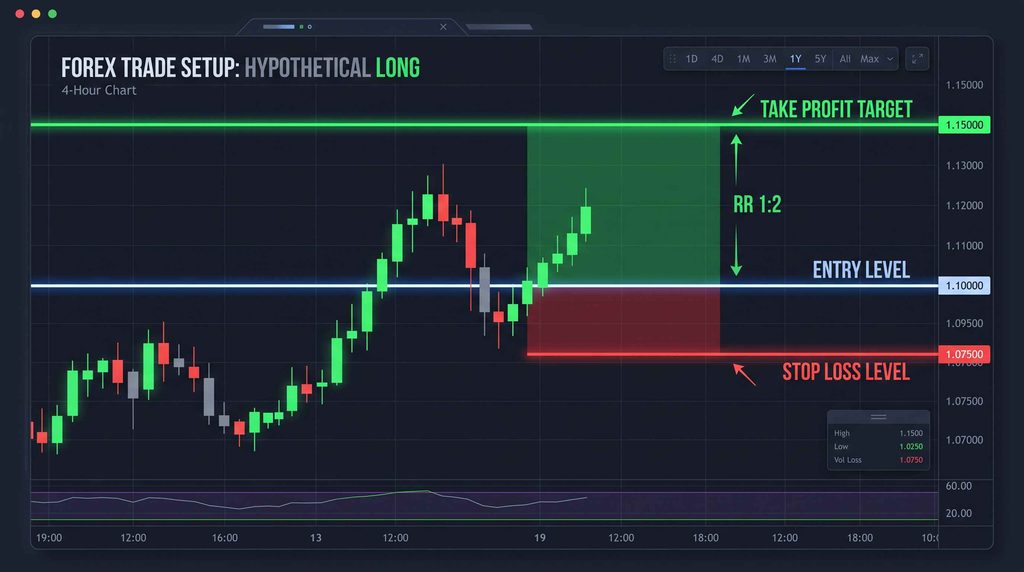
After identifying a potential entry, the analyst can establish appropriate Stop Loss and Take Profit levels.
The Stop Loss helps define where the trade should be closed if the market moves against the expected direction.
The Take Profit identifies the intended profit target.
Together, these levels help create a structured trade setup.
What Indicators Are Used to Generate Forex Signals?
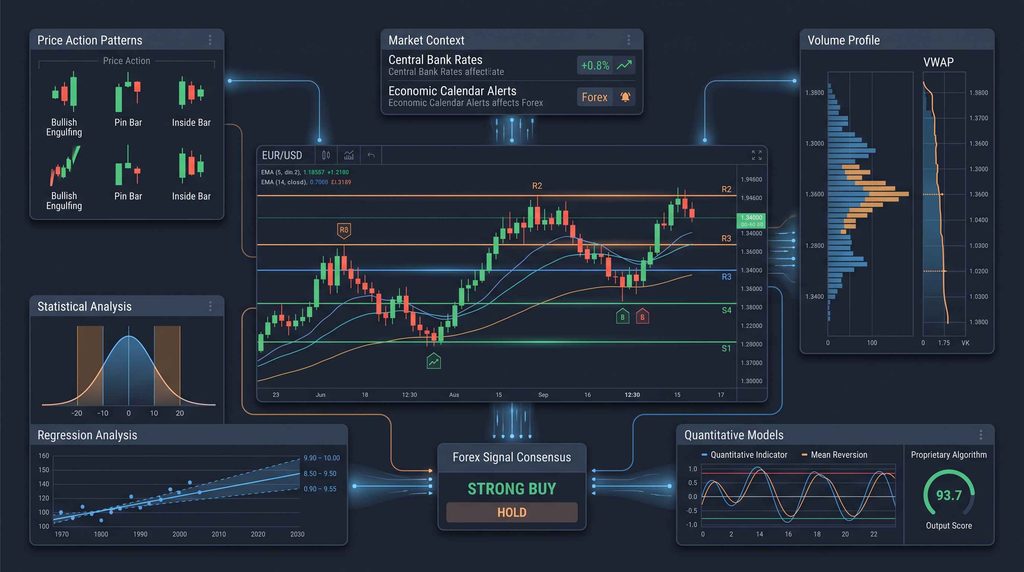
Different signal providers use different combinations of indicators.
At FXProfitBuilder, our system uses various tools to analyse the Forex market, including volume indicators and support and resistance studies.
Let’s look at some of the most common tools.
1. Volume Indicators
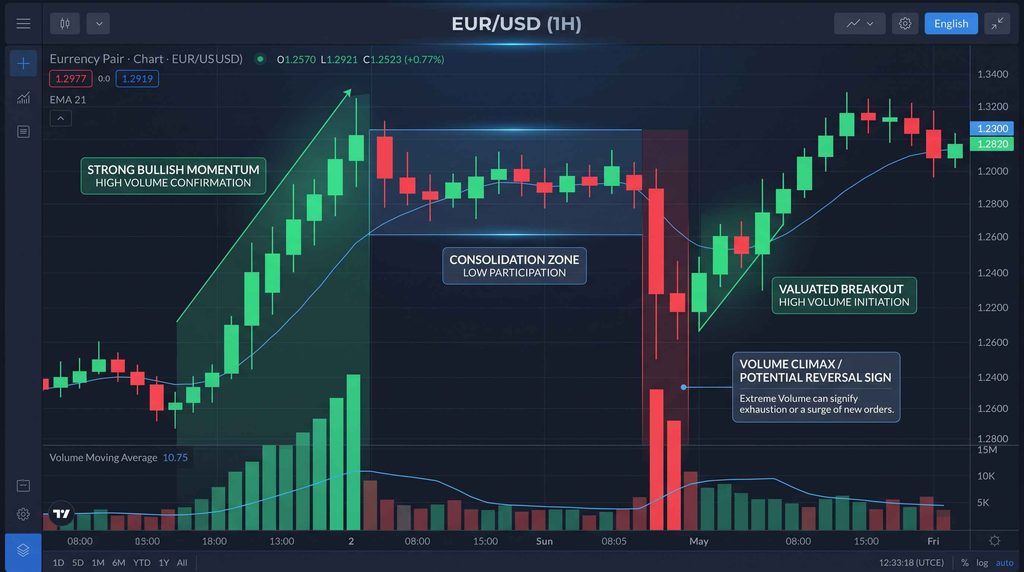
Volume indicators can provide information about trading activity and market participation.
Changes in volume may help analysts understand whether a price movement is supported by stronger or weaker market activity.
Volume can therefore be used alongside other forms of analysis rather than being considered in isolation.
At FXProfitBuilder, volume indicators form part of the analysis used to develop our Forex signals.
2. Support Levels
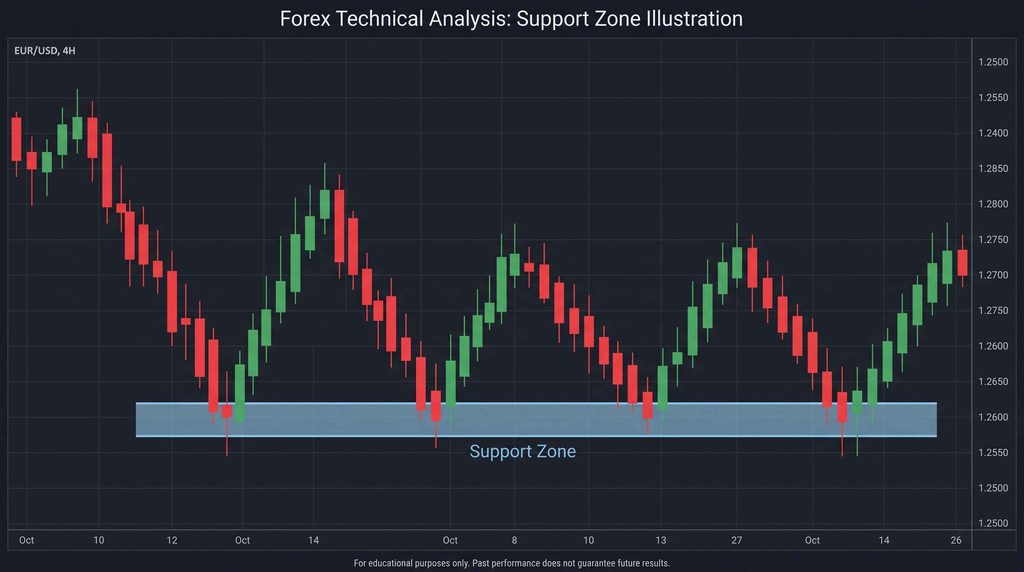
Support refers to a price area where buying interest may become stronger and potentially prevent the price from falling further.
For example, if a currency repeatedly finds buying interest around a particular price level, analysts may identify that area as potential support.
Support can help traders understand possible areas where the market could react.
3. Resistance Levels
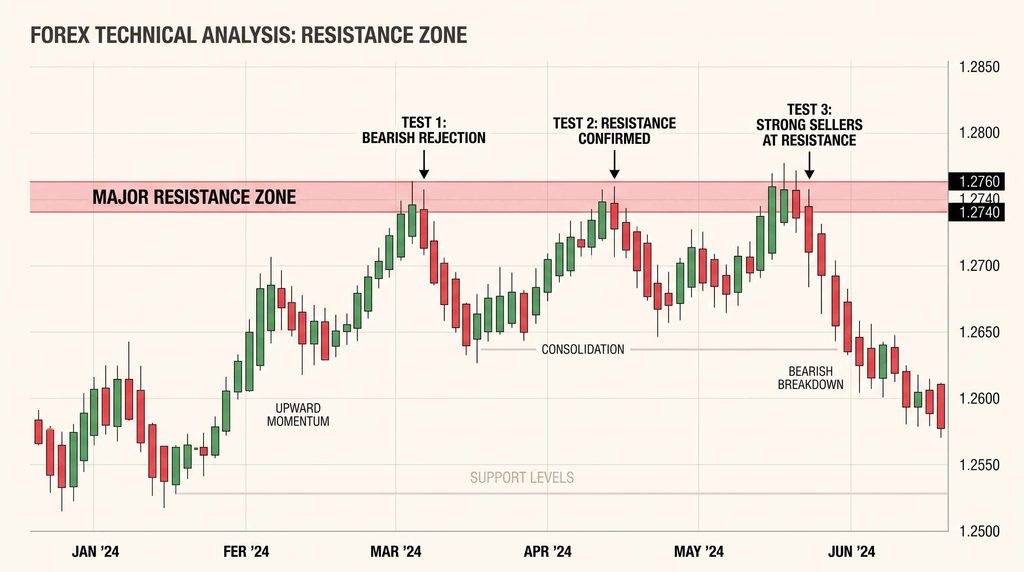
Resistance is the opposite concept.
It represents a price area where selling pressure may become stronger and potentially prevent the market from moving higher.
Repeated reactions around a particular price can make that level important to traders.
Support and resistance can therefore help analysts identify potential entry and exit areas.
4. Price Action
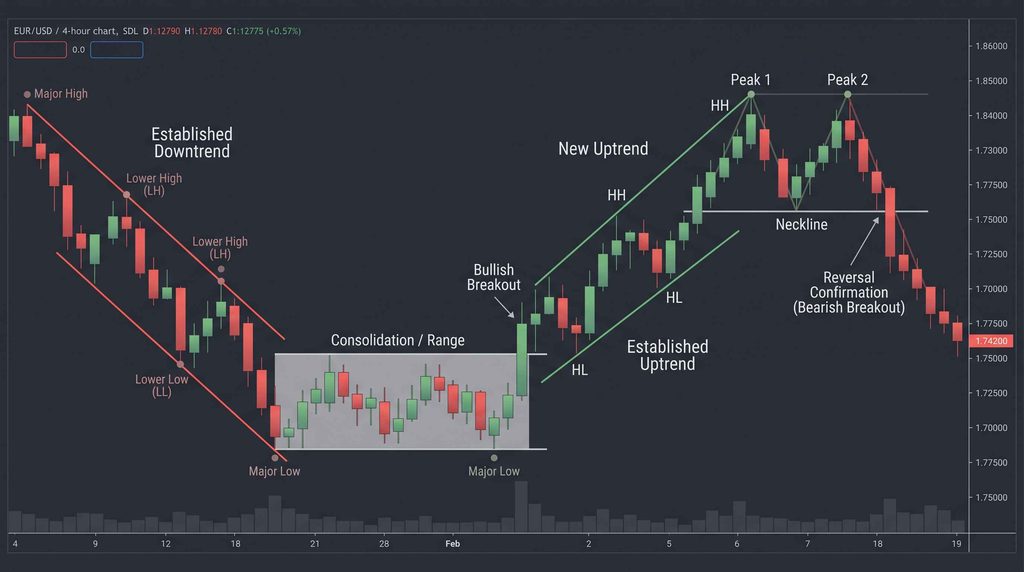
Price action refers to the movement of a currency pair over time.
Analysts can study:
- Highs
- Lows
- Trends
- Breakouts
- Reversals
- Consolidation
Studying price behaviour can provide useful context when determining whether a potential trade setup is developing.
5. Mathematical Models

Some professional trading systems use mathematical models to analyse large amounts of market information.
At FXProfitBuilder, various analytical tools are combined into a complex mathematical model designed to help identify potential Forex trading opportunities.
The purpose is to turn large amounts of market information into simpler and more actionable trading results.
6. Statistical Analysis
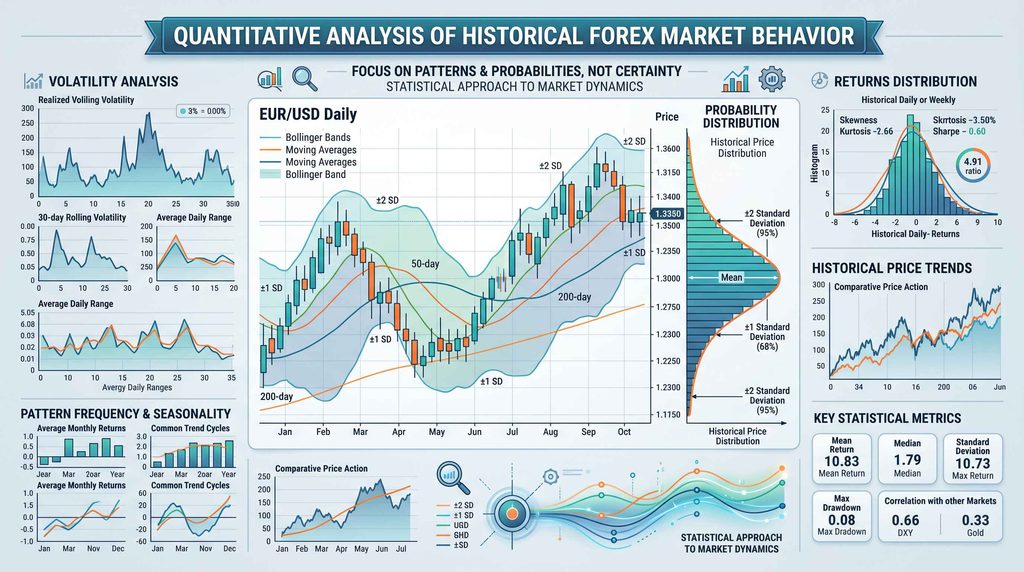
Statistics can also play an important role in trading research.
Historical market behaviour can be analysed to identify patterns, relationships, and probabilities.
However, historical patterns do not guarantee that the same outcome will occur in the future.
This is why statistical analysis is generally used as part of a broader trading methodology.
How Are Entry Prices Determined?
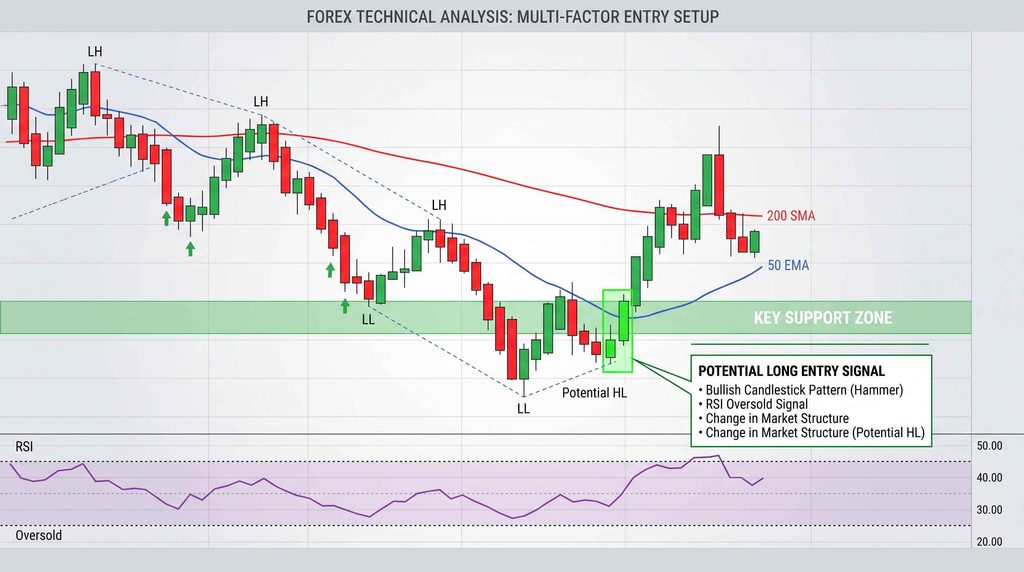
The entry price is one of the most important elements of a Forex signal.
An analyst may consider several factors when determining an entry level, including:
- Current market price
- Support and resistance
- Price behaviour
- Market momentum
- Technical indicators
- Statistical analysis
The final entry level represents the price at which the trading setup is intended to be activated.
How Are Stop Loss Levels Determined?
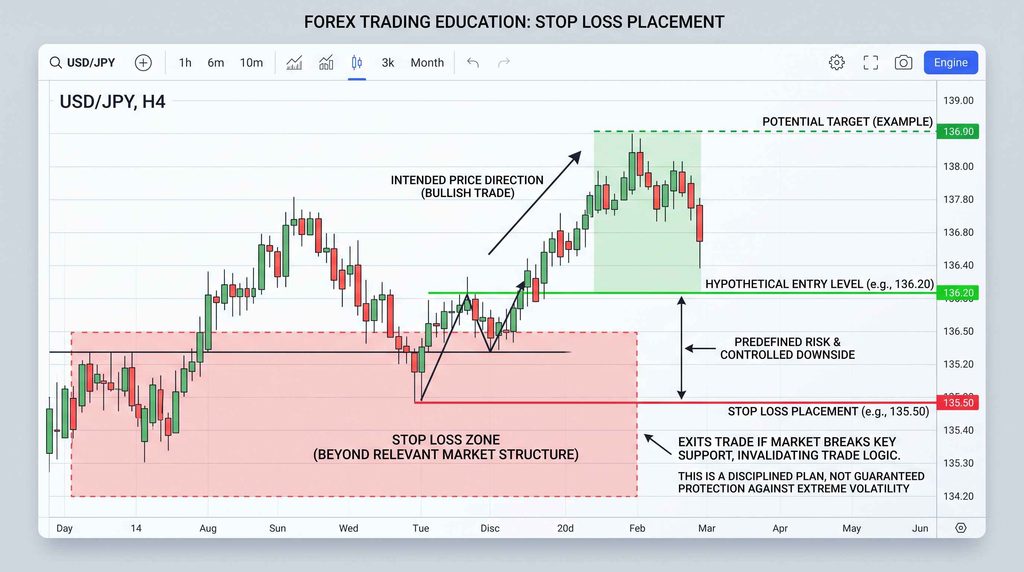
A Stop Loss is designed to limit potential losses when a trade moves against the expected direction.
The exact level depends on the trading methodology.
An analyst may consider:
- Market structure
- Support or resistance
- Recent price movements
- Volatility
- Trading strategy
The objective is to create a predefined exit point rather than leaving the trade completely unmanaged.
How Are Take Profit Levels Determined?
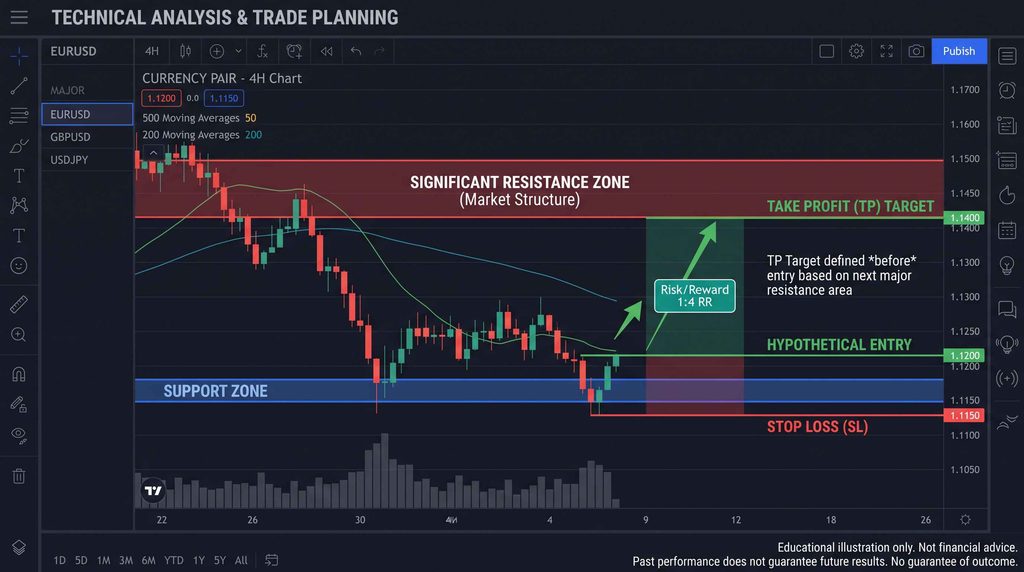
Take Profit identifies the intended target for a trade.
Analysts may consider:
- Potential price movement
- Market structure
- Resistance or support levels
- Historical behaviour
- Risk and reward considerations
Having a predefined target helps traders avoid making emotional decisions after entering a position.
Why Multiple Indicators Can Be Useful
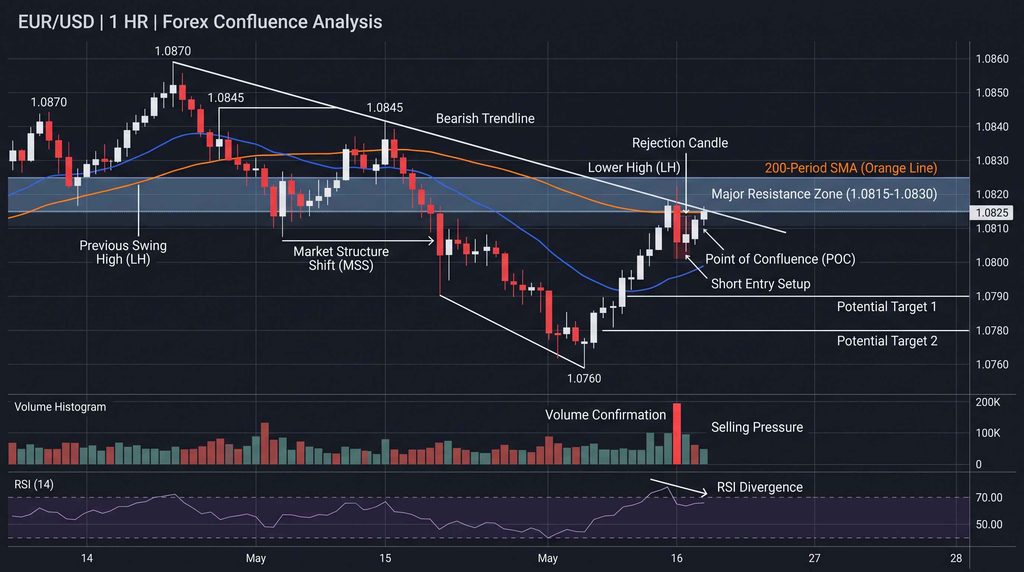
A single indicator rarely tells the entire story.
For example, an indicator may suggest that a market is gaining momentum, but support and resistance analysis may show that the price is approaching an important resistance level.
Combining different forms of analysis can provide additional context.
This is why FXProfitBuilder uses various tools together rather than relying on a single indicator to generate its Forex signals.
From Complex Analysis to a Simple Signal

One of the biggest advantages of a professional Forex signal service is that traders don’t necessarily need to perform all of this analysis themselves.
Behind a simple signal can be a significant amount of research.
The process can be viewed as:
Market Data → Analysis → Indicators → Price Levels → Trading Setup → Forex Signal
The trader receives the final result in an easier-to-follow format.
Why FXProfitBuilder Uses Multiple Analytical Tools
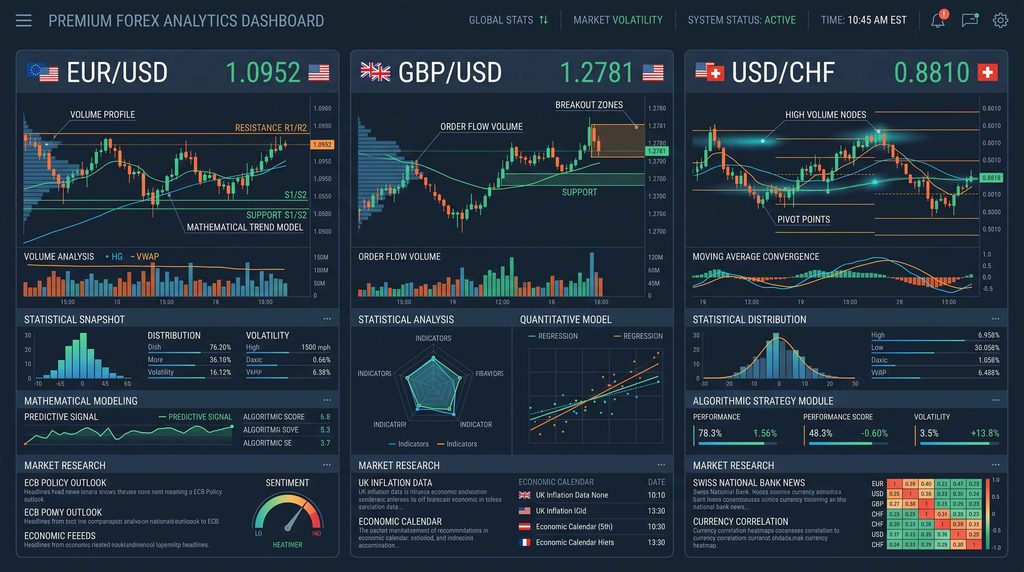
FXProfitBuilder’s objective is to simplify Forex trading.
Our analysts perform the background research and use various tools to develop Forex signals.
The system incorporates:
- Volume indicators
- Support and resistance studies
- Statistical analysis
- Mathematical modelling
- Market research
The results are transformed into clear entry and exit points for three currency pairs:
- EUR/USD
- GBP/USD
- USD/CHF
Can Forex Signals Be Generated Automatically?

Yes, Forex signals can be generated using automated or mechanical trading systems.
Computer-based systems can analyse market data according to predefined rules and generate trading alerts when certain conditions are met.
FXProfitBuilder’s alerts system can be traded manually or mechanically, giving traders flexibility in how they follow the system.
However, automated systems still depend on the rules and methodology behind them, and no automated approach eliminates market risk.
Are Forex Signals Based Only on Indicators?
No.
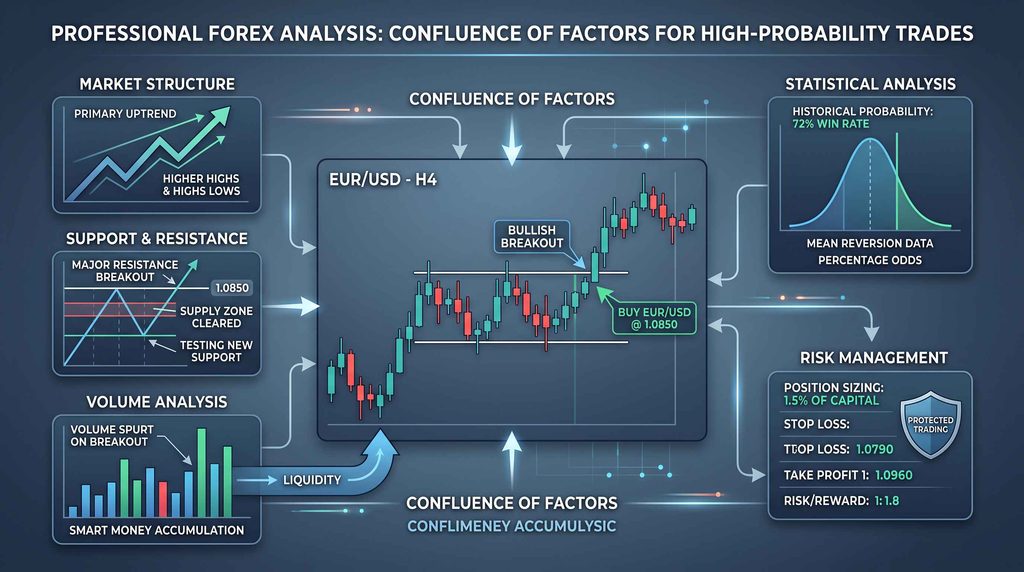
Indicators are only one part of the overall analysis.
A comprehensive signal can also consider:
- Price levels
- Market structure
- Support and resistance
- Volume
- Statistical information
- Trading rules
- Risk management
This is why simply copying an indicator’s Buy or Sell suggestion isn’t necessarily the same as using a complete Forex signal system.
Why Price Levels Matter
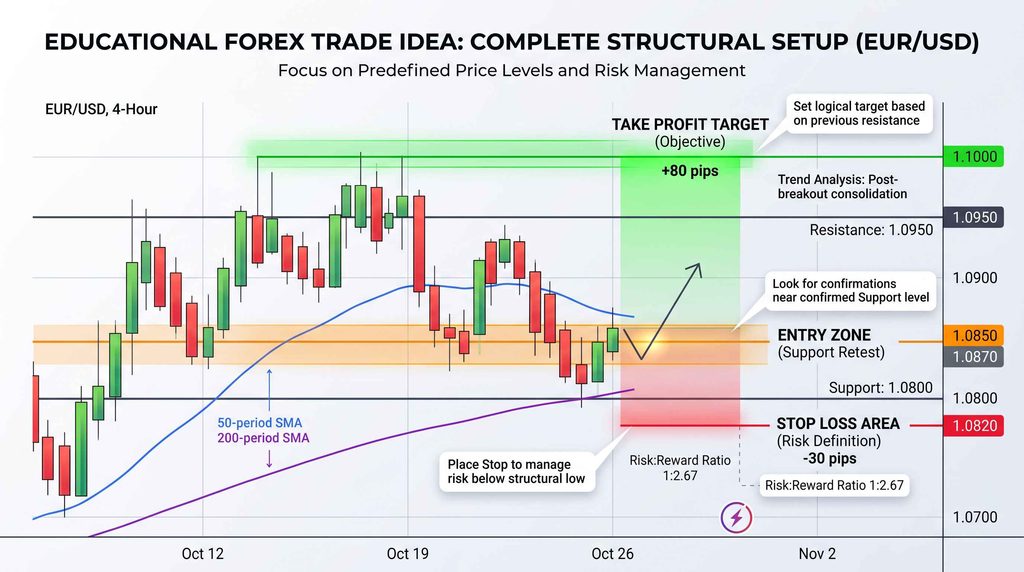
Price levels provide a practical framework for a trade.
Instead of simply saying:
“EUR/USD may rise.”
A structured signal can identify:
- Where to enter
- Where to limit potential losses
- Where to target potential profits
This makes the trading idea much easier to understand and execute.
What Beginners Should Understand
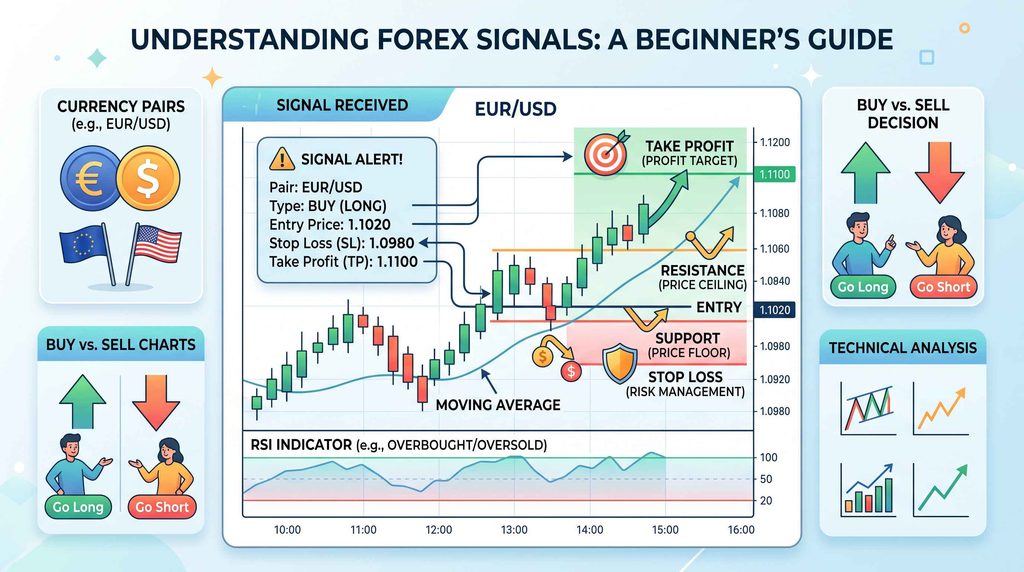
If you’re new to Forex, you don’t need to master every technical indicator before you can understand how signals work.
Start by learning the basics:
- Understand currency pairs.
- Learn the difference between Buy and Sell.
- Understand Entry prices.
- Learn how Stop Loss works.
- Understand Take Profit.
- Learn basic support and resistance.
- Gradually explore technical indicators.
As your knowledge develops, you’ll begin to understand the analysis behind the signals you receive.
Final Thoughts
Forex signals are the result of market analysis designed to identify potential trading opportunities.
Depending on the provider, signals can be generated using technical indicators, volume analysis, support and resistance, price action, statistical research, mathematical models, and predefined trading rules.
At FXProfitBuilder, we combine various analytical tools to simplify complex Forex market information into clear trading signals for EUR/USD, GBP/USD, and USD/CHF.
The objective isn’t to predict every market movement perfectly. Instead, it is to create a structured approach with clearly defined entry and exit points while maintaining sensible risk management.
FAQ

1. How are Forex signals generated?
Forex signals can be generated through a combination of technical indicators, price action, volume analysis, support and resistance, statistical research, mathematical models, and predefined trading rules.
2. What indicators does FXProfitBuilder use?
FXProfitBuilder uses various tools, including volume indicators and support and resistance studies, as part of a broader analytical and mathematical model.
3. How is the Forex entry price determined?
An entry price can be determined by analysing market conditions, price behaviour, support and resistance, indicators, statistical information, and the trading methodology being used.
4. What is the purpose of a Stop Loss?
A Stop Loss provides a predefined level where a trade can be closed if the market moves against the expected direction. It is an important part of risk management.
5. How is a Take Profit level determined?
A Take Profit level can be based on factors such as market structure, support and resistance, expected price movement, and the trading strategy being used.
6. Does FXProfitBuilder provide signals for multiple currency pairs?
Yes. FXProfitBuilder provides daily Forex signals for EUR/USD, GBP/USD, and USD/CHF.
7. Can FXProfitBuilder signals be automated?
Yes. The FXProfitBuilder alerts system can be traded manually or mechanically, allowing traders to follow the system according to their preferred approach.
8. Do Forex indicators guarantee accurate signals?
No. Indicators and analytical models cannot guarantee the future movement of a currency pair. Forex trading involves risk, and signals should always be used alongside appropriate risk management.
👉 Start your journey today—subscribe to our forex pip tips service and see the difference for yourself! Sign Up to get Exclusive Offers