What Drives the Swiss Franc? USD/CHF Price Factors
Posted On - November 12, 2026 | By - FXProfitBuilder | Categories - Currency Pairs (EUR/USD, GBP/USD, USD/CHF)
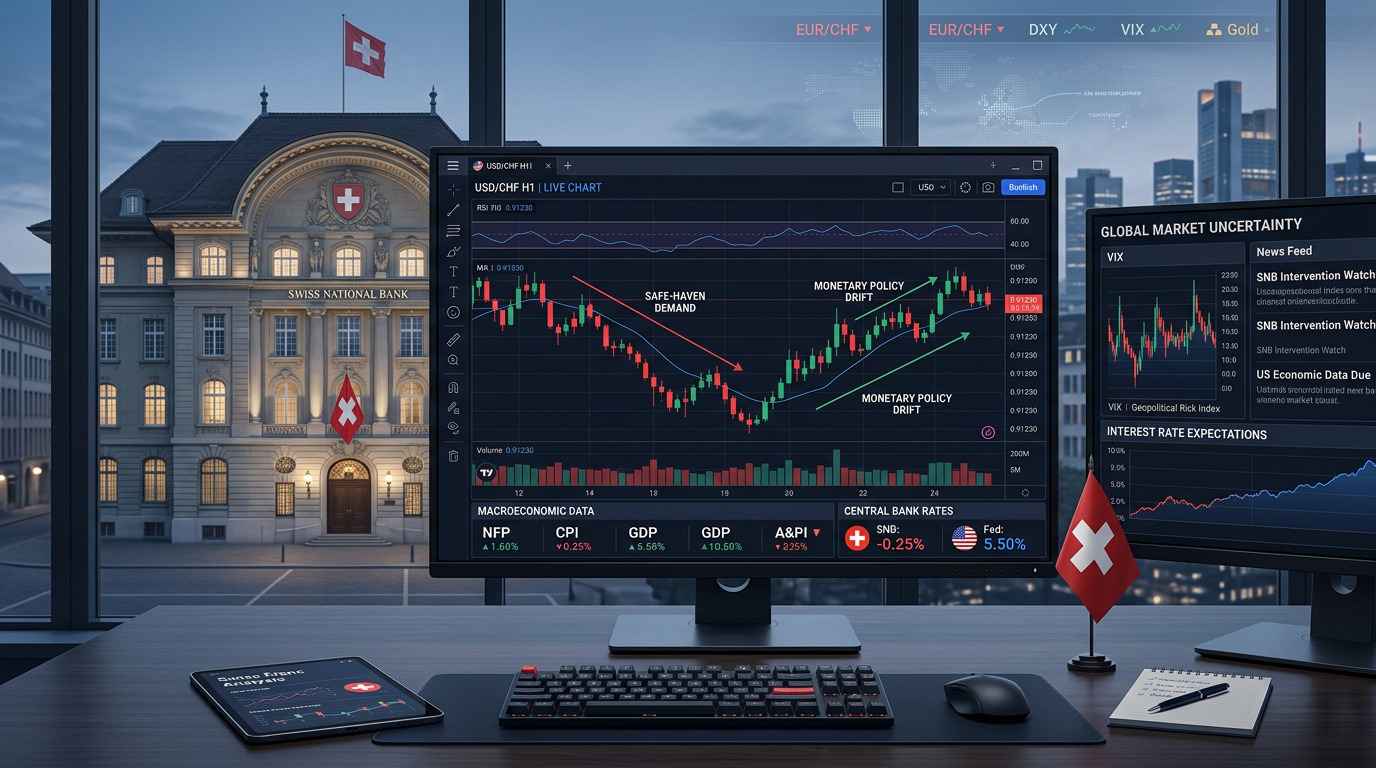
The Swiss franc is one of the most closely watched currencies in the forex market. Known for its reputation as a safe-haven currency, it can attract investor demand during periods of financial uncertainty, geopolitical tension and market volatility.
However, the Swiss franc does not move only because investors are looking for safety. Interest rates, inflation, central bank decisions, economic conditions and movements in the US dollar can all influence its value.
For forex traders following USD/CHF, understanding these factors is particularly important. The pair represents the value of one US dollar in Swiss francs, meaning that a stronger Swiss franc generally pushes USD/CHF lower, while a stronger US dollar can push it higher.
In this guide, we explain what drives the Swiss franc, how the Swiss National Bank influences its value, and which economic and market developments traders should monitor when analysing USD/CHF.
1. Why Is the Swiss Franc Considered a Safe-Haven Currency?

The Swiss franc (CHF) has a long-standing reputation as a safe-haven currency. This means investors may seek exposure to the franc during periods of uncertainty when they become concerned about financial markets, geopolitical developments or economic stability.
Switzerland is often associated with:
- Political and institutional stability.
- A well-established financial system.
- A history of relatively low inflation.
- Strong public institutions.
- A stable economic and monetary framework.
These characteristics can make Swiss franc-denominated assets attractive when investors become more cautious about other markets.
How does safe-haven demand affect USD/CHF?
Imagine a period of significant global financial uncertainty.
Investors may reduce exposure to riskier assets and increase demand for currencies they consider relatively stable, including the Swiss franc.
If demand for CHF increases against the US dollar, the franc may strengthen and USD/CHF may fall.
However, there is an important complication: the US dollar is also widely regarded as a safe-haven currency.
During some periods of uncertainty, both currencies can attract demand. The direction of USD/CHF then depends on which currency experiences stronger buying pressure.
Important: The Swiss franc does not strengthen during every crisis. Safe-haven behaviour is a market tendency, not a guaranteed rule.
2. Swiss National Bank (SNB) Interest Rate Decisions

One of the most important influences on the Swiss franc is the monetary policy of the Swiss National Bank (SNB).
The SNB is Switzerland’s central bank. Its primary monetary policy mandate is to maintain price stability while taking economic developments into account.
Its decisions can influence borrowing costs, investment returns, financial conditions and the exchange rate.
How can an SNB interest rate increase affect CHF?
When the SNB raises its policy rate, Swiss franc assets may become more attractive relative to assets in currencies with lower interest rates.
This can increase demand for CHF, potentially strengthening the currency.
For USD/CHF, a stronger franc generally creates downward pressure on the pair.
What happens when the SNB cuts interest rates?
A reduction in Swiss interest rates may make franc-denominated assets less attractive relative to assets offering higher returns elsewhere.
This can reduce demand for CHF and potentially weaken the currency.
In that situation, USD/CHF may rise if the US dollar remains relatively stable or strengthens.
However, the market reaction depends on expectations. If traders have already anticipated an interest rate decision, the announcement itself may produce a limited reaction.
Why SNB communication matters
Traders should monitor more than the headline interest rate.
Important information includes:
- The SNB’s monetary policy assessment.
- Its inflation forecasts.
- Comments from Governing Board members.
- Economic growth expectations.
- Statements about exchange rate developments.
- Any discussion of additional monetary policy measures.
A change in the SNB’s outlook can influence the franc even when the policy rate remains unchanged.
3. US Federal Reserve Decisions and USD/CHF

USD/CHF is influenced by both Swiss and US monetary policy.
The Federal Reserve (Fed) sets US monetary policy, and its interest rate decisions can significantly influence demand for the US dollar.
Because USD/CHF measures the value of one dollar in Swiss francs, changes in the relative outlook for US and Swiss interest rates are important.
When the Federal Reserve raises interest rates
Higher US interest rates can make dollar-denominated assets more attractive.
If investors expect US interest rates to remain higher relative to Swiss rates, demand for the US dollar may increase.
This can support USD/CHF and push the pair higher.
When the Federal Reserve cuts interest rates
Lower US interest rates may reduce the relative attraction of dollar-denominated assets.
If the SNB maintains a comparatively tighter monetary policy, the Swiss franc may strengthen relative to the dollar.
This could place downward pressure on USD/CHF.
Why the interest rate difference matters
Forex traders often compare the interest rate outlook of two countries rather than looking at one central bank in isolation.
For USD/CHF, they monitor:
- Federal Reserve policy.
- Swiss National Bank policy.
- Expected future interest rate changes.
- US and Swiss inflation.
- Differences in economic growth.
A change in the expected interest rate difference can influence the currency pair before either central bank actually changes its policy rate.
4. Swiss Inflation and Its Influence on the Franc

Inflation is another important factor affecting the Swiss franc.
The SNB monitors price developments closely because maintaining price stability is central to its monetary policy mandate.
If inflation rises unexpectedly, policymakers may consider whether monetary conditions need to become tighter.
If inflation remains low or falls, the central bank may have more room to maintain or adopt a less restrictive monetary policy.
How does Swiss inflation affect USD/CHF?
Consider two simplified situations.
Scenario A: Swiss inflation rises more than expected
Traders may expect the SNB to maintain higher interest rates or become more restrictive.
If this increases demand for CHF relative to USD, the franc may strengthen and USD/CHF may fall.
Scenario B: Swiss inflation falls more than expected
Traders may expect the SNB to have more room to reduce interest rates.
If this weakens demand for CHF relative to USD, USD/CHF may rise.
These are possible reactions, not automatic outcomes. The SNB considers its broader inflation outlook, economic conditions and exchange rate developments rather than reacting mechanically to one inflation report.
5. Global Economic Uncertainty and Market Risk Sentiment

The Swiss franc’s safe-haven reputation means that global market conditions can influence USD/CHF even when there is no major Swiss economic announcement.
Traders often describe market conditions using two broad terms:
- Risk-on: Investors are generally more comfortable taking risks and may increase exposure to equities and other risk-sensitive assets.
- Risk-off: Investors become more cautious and may seek assets or currencies they consider relatively safer.
What can create risk-off conditions?
Examples include:
- Major geopolitical conflicts.
- Financial market instability.
- Banking sector concerns.
- Unexpected economic downturns.
- Global trade disruptions.
- Significant political uncertainty.
During a risk-off period, demand for the Swiss franc may increase.
If the franc strengthens more than the US dollar, USD/CHF can decline.
However, the dollar can also benefit from safe-haven demand. Therefore, traders should examine the relative performance of both currencies rather than assuming that uncertainty will always push USD/CHF lower.
6. Swiss National Bank Foreign Exchange Interventions

An important feature of Swiss monetary policy is that the SNB can use foreign exchange interventions when necessary.
This means the central bank may buy or sell foreign currencies in the foreign exchange market to influence monetary conditions.
Why does this matter?
Switzerland is a relatively small, open economy with substantial international trade. Changes in the Swiss franc’s value can affect import prices, export competitiveness and domestic inflation.
For example, a rapidly strengthening franc can make imported products cheaper but can also make Swiss exports more expensive for international customers.
The SNB therefore considers exchange rate developments as part of its broader monetary policy decisions.
How can intervention affect USD/CHF?
If the SNB buys foreign currencies and sells Swiss francs, this can increase the supply of CHF in the market and potentially reduce upward pressure on the franc.
If the SNB sells foreign currencies and buys Swiss francs, it can increase demand for CHF and potentially support its value.
The actual effect depends on the scale, timing and market conditions surrounding the intervention.
Traders should monitor SNB announcements and official communication rather than assume that the central bank will intervene whenever the franc moves sharply.
7. US Economic Data Can Move USD/CHF

Although the Swiss franc has its own economic drivers, USD/CHF is also strongly influenced by developments in the United States.
Important US economic releases include:
- Consumer Price Index (CPI).
- Nonfarm Payrolls (NFP).
- Unemployment rate.
- Federal Reserve interest rate decisions.
- Gross Domestic Product (GDP).
- Retail sales.
- Manufacturing and services PMI.
Example: Strong US employment data
Suppose US employment growth is significantly stronger than expected.
Traders may believe the US economy is more resilient than previously thought. If this changes expectations about Federal Reserve policy in a way that supports the dollar, USD/CHF may rise.
Example: Weaker US inflation
Suppose US inflation comes in lower than forecast.
Traders may expect the Federal Reserve to have more room to reduce interest rates. If this weakens demand for the US dollar relative to the franc, USD/CHF may fall.
However, economic releases rarely work in isolation. Traders also consider wage growth, previous revisions, central bank communication and broader market sentiment.
8. The Relationship Between the Swiss Franc and the Euro

Switzerland is geographically located in the heart of Europe and has close economic and trading relationships with the euro area.
As a result, developments affecting the euro area can sometimes influence the Swiss franc.
For example:
- European Central Bank policy decisions.
- Euro area economic growth.
- European political developments.
- Regional financial uncertainty.
- Changes in European trade conditions.
During periods of regional uncertainty, investors may increase demand for the Swiss franc.
The franc may also respond to developments in the euro area because Switzerland is economically connected to its neighbouring markets.
For USD/CHF traders, monitoring EUR/CHF can provide additional context about the franc’s relative strength.
However, EUR/CHF and USD/CHF do not always move in the same direction because the US dollar has its own economic and monetary policy influences.
9. Important Economic Indicators to Monitor When Trading USD/CHF

If you follow USD/CHF, you do not need to monitor every economic announcement in the world.
Instead, focus on the data and events that provide useful information about the Swiss franc and US dollar.
| Economic indicator or event | Why it matters for USD/CHF |
| SNB interest rate decision | Influences Swiss monetary policy and CHF demand |
| Federal Reserve decision | Influences US monetary policy and USD demand |
| Swiss CPI inflation | Helps shape SNB policy expectations |
| US CPI inflation | Influences expectations about Federal Reserve policy |
| US Nonfarm Payrolls | Provides information about US employment conditions |
| US GDP | Indicates the strength of the US economy |
| Swiss economic growth | Provides information about domestic economic conditions |
| Global market volatility | Can influence safe-haven demand |
| SNB foreign exchange policy | May affect demand and supply for the franc |
A useful habit is to check an economic calendar before trading and identify high-impact announcements affecting either currency.
Pay attention to actual results compared with forecasts, not simply whether a figure has increased or decreased.
10. How to Analyse USD/CHF Before Entering a Trade

Understanding the economic factors behind USD/CHF is only one part of market analysis. Traders also need to study price behaviour and establish clear risk-management rules.
Here is a practical process.
Step 1: Check the economic calendar
Look for upcoming SNB and Federal Reserve announcements, inflation reports and important US economic releases.
Avoid entering a trade without considering the possibility of increased volatility around major announcements.
Step 2: Understand the relative strength of USD and CHF
Ask yourself:
- Is the US dollar strengthening or weakening?
- Is the Swiss franc attracting safe-haven demand?
- Are interest rate expectations changing?
- Is there a major economic development affecting either currency?
This helps establish the broader market context.
Step 3: Identify the trend
Review the USD/CHF chart and determine whether the market is showing an upward trend, downward trend or sideways movement.
Avoid assuming that a single price movement represents a lasting trend.
Step 4: Mark support and resistance
Identify important price areas where USD/CHF has previously encountered buying or selling pressure.
These levels can help you plan potential entries and exits, although they do not guarantee that price will reverse.
Step 5: Define your risk before entering
Calculate your position size based on your account balance, stop-loss distance and chosen risk limit.
Also consider spreads, slippage and possible overnight financing costs.
A trade should have a clear risk plan before it is opened, not after the market starts moving against you.
11. How FXProfitBuilder Approaches USD/CHF Analysis

For traders who want a structured approach to forex analysis, FXProfitBuilder focuses on three major currency pairs:
Its stated methodology combines volume indicators, support and resistance analysis, and a mathematical model to identify potential entry and exit levels.
Signals can be followed manually or mechanically, depending on the trader’s preferred approach and trading setup.
USD/CHF is an important part of this selection because it provides exposure to the relationship between the US dollar and Swiss franc.
Understanding what drives the pair can help traders place potential signals in a wider market context. For example, an upcoming Federal Reserve decision, SNB announcement or period of global uncertainty may be relevant when assessing an open USD/CHF position.
However, no trading signal can guarantee a particular result. Traders should understand the entry, stop-loss and take-profit instructions, assess their overall exposure and follow appropriate risk-management practices.
You can also explore our guides on USD/CHF trading for beginners and how news and data releases move EUR/USD and GBP/USD.
Conclusion: Understand What Moves the Swiss Franc Before Trading USD/CHF

The Swiss franc is influenced by several interconnected factors. Its safe-haven reputation, Swiss National Bank decisions, inflation, interest rate differences, global economic uncertainty and US dollar movements can all affect its value.
For USD/CHF traders, the most important principle is to consider both currencies rather than focusing only on Switzerland.
A stronger Swiss franc generally pushes USD/CHF lower, while a stronger US dollar generally pushes the pair higher. But when both currencies attract safe-haven demand, the direction can become less straightforward.
By following central bank decisions, monitoring economic announcements and combining fundamental analysis with technical analysis, traders can develop a better understanding of USD/CHF price movements.
Remember that no economic indicator or market pattern predicts every movement. A consistent strategy, sensible position sizing and careful risk management remain essential.
Forex trading involves substantial risk, particularly when leverage is used. This article is for educational purposes only and is not financial advice. You can lose some or all of your trading capital.
FAQ
1. Why is the Swiss franc considered a safe-haven currency?
The Swiss franc has a reputation for stability because of Switzerland’s political and institutional environment, established financial system and history of relatively low inflation. Investors may seek CHF during periods of global uncertainty, although this behaviour is not guaranteed.
2. What makes USD/CHF go up?
USD/CHF may rise when the US dollar strengthens against the Swiss franc. Possible drivers include stronger US economic data, more restrictive Federal Reserve expectations, weaker demand for the franc or reduced safe-haven interest in CHF.
3. What makes USD/CHF go down?
USD/CHF may fall when the Swiss franc strengthens against the US dollar. This can happen during periods of increased safe-haven demand for CHF, stronger Swiss monetary policy expectations or weakening demand for the US dollar.
4. Does the Swiss National Bank influence USD/CHF?
Yes. The SNB influences Swiss monetary conditions through its policy rate and can use additional measures, including foreign exchange interventions, when necessary. Its decisions and communication can affect the value of the Swiss franc and therefore USD/CHF.
5. Does US economic news affect USD/CHF?
Yes. US inflation, employment, GDP and Federal Reserve announcements can influence demand for the dollar. Since USD is the base currency in USD/CHF, changes in its relative strength can move the pair.
6. Is USD/CHF a good currency pair for beginners?
USD/CHF is a widely followed major currency pair and can be useful for learning about central bank policy and safe-haven demand. However, beginners should understand its economic drivers, trading costs and volatility before trading it with real money.
7. What is the best time to trade USD/CHF?
USD/CHF can attract activity during the European and London sessions and during the overlap between London and New York. Its liquidity and volatility can vary depending on economic announcements and market conditions.
8. Does the Swiss franc always strengthen during a financial crisis?
No. The franc has historically attracted safe-haven demand during several periods of market uncertainty, but the US dollar can also benefit from these conditions. The relative performance of both currencies determines the direction of USD/CHF.
9. Which economic reports should I monitor for USD/CHF?
Important releases include Swiss CPI, SNB monetary policy assessments, US CPI, US employment reports, GDP figures and Federal Reserve decisions. Global market conditions and geopolitical developments are also worth monitoring.
👉 Start your journey today—subscribe to our forex pip tips service and see the difference for yourself! Sign Up to get Exclusive Offers