Why a 7-Day Free Forex Signals Trial Is the Smartest Way to Start
Posted On - September 23, 2026 | By - FXProfitBuilder | Categories - Choosing & Buying Signals (High Intent)
Introduction

Choosing a Forex signals service can be difficult, especially if you are completely new to trading.
There are plenty of services promising daily signals, trading opportunities, educational content and market analysis. But how do you know whether a particular service actually fits your trading style before committing to a subscription?
This is where a 7-day free Forex signals trial can be useful.
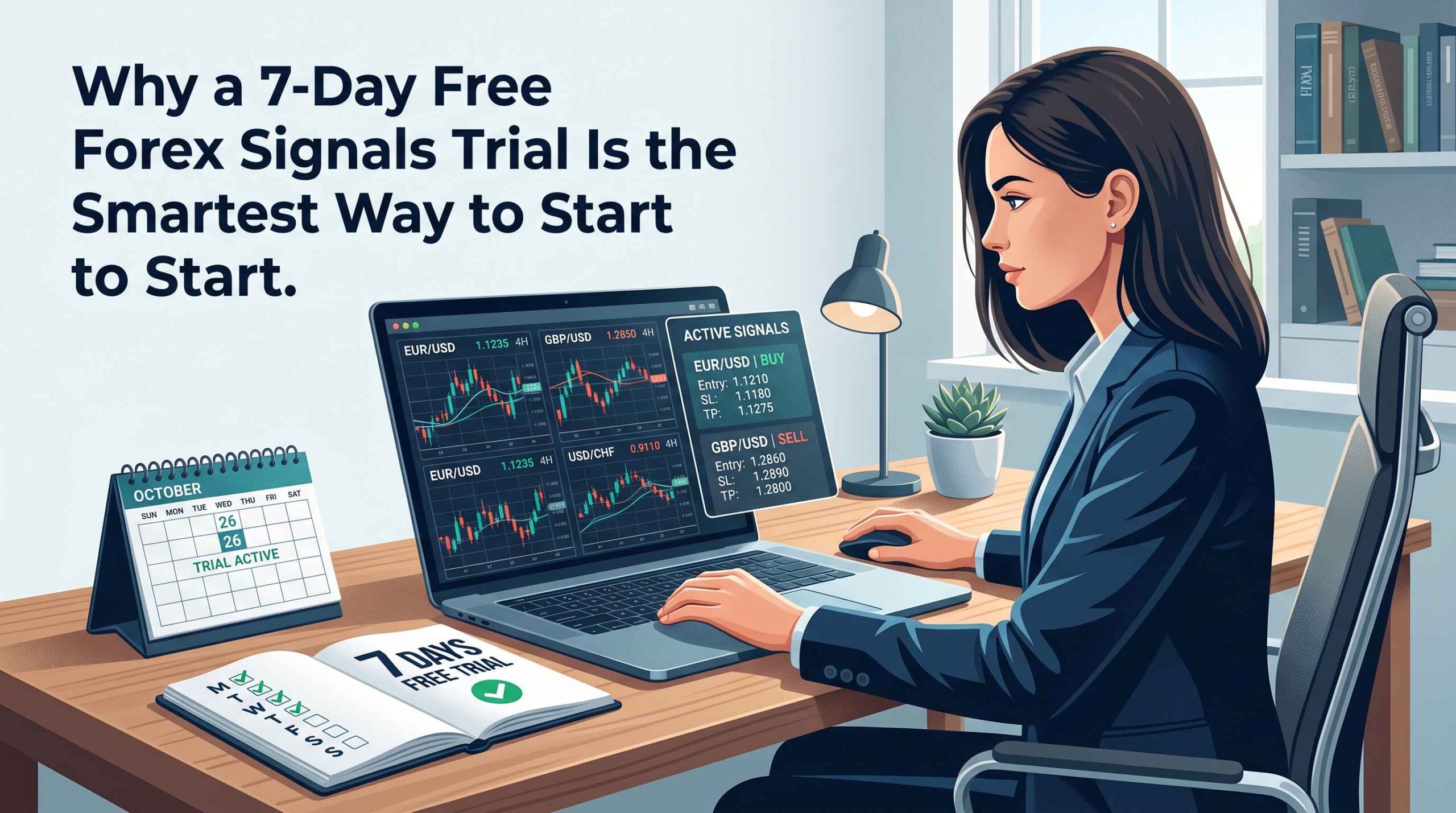
Instead of immediately paying for a long-term subscription, a free trial gives beginners an opportunity to experience how a signals service works in real trading conditions. You can see how signals are delivered, understand the format, assess how frequently alerts arrive and decide whether the service is easy enough to follow.
A free trial does not prove that a signals provider will make you money. Forex trading involves significant risk, and past performance cannot guarantee future results. The CFTC specifically warns against trading services that promise guaranteed or unrealistic returns.
The real value of a 7-day trial is much simpler:
It gives you a chance to evaluate the service before deciding whether it is worth paying for.
What Is a 7-Day Free Forex Signals Trial?
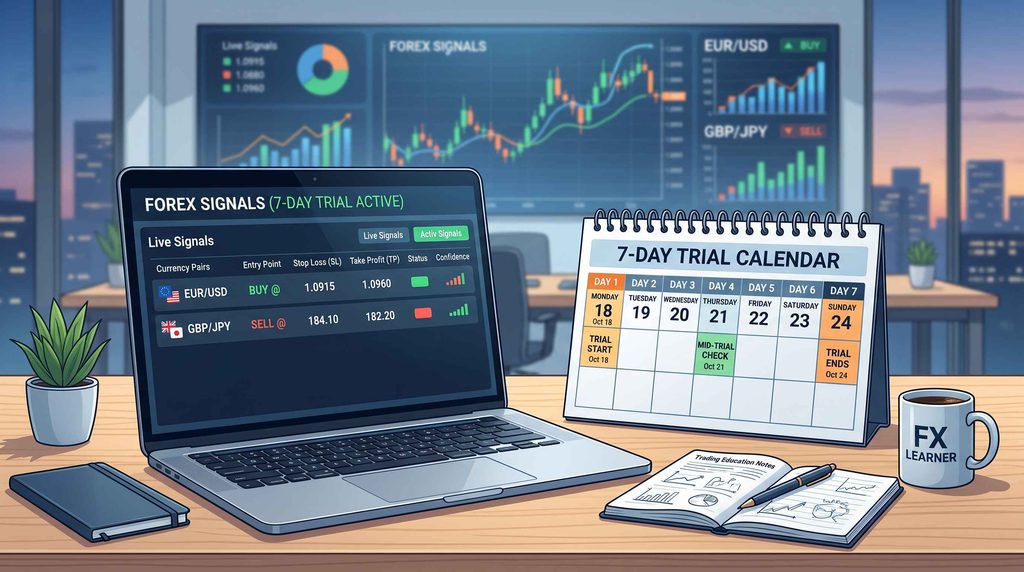
A 7-day free Forex signals trial is a short introductory period during which a trader can access a signals service without paying the normal subscription price.
Depending on the provider, the trial may allow access to:
- Daily Forex signals
- Entry prices
- Stop-loss levels
- Take-profit targets
- Selected currency pairs
- Signal notifications
- Trading commentary
- Educational material
- Customer support
The exact features depend on the provider.
The important point is that you get enough time to understand the actual experience of using the service rather than judging it purely from advertisements or screenshots.
Why Seven Days?
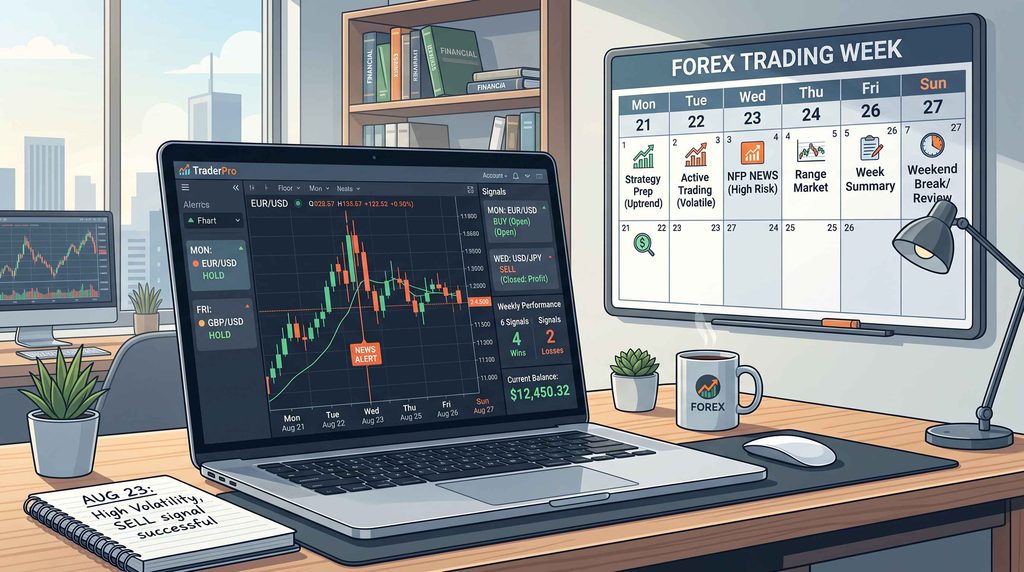
Seven days is long enough to experience a complete trading week.
That matters because Forex markets can behave differently from one day to another.
During a seven-day period, a beginner may be able to observe:
- How often signals are sent
- Which currency pairs are covered
- How quickly alerts arrive
- How clear the instructions are
- How entry and exit information is presented
- How the provider communicates during changing market conditions
- Whether the service fits their daily routine
A single signal or one day’s results tell you very little.
A full week provides more context.
It still isn’t long enough to judge the long-term profitability of a trading strategy, but it can be enough to judge whether the service itself is suitable for you.
The Biggest Advantage: Try Before You Buy
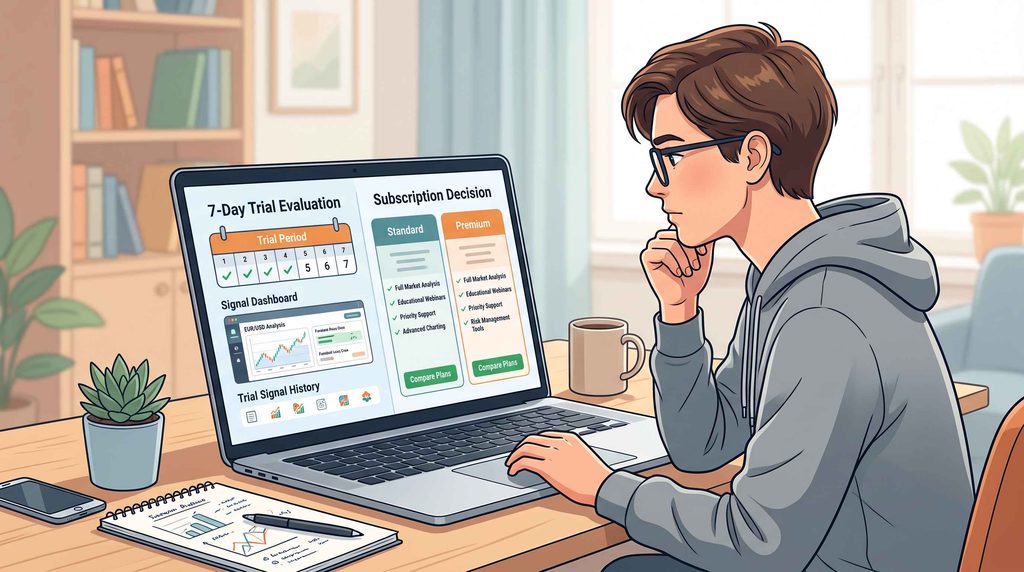
The most obvious benefit of a free trial is simple:
You can experience the service before paying for it.
Imagine you subscribe to a six-month service without testing it first.
After a few days, you discover that:
- The signals arrive at inconvenient times
- The instructions are difficult to understand
- There are too many alerts
- There are too few alerts
- The service doesn’t cover the pairs you want
- The communication isn’t clear
- The educational material isn’t useful to you
You have already paid.
A free trial reverses that process.
You can first ask:
“Does this service actually work for the way I want to trade?”
Only then should you consider paying.
A Free Trial Is About Evaluating the Service – Not Chasing Profit

This is one of the most important points for beginners.
A seven-day trial should not be treated as a challenge to make as much money as possible.
That approach can lead to excessive risk.
For example, a beginner might think:
“I only have seven days, so I need to make as much profit as possible.”
That is exactly the wrong mindset.
Instead, use the trial to evaluate:
- Signal quality
- Signal clarity
- Delivery speed
- Trading methodology
- Risk information
- Educational support
- Customer experience
- Overall suitability
The objective is to gather information.
You are testing the service, not trying to prove that you can become profitable in seven days.
What Should Beginners Look for During a 7-Day Trial?

A free trial is most useful when you know what to evaluate.
Here are the most important things to watch.
1. Are the Signals Clear?
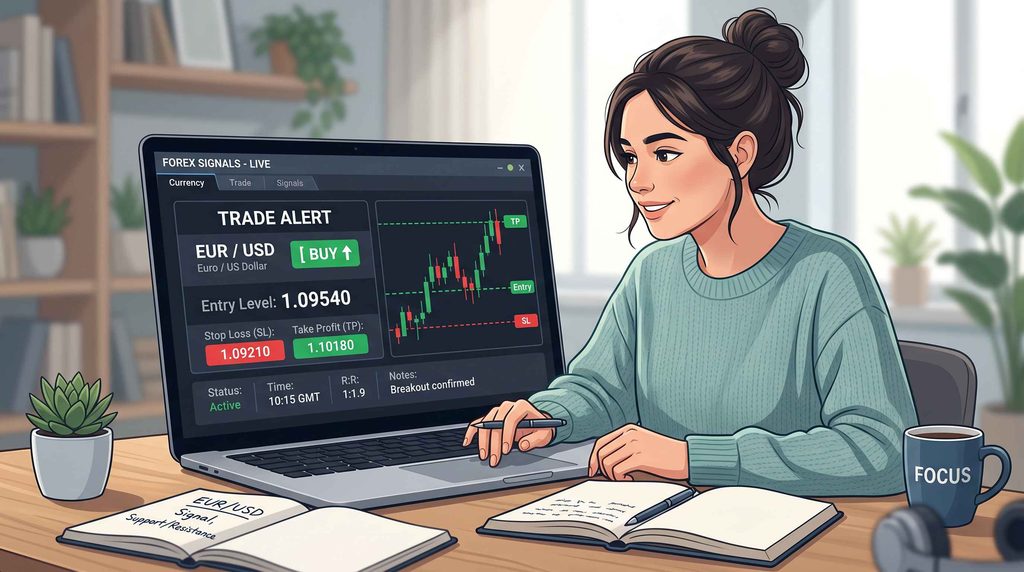
A good signal should be easy to understand.
For example, a beginner should be able to identify:
Currency pair: EUR/USD
Direction: Buy
Entry: Defined level
Stop Loss: Defined level
Take Profit: Defined level
The exact format varies, but the important information should be easy to find.
If you need to search through several messages just to understand what the signal means, the service may be difficult to use.
2. How Quickly Are Signals Delivered?

Timing matters in Forex trading.
If a signal is delivered late, the market price may already have moved significantly.
During your trial, pay attention to how signals are delivered.
Ask:
- Are alerts sent promptly?
- Are changes communicated clearly?
- Are cancelled or modified signals updated?
- Do you receive notifications through a convenient channel?
The purpose isn’t simply to count how many signals arrive.
You want to understand how practical the service is to use.
3. How Many Signals Do You Receive?
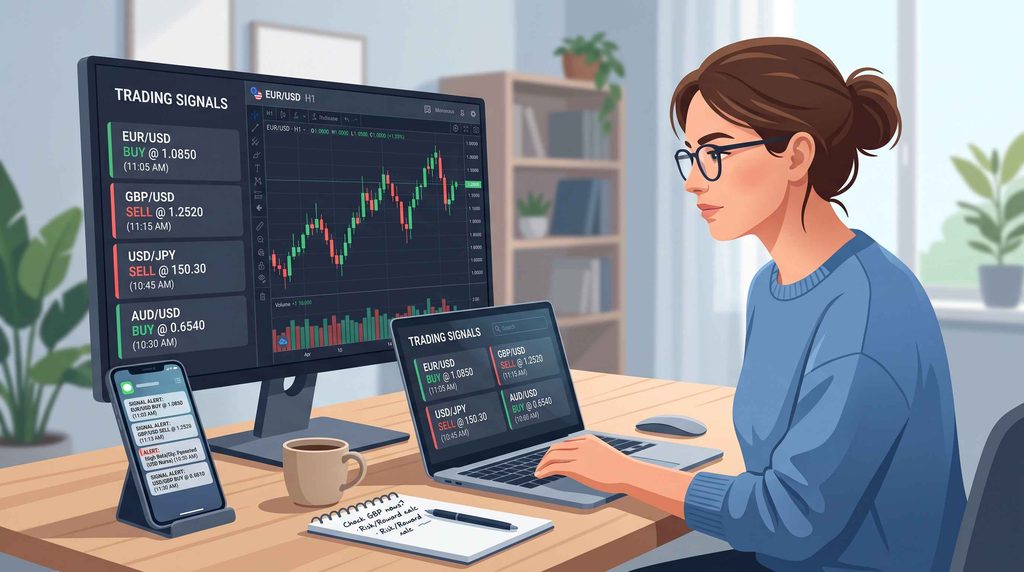
More signals do not automatically mean better service.
A beginner may actually find too many signals overwhelming.
During the seven-day trial, record:
- Number of signals
- Currency pairs used
- Time of day
- Signal frequency
- Whether multiple signals overlap
This can help you determine whether the service fits your trading schedule.
4. Which Currency Pairs Are Covered?

Different signal providers focus on different markets.
FXProfitBuilder provides signals for:
- EUR/USD
- GBP/USD
- USD/CHF
This focused approach means users are not necessarily expected to monitor every currency pair available in the Forex market.
During a free trial, check whether the provider covers the pairs you are interested in.
5. Does the Provider Explain Risk?

A responsible trading service should not make you believe that every signal will be profitable.
Instead, look for information about:
- Stop-loss levels
- Position sizing
- Risk per trade
- Market volatility
- Potential losses
- Trading discipline
Risk management matters because Forex trading can result in rapid losses, particularly when leverage is involved. The CFTC advises traders to determine how much risk capital they can afford and not to use money needed for living expenses or savings.
6. Is the Methodology Understandable?
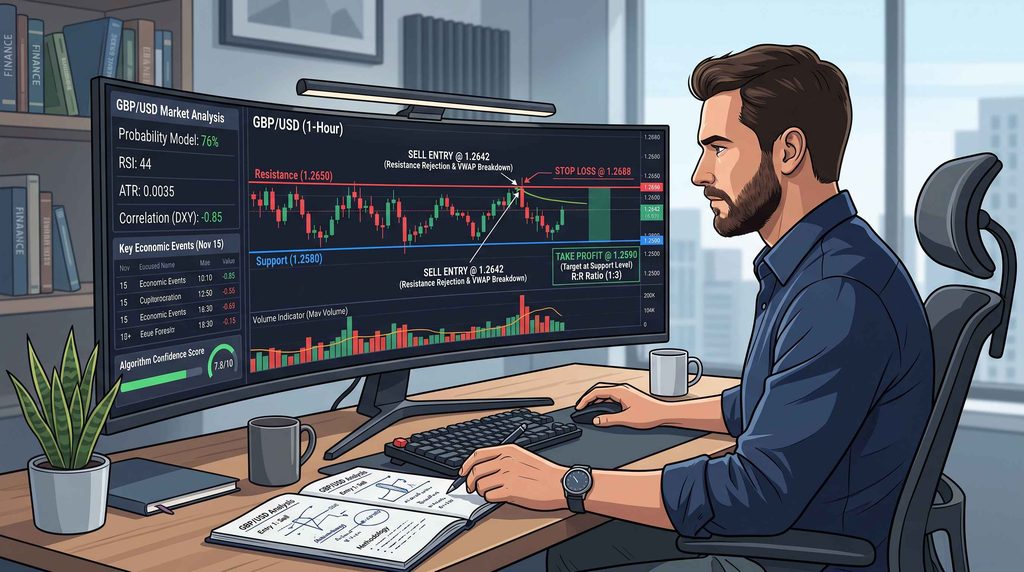
You do not necessarily need to know every technical detail behind a signal.
But you should be able to understand the general idea of how signals are produced.
For example, FXProfitBuilder states that its system uses tools including:
- Volume indicators
- Support and resistance analysis
- A mathematical model
The company describes its objective as simplifying the trading process by providing defined entry and exit points.
During a trial, this type of information can help beginners understand what they are actually subscribing to.
7. Is There Educational Support?

A signal can tell you what the setup is.
Education can help you understand why the setup exists.
For beginners, this distinction matters.
A useful trial should give you an opportunity to see whether the provider offers educational resources alongside its alerts.
Look for material covering subjects such as:
- Forex terminology
- Charts
- Entry and exit concepts
- Stop loss
- Take profit
- Risk management
- Trading psychology
- Position sizing
The more you understand, the less likely you are to treat signals as mysterious instructions that must simply be followed blindly.
How a 7-Day Trial Can Save Beginners Money
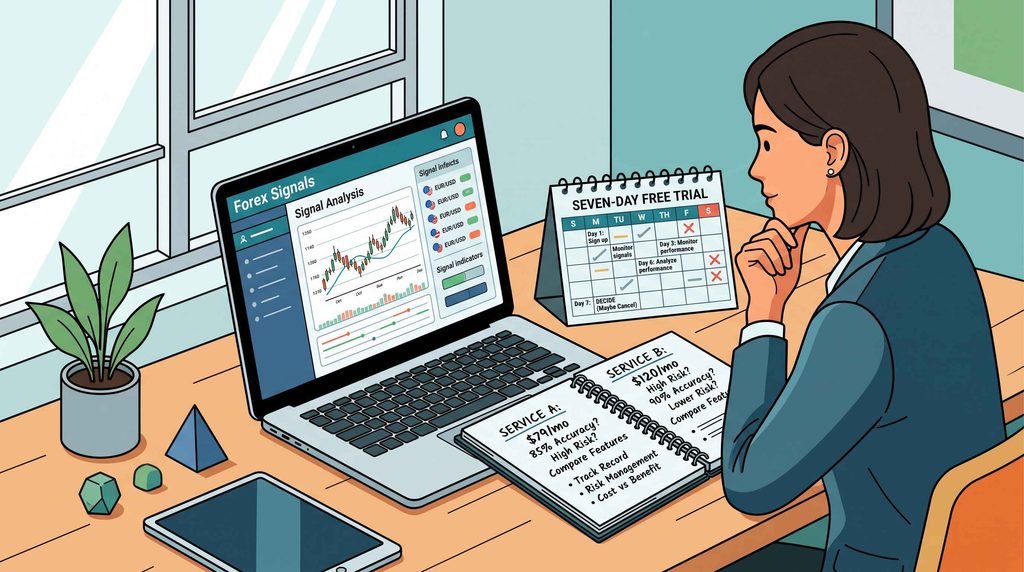
A free trial does not eliminate trading losses.
But it can potentially prevent a different type of financial mistake:
Paying for a service that you quickly discover isn’t suitable for you.
For example, suppose a beginner pays for a three-month subscription and discovers after three days that the service doesn’t suit their schedule.
The subscription has already been purchased.
With a free seven-day trial, that person can discover the mismatch before committing to a longer paid period.
This makes the trial valuable as a due-diligence opportunity.
The CFTC recommends researching the person or firm offering a trading product or strategy, understanding how it works and understanding the costs involved before participating.
How a Free Trial Can Save Beginners Time

The same principle applies to time.
Imagine testing several services individually without a free trial.
You might:
- Subscribe
- Learn the platform
- Learn the signal format
- Wait for signals
- Decide you don’t like the service
- Cancel
- Repeat the process with another provider
A free trial can make the initial evaluation much easier.
Within seven days, you can learn whether:
- Alerts fit your schedule
- The communication is easy to follow
- The trading pairs are relevant
- The signal format makes sense
- The educational content is useful
- The service is compatible with your preferred trading approach
That can save both time and unnecessary subscription costs.
Don’t Judge a Trial Only by Its Profit or Loss

This is probably the biggest mistake a beginner can make.
Suppose you receive several signals during your trial.
Some win.
Some lose.
That does not automatically tell you whether the service is good or bad.
Seven days is an extremely short period for evaluating a trading strategy.
Market conditions change.
A strategy can perform differently during trending markets, ranging markets, volatile sessions and major economic events.
The CFTC explicitly states that past results do not guarantee future success and warns that trading signals or automated systems cannot consistently predict the future.
Instead of asking:
“How much money did I make this week?”
ask:
“Did I understand the signals, and does this service fit my trading process?”
That is a much more useful question.
What Beginners Should Record During the Trial
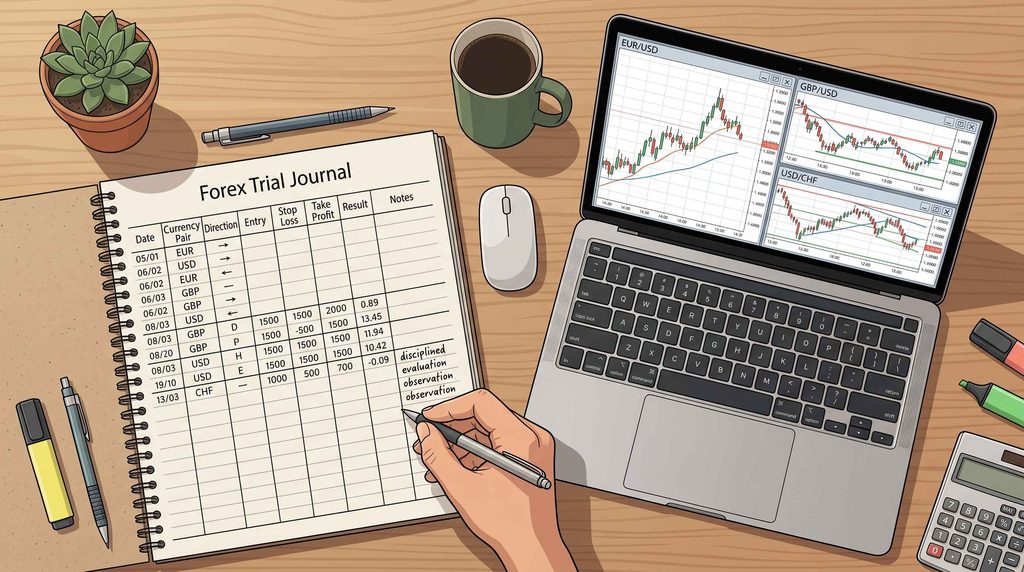
Keeping a simple trial journal can make the experience much more useful.
Create a basic table:
| Date | Pair | Direction | Entry | Stop Loss | Take Profit | Result | Notes |
| Day 1 | EUR/USD | Buy | Signal level | Signal level | Signal level | — | Easy to understand |
| Day 2 | GBP/USD | Sell | Signal level | Signal level | Signal level | — | Alert arrived quickly |
| Day 3 | USD/CHF | Buy | Signal level | Signal level | Signal level | — | Reviewed risk first |
You can add your own observations.
For example:
- Was the alert easy to understand?
- Did you have enough time to react?
- Did you understand the risk?
- Did the trade fit your strategy?
- Did you feel pressured to enter?
- Did the provider explain changes?
At the end of seven days, you’ll have something much more useful than a screenshot of one winning trade.
Seven Things to Test During Your Free Trial

A simple checklist can make the trial easier.
Day 1 – Understand the Service
Learn how signals are delivered and where to find the trading instructions.
Day 2 – Study the Signal Format
Understand the currency pair, entry, stop loss and take profit.
Day 3 – Evaluate Timing
Check how quickly alerts arrive and whether updates are communicated clearly.
Day 4 – Review Risk Management
Understand how much risk you would actually take on each trade.
Day 5 – Evaluate Education
Explore training material and see whether it helps you understand the strategy.
Day 6 – Assess Convenience
Ask whether the service fits around your work, studies or other commitments.
Day 7 – Make an Evaluation
Review the entire experience rather than focusing on one winning or losing trade.
Should You Trade Real Money During a Free Trial?
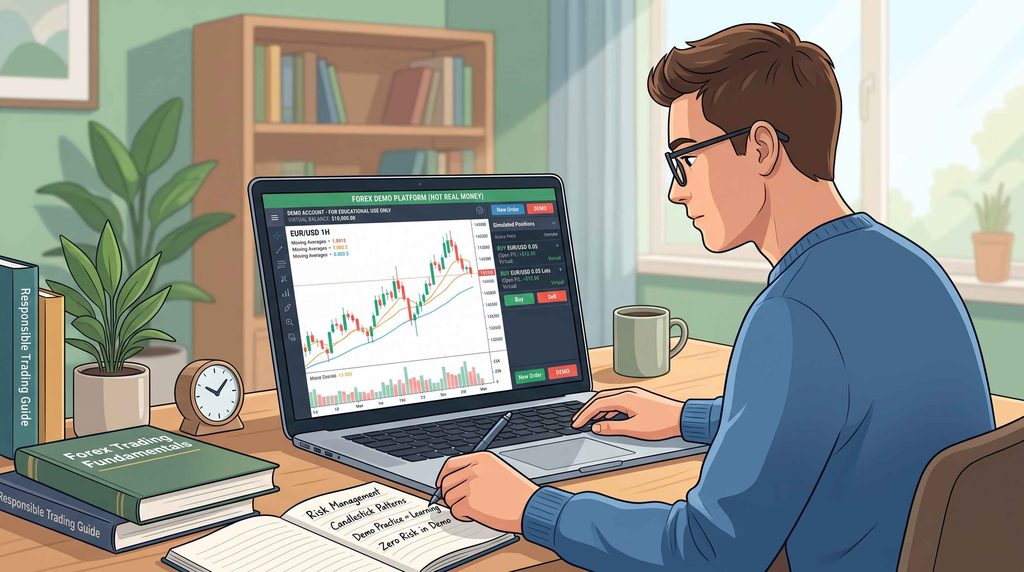
Not necessarily.
For a complete beginner, a free trial can first be used to observe signals and practise on a demo account.
This allows you to understand how the service works without immediately putting real capital at risk.
The CFTC specifically notes that demo platforms can allow people to practise without the risk of losing money.
If you eventually decide to trade with real money, you should understand the risks and only use money you can afford to lose.
A free trial is not a reason to rush into live trading.
Why FXProfitBuilder’s Trial Approach Can Be Useful
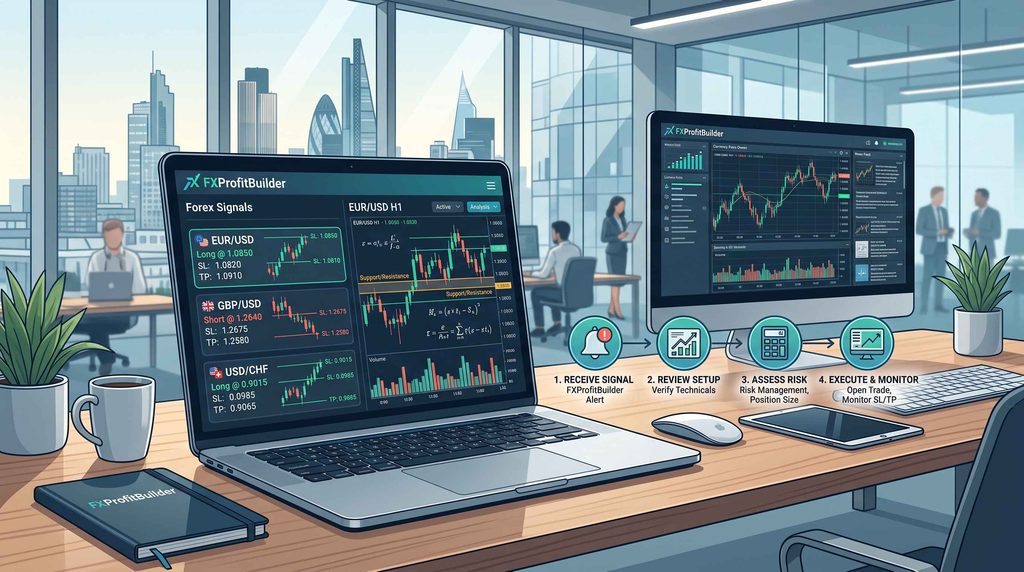
FXProfitBuilder’s signal system is designed around providing structured Forex alerts rather than requiring users to perform every part of the market analysis themselves.
The service focuses on three currency pairs:
- EUR/USD
- GBP/USD
- USD/CHF
Its stated methodology uses volume indicators, support and resistance analysis and a mathematical model to develop signals.
The alerts can be followed manually or mechanically, depending on how a trader chooses to use the system.
For a beginner, a trial period can therefore be useful for understanding the practical workflow:
Receive signal → Review setup → Assess risk → Decide whether to trade → Monitor the position
It also gives the user an opportunity to explore the educational material and determine whether the overall approach is easy to understand.
The key point is that the trial should be used to evaluate the service, not to assume that every signal will generate a profit.
Questions to Ask Before Paying After the Trial

When your seven days are over, don’t automatically subscribe.
Ask yourself:
Did I understand the signals?
If the instructions were confusing, investigate why.
Did the service fit my schedule?
A signal service is only useful if you can realistically monitor and act on alerts when appropriate.
Was the risk clearly explained?
You should understand how much money could be lost before committing capital.
Did I understand what I was paying for?
Know exactly what the subscription includes.
Is the price reasonable for my situation?
A subscription should fit comfortably within your budget.
Am I subscribing because I understand the service?
Or are you subscribing because you saw a few winning trades?
That distinction matters.
Red Flags During a Free Forex Signals Trial
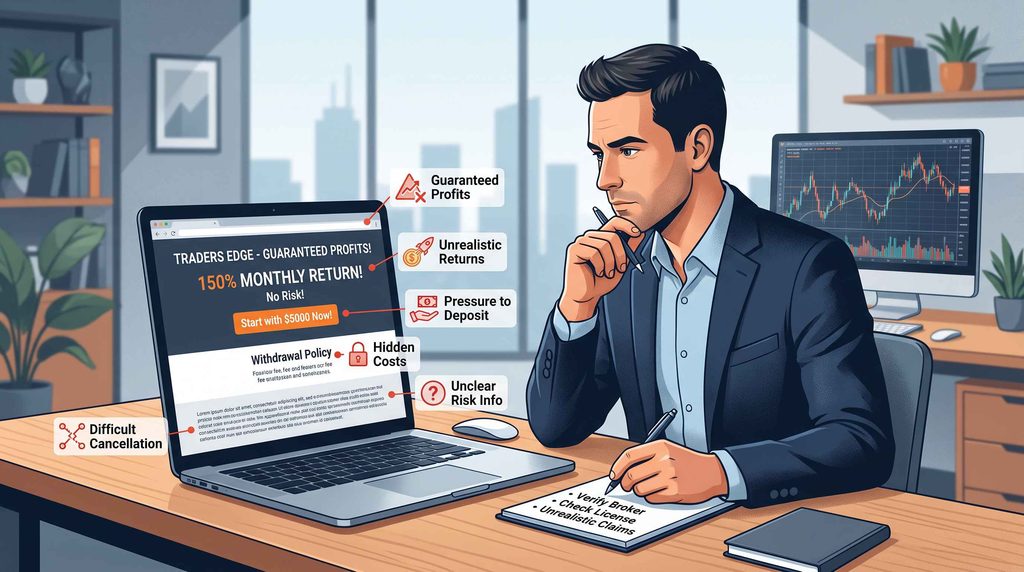
A free trial should make you more informed, not pressured.
Be cautious if a provider:
- Promises guaranteed profits
- Claims that losses are impossible
- Pressures you to deposit money immediately
- Uses unrealistic profit claims
- Hides subscription costs
- Makes cancellation difficult
- Refuses to explain basic risk information
- Pressures you to increase your trading size
- Focuses entirely on screenshots of winning trades
- Tells you that you must act immediately or miss your chance
The FCA warns that forex and online trading scams can use promises of very high or guaranteed returns and recommends checking whether relevant firms are authorised and using the FCA’s Firm Checker where applicable.
The CFTC similarly warns against limited-time pressure, promises of easy money and claims suggesting guaranteed returns.
A free trial itself is not proof that a provider is legitimate.
The provider still needs to be researched.
Free Trial vs Paying Immediately
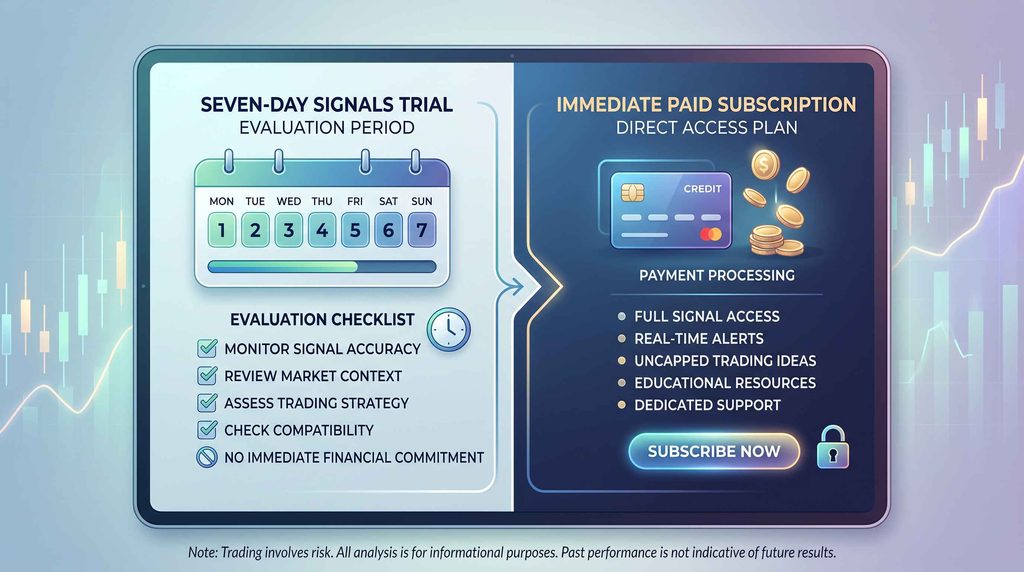
| Factor | 7-Day Free Trial | Immediate Subscription |
| Initial subscription cost | Usually none | Required |
| Experience the signal format | Yes | Yes |
| Evaluate delivery | Yes | Yes |
| Test whether it fits your schedule | Yes | Yes |
| Financial commitment | Lower initially | Higher initially |
| Ability to assess service before paying | Higher | Lower |
| Trading risk | Still exists if trading | Still exists |
| Guaranteed profit | No | No |
The biggest difference is simply the opportunity to evaluate the service before making a longer financial commitment.
Is a 7-Day Free Forex Signals Trial Right for Every Beginner?

Not necessarily.
Some traders may prefer to learn Forex independently.
Others may want to use a demo account first.
Some may already have enough trading experience to evaluate a service without needing a trial.
A free trial is simply one evaluation method.
For beginners who are considering a signals subscription, however, it can be a practical way to understand the service before paying.
Final Thoughts

A 7-day free Forex signals trial can be a sensible starting point because it lets beginners experience a signals service before making a longer-term financial commitment.
The biggest benefit isn’t the possibility of making money during those seven days.
It is the opportunity to learn.
You can discover:
- How signals are delivered
- How frequently alerts arrive
- Whether the instructions are clear
- Which currency pairs are covered
- How risk is communicated
- Whether educational support is available
- Whether the service fits your lifestyle
- Whether the subscription appears to provide value for you
For FXProfitBuilder, a trial can also give potential users an opportunity to understand its approach to EUR/USD, GBP/USD and USD/CHF signals and see how its structured alerts fit into their own trading routine.
But remember: seven days cannot prove long-term profitability.
Use the trial as a research period, keep your risk controlled, consider using a demo account if you’re new to trading, and never treat a signal as a guarantee of profit.
The smartest part of a free trial is not trying to make the biggest return in seven days.
It’s making a better-informed decision before you pay.
FAQ
1. What is a 7-day free Forex signals trial?
It is a short introductory period that allows potential subscribers to experience a Forex signals service before paying for a subscription.
2. Is a 7-day Forex signals trial really free?
That depends on the provider. Always check the exact terms, including whether payment details are required, whether the subscription automatically renews and how cancellation works.
3. Can I make money during a free Forex signals trial?
It is possible to have profitable or losing trades, but a seven-day period cannot establish long-term profitability. Forex trading involves significant risk.
4. Should beginners trade real money during the trial?
Not necessarily. Beginners can use the trial to observe signals and practise using a demo account before considering live trading.
5. What should I look for during a Forex signals trial?
Look at signal clarity, delivery speed, currency pairs, entry and exit information, risk management, educational resources, customer support and overall ease of use.
6. How many signals should I expect during seven days?
There is no standard number. Different providers use different strategies and trading frequencies. More signals do not automatically mean better service.
7. Does a free trial prove that a Forex signals provider is reliable?
No. A trial lets you evaluate the service experience, but you should independently research the provider, its claims, pricing and relevant regulatory information.
8. Can I use Forex signals on a demo account?
Yes. Using a demo account can allow beginners to practise following signals without risking real trading capital. The CFTC specifically identifies demo platforms as a way to practise without the risk of losing money.
9. What happens after the 7-day trial?
This depends on the provider. Some trials end automatically, while others may convert into a paid subscription. Always check the terms before starting.
10. Does FXProfitBuilder provide signals for multiple currency pairs?
Yes. FXProfitBuilder provides signals for EUR/USD, GBP/USD and USD/CHF.
11. Can Forex signals guarantee profits?
No. No legitimate trading strategy can guarantee future profits. Regulators warn consumers to be cautious of services making guaranteed or unrealistic return claims.
12. Is a free trial better than paying immediately?
A free trial gives you an opportunity to evaluate the service before making a longer financial commitment. Whether it is suitable for you depends on your goals, experience, risk tolerance and the terms of the particular trial.
👉 Start your journey today—subscribe to our forex pip tips service and see the difference for yourself! Sign Up to get Exclusive Offers