GBP/USD Explained: How to Trade the ‘Cable’ Pair
Posted On - October 26, 2026 | By - FXProfitBuilder | Categories - Currency Pairs (EUR/USD, GBP/USD, USD/CHF)
Introduction

When learning Forex trading, you’ll quickly discover that some currency pairs have their own nicknames. One of the best-known is Cable, the traditional name for GBP/USD.
GBP/USD represents the exchange rate between the British pound sterling and the US dollar. It is one of the major Forex pairs, attracting traders who want to follow the relationship between the UK and US economies.
But Cable is known for more than its long history. It can experience sharp price movements around economic announcements, central bank decisions and political developments. These movements can create trading opportunities, but they can also increase the risk of losses.
So, how does GBP/USD work? Why is it called Cable? What makes its price rise or fall, and how can beginners develop a structured approach to trading it?
In this guide, we’ll cover the fundamentals of GBP/USD, its main price drivers, the most active trading sessions, common trading strategies, risk-management techniques and how Forex signals can fit into a trading routine.
What Is GBP/USD?
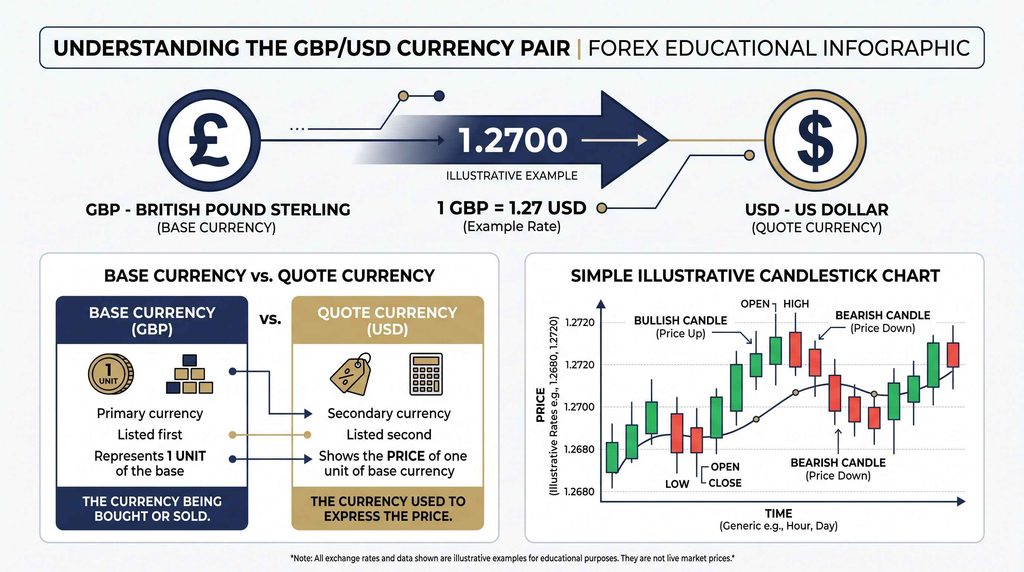
GBP/USD is a currency pair that tells you how many US dollars are required to buy one British pound.
The pair consists of two currencies:
- GBP: British pound sterling, the base currency.
- USD: US dollar, the quote currency.
For example, if GBP/USD is quoted at 1.2700, one British pound is worth 1.27 US dollars at that exchange rate.
The price changes as demand for the pound and dollar changes relative to one another.
What happens when GBP/USD rises?
Suppose GBP/USD rises from 1.2700 to 1.2800.
The pound has strengthened against the dollar, or the dollar has weakened against the pound.
A trader who bought the pair at 1.2700 and closed at 1.2800 would have benefited from the 100-pip increase, before trading costs.
What happens when GBP/USD falls?
Suppose GBP/USD drops from 1.2700 to 1.2600.
The pound has weakened relative to the dollar, or the dollar has strengthened relative to the pound.
A trader who sold the pair at 1.2700 and closed at 1.2600 would have benefited from the 100-pip decline, before costs.
These examples illustrate how price movements work. They do not predict future exchange rates, and a real trade can incur losses even when a trader’s broader market analysis appears reasonable.
Why Is GBP/USD Called the ‘Cable’ Pair?

The nickname Cable comes from the transatlantic telegraph cable that connected Britain and North America in the nineteenth century.
The cable helped transmit exchange-rate information between London and New York. Over time, the term became associated with the pound-dollar exchange rate itself.
Although modern Forex markets rely on electronic trading and communications systems, traders still use the traditional nickname.
You may hear phrases such as:
- “Cable is moving higher.”
- “Cable broke through resistance.”
- “Cable is reacting to UK inflation data.”
- “Cable is volatile ahead of the Federal Reserve announcement.”
These phrases all refer to GBP/USD.
Understanding common Forex terminology makes it easier to follow market commentary, educational material and trading discussions.
Why Do Traders Watch GBP/USD?
GBP/USD is popular because it connects two major currencies and responds to a wide range of economic and financial developments.
Here are some of the main reasons traders follow Cable.
1. Significant Trading Activity
GBP/USD is one of the major currency pairs and attracts participation from banks, institutions, businesses and individual traders.
Its substantial trading activity can support competitive spreads and relatively deep liquidity during active market hours.
However, liquidity varies throughout the day. Spreads can widen around major announcements, during quieter periods and when unexpected events disrupt the market.
2. Opportunities to Study Price Movements
Cable can experience pronounced intraday movements, especially when economic news changes expectations about interest rates or economic growth.
Some traders prefer these larger movements because they provide more room for price fluctuations. But larger movements do not automatically produce better trading opportunities.
A sharp move can also trigger Stop Loss orders, cause slippage and produce rapid reversals.
3. Clear Economic Drivers to Follow
GBP/USD is influenced by developments in both the United Kingdom and the United States.
Traders can monitor information such as:
- Bank of England interest rate decisions.
- US Federal Reserve policy announcements.
- UK inflation and employment figures.
- US inflation and employment reports.
- Economic growth in both countries.
- Changes in government policy and market sentiment.
These factors provide a framework for understanding why Cable may move, although the direction is not always predictable.
4. Extensive Educational Resources
GBP/USD is widely covered in Forex analysis, trading courses, financial news and market commentary.
Beginners can find explanations of its price behaviour, historical movements and common strategies.
Nevertheless, access to information does not remove trading risk. It is important to evaluate claims carefully and develop a repeatable approach rather than relying on predictions alone.
What Makes GBP/USD Move?
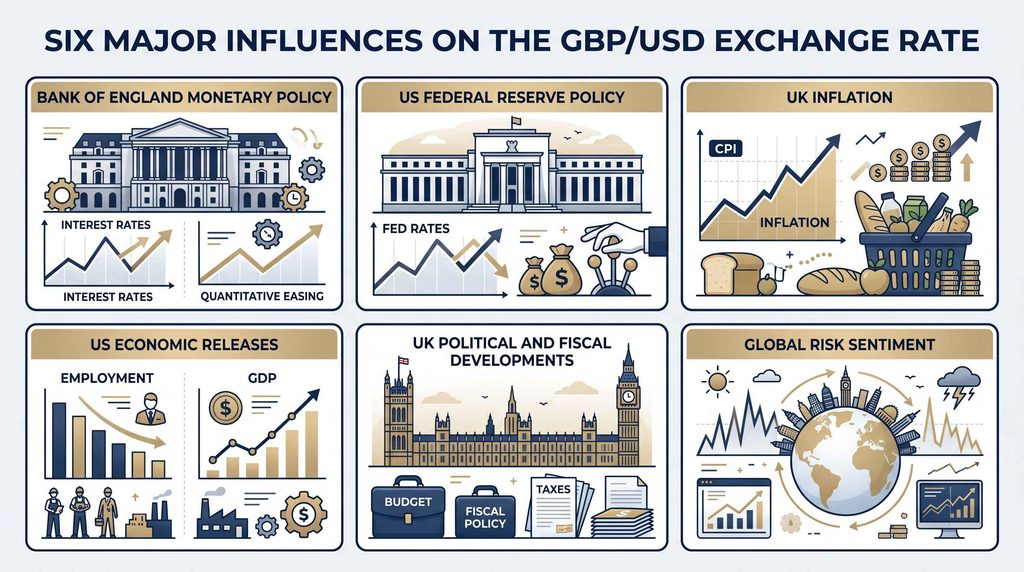
To understand Cable, you need to look at both sides of the pair.
A stronger pound can push GBP/USD higher, while a stronger dollar can push it lower. Sometimes both currencies strengthen or weaken at the same time, and the exchange rate reflects their relative performance.
1. Bank of England Interest Rate Decisions
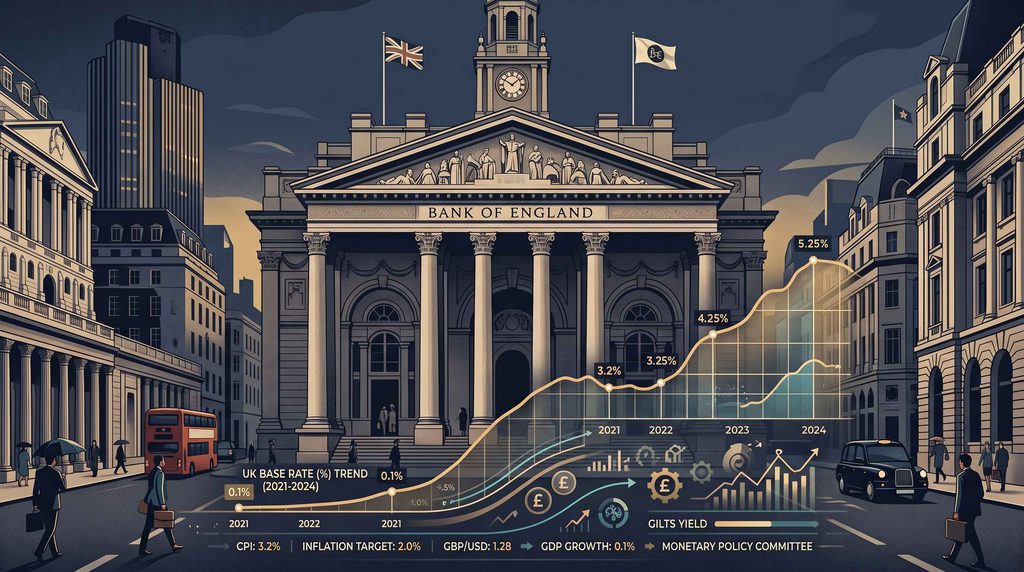
The Bank of England (BoE) sets monetary policy for the United Kingdom.
Its interest rate decisions can affect expectations about the pound because they influence borrowing costs, savings returns, inflation expectations and investment decisions.
For example, if markets expect UK interest rates to remain higher relative to US rates, sterling may receive support, all else being equal.
On the other hand, if markets expect the Bank of England to reduce interest rates more quickly than anticipated, the pound may come under pressure.
The market reaction depends heavily on expectations. A rate increase does not guarantee that GBP/USD will rise if traders were expecting an even more hawkish decision.
2. US Federal Reserve Policy
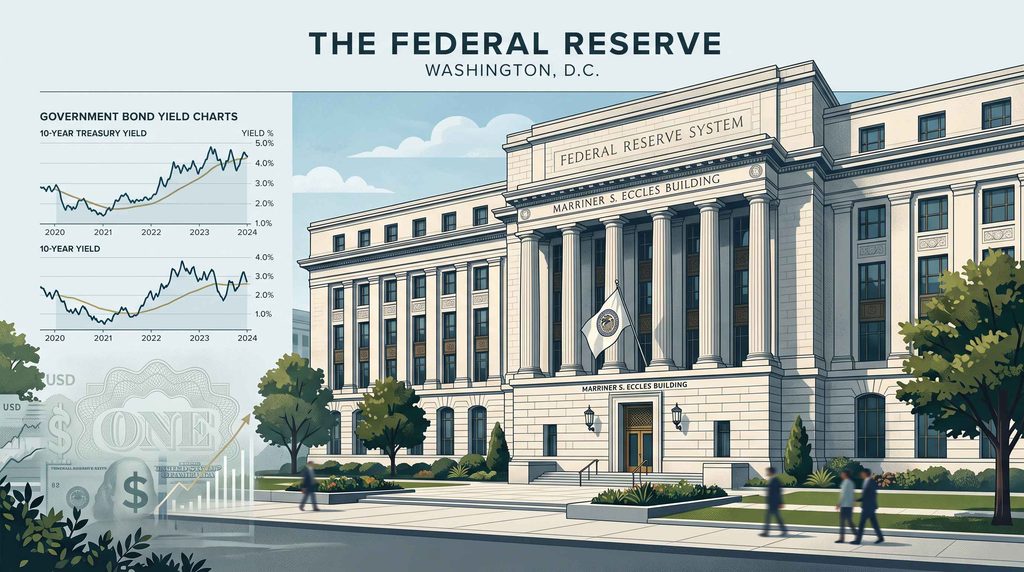
The Federal Reserve is a major influence on the US dollar.
Its monetary policy decisions affect US interest rates, bond yields, financial conditions and expectations for the American economy.
If the Federal Reserve signals that interest rates may remain higher for longer than markets expected, the dollar may strengthen, potentially putting downward pressure on GBP/USD.
If expectations shift toward lower US interest rates, the dollar may weaken, potentially supporting Cable.
However, the pound’s own outlook matters too. A change in US policy can have a different effect depending on what is happening in the UK at the same time.
3. UK Inflation Data
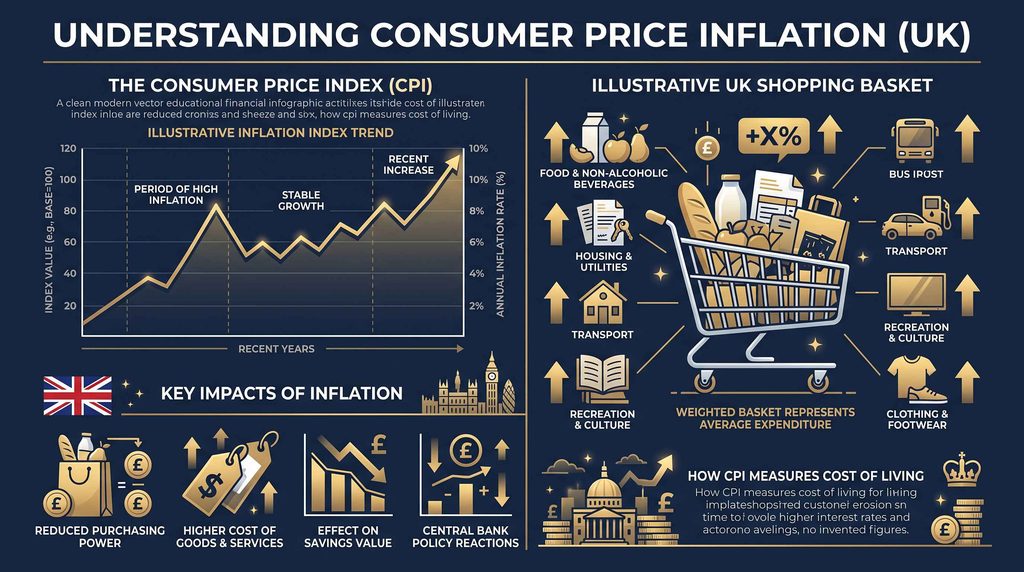
Inflation measures how quickly prices are rising across the economy.
UK Consumer Price Index (CPI) data can influence expectations about future Bank of England decisions.
Suppose UK inflation comes in above expectations. Traders may reassess the likelihood of interest rate cuts, which could support sterling.
If inflation falls more sharply than anticipated, markets may increase their expectations of monetary easing, potentially weighing on the pound.
These are possible reactions, not guaranteed outcomes. The figures need to be interpreted alongside wages, economic growth, central bank guidance and market expectations.
4. US Economic Releases
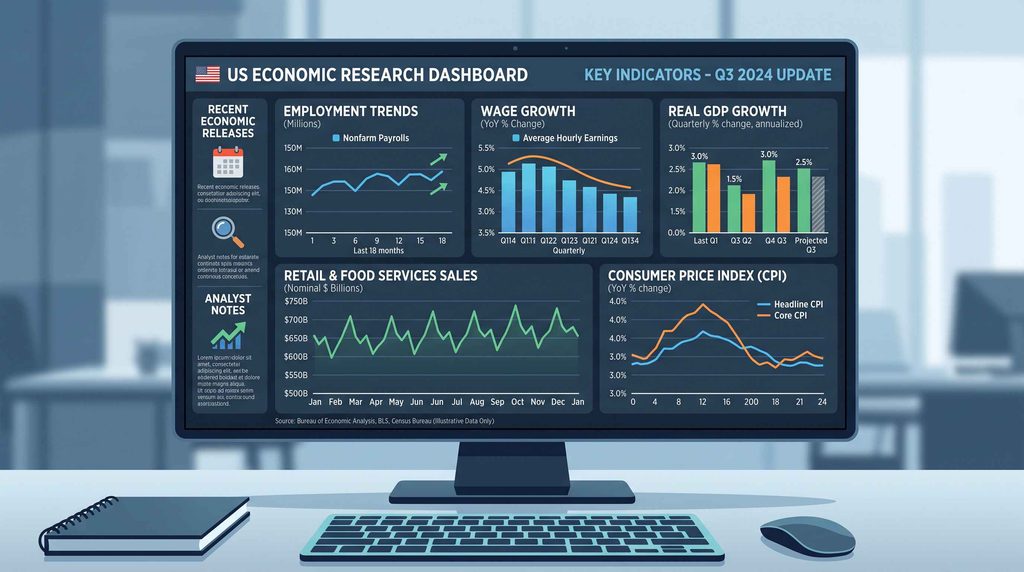
Important US data can move GBP/USD even when the UK economic calendar is quiet.
Traders commonly watch:
- US Consumer Price Index (CPI).
- Nonfarm payrolls.
- Unemployment and wage growth.
- Gross Domestic Product (GDP).
- Retail sales.
- Purchasing Managers’ Index (PMI) reports.
Stronger-than-expected US data can support the dollar if it changes expectations for Federal Reserve policy. Weaker-than-expected data may have the opposite effect.
The reaction depends on what the market expected before the release and how the figures affect the broader economic outlook.
5. UK Political and Fiscal Developments
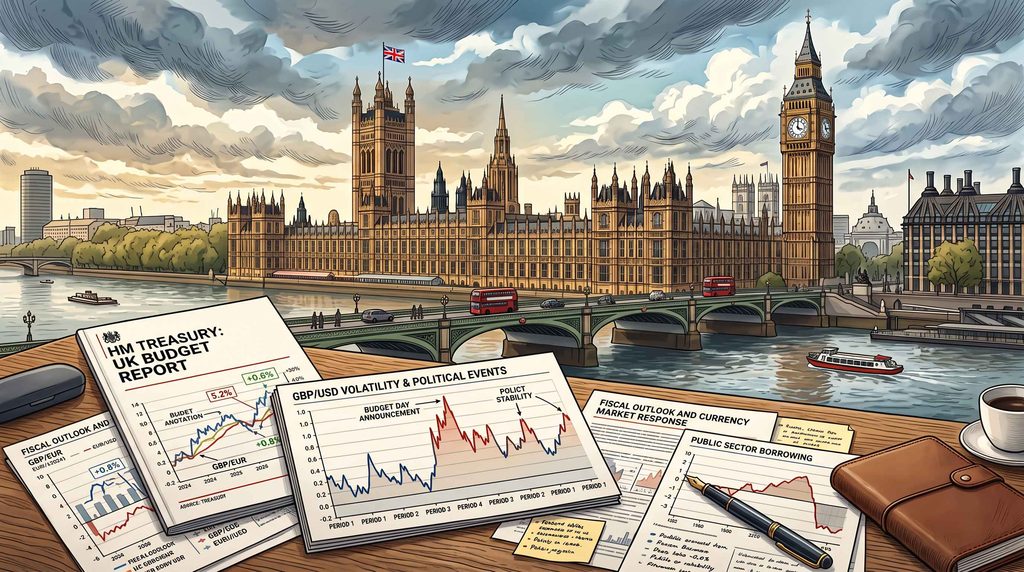
GBP/USD can react to political uncertainty, government budgets, tax announcements, fiscal plans and changes in expectations about the UK’s economic outlook.
Events that influence investor confidence or expectations for government borrowing can affect sterling.
The Brexit referendum in 2016 is a well-known historical example of a political event causing a major repricing of the pound.
The lesson is that currency markets respond not only to scheduled economic releases but also to unexpected developments that change how investors assess a country’s prospects.
6. Global Risk Sentiment

The US dollar often attracts demand during periods of heightened global uncertainty, although its response varies depending on the circumstances.
If investors seek greater exposure to perceived safe-haven assets, the dollar may strengthen relative to sterling. In other market environments, movements can be different.
When Is the Best Time to Trade GBP/USD?
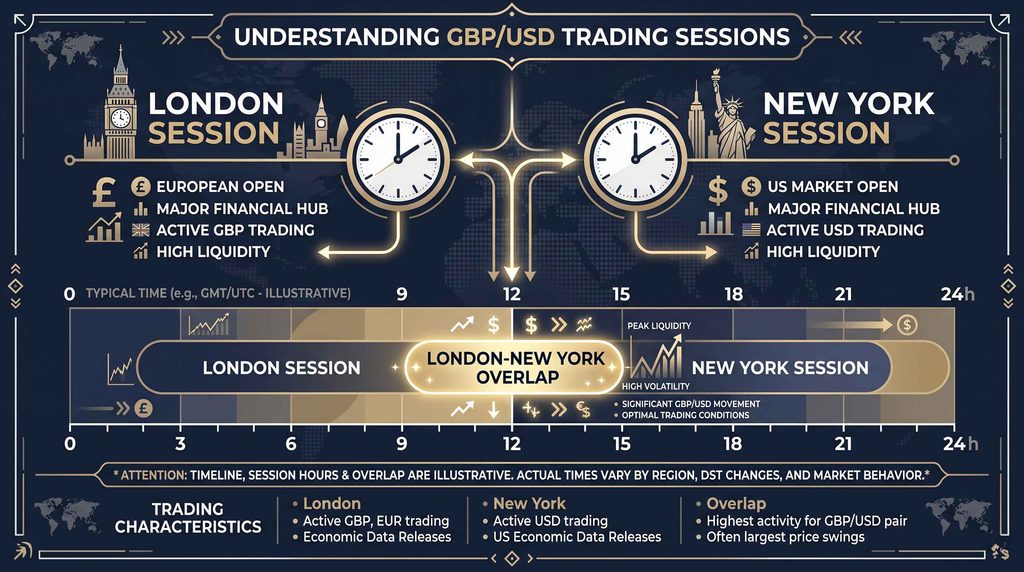
GBP/USD can be traded during most of the Forex trading week, but trading conditions vary throughout the day.
Two periods deserve particular attention: the London session and the overlap between London and New York.
The London Session
London is a major centre for global foreign exchange trading.
During UK market hours, traders respond to British economic releases, European market developments and changes in expectations for Bank of England policy.
This period may suit traders who monitor UK data or prefer to analyse Cable during active European hours.
The New York Session
The New York session brings substantial US market participation.
US inflation, employment and central bank news can produce significant movements in GBP/USD.
If the dollar strengthens following an unexpected economic release, Cable may fall. If the dollar weakens, the pair may rise, although the pound’s own performance also matters.
The London–New York Overlap
The period when London and New York are both active often offers substantial trading activity in GBP/USD.
More market participants are available during this overlap, but increased activity can also mean faster price changes.
The exact overlap hours vary with daylight-saving changes in the UK and United States. Check the current session times and your local time zone rather than assuming the hours remain fixed all year.
Should beginners trade during major announcements?
Not necessarily.
Economic announcements can create rapid price changes, wider spreads and slippage. Price may initially move in one direction before reversing as traders interpret the full release.
If you are still learning, consider observing major announcements or practising on a demo account before deciding whether news trading fits your approach.
How to Analyse GBP/USD Before Entering a Trade
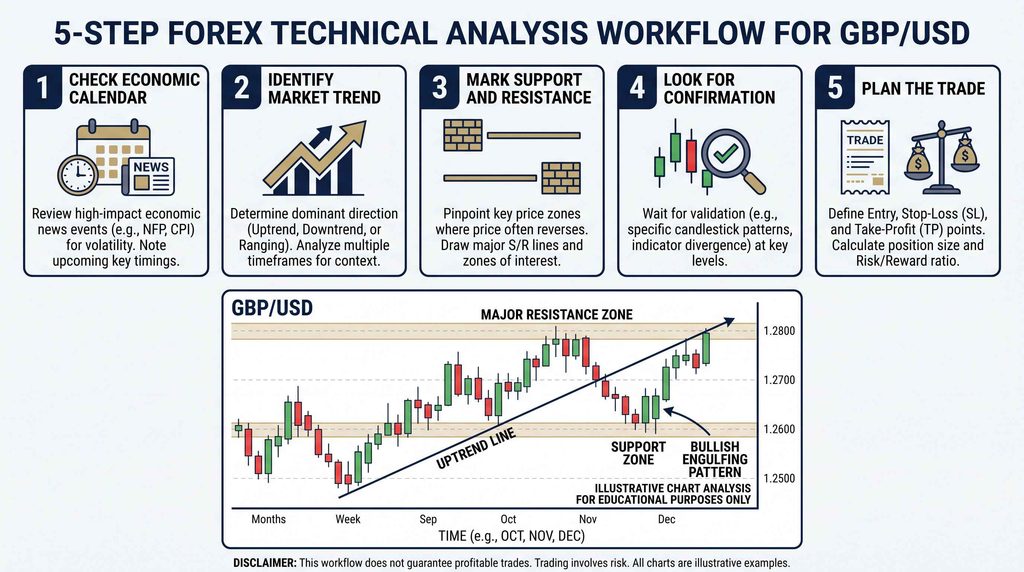
A structured analysis process can help you avoid impulsive decisions.
Rather than relying on a single indicator or prediction, consider the following steps.
Step 1: Check the Economic Calendar
Look for upcoming UK and US releases that could affect Cable.
Prioritise Bank of England and Federal Reserve announcements, inflation figures, employment reports and major growth data.
Before entering a trade, consider whether an important announcement is approaching and whether your strategy is designed to handle the potential volatility.
Step 2: Identify the Market Trend
Study the chart to determine whether GBP/USD appears to be trending higher, trending lower or moving sideways.
Some traders use a higher timeframe to understand the broader market structure and a lower timeframe to examine potential entry points.
For example, a four-hour chart may help show the wider trend, while a fifteen-minute chart may help examine a short-term setup.
Step 3: Mark Support and Resistance
Support is a price area where buying interest has previously appeared. Resistance is an area where selling pressure has previously emerged.
These areas can help traders organise their analysis, but they are not guaranteed turning points.
A trader might look for a possible buy setup near support if the market shows signs of recovery. Near resistance, the trader might watch for a rejection or a breakout.
The important point is to wait for a defined setup rather than assuming that price must reverse at a particular level.
Step 4: Look for Confirmation
Depending on the strategy, confirmation might include a candlestick pattern, a change in momentum, a break of market structure or a successful retest of a price level.
No confirmation method works in every market condition.
A useful approach is to define your entry conditions in advance and test them consistently rather than changing the rules after every trade.
Step 5: Plan the Trade
Before placing an order, establish:
- The intended entry price or entry zone.
- The Stop Loss level.
- The Take Profit target or exit conditions.
- The position size.
- The amount of capital at risk.
- The reason for entering the trade.
A written plan helps ensure that the decision is based on a repeatable process rather than fear of missing out.
Three Common GBP/USD Trading Strategies
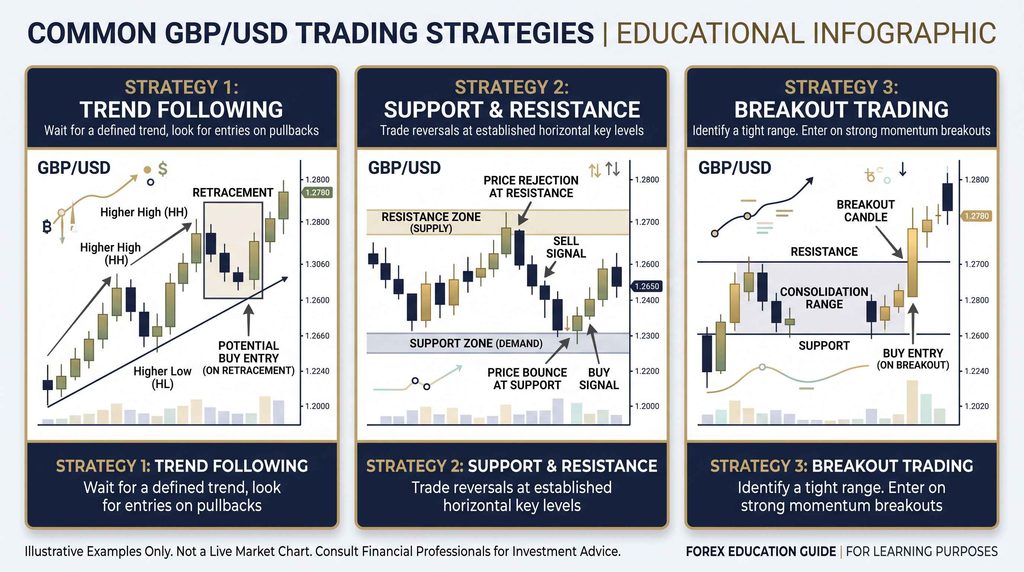
Different strategies may suit different market conditions. None is guaranteed to work, and any approach should be tested before being used with real money.
1. Trend-Following Strategy
Trend-following traders try to participate in sustained price movements.
For example, if Cable is making higher highs and higher lows, a trader may look for a potential buying opportunity after a pullback.
Possible tools include moving averages, trend lines and market structure.
The main challenge is distinguishing a genuine trend from a temporary movement. Trend-following strategies may also struggle during sideways markets.
2. Support and Resistance Strategy
This approach focuses on areas where price has previously encountered buying or selling pressure.
A trader may wait for GBP/USD to approach a support zone and then look for evidence of a possible rebound.
Alternatively, a trader may watch for a breakout above resistance and assess whether price can hold above the former level.
False breakouts are possible, especially around major economic announcements. A price level should therefore be part of a wider trading plan, not a reason to enter automatically.
3. Breakout Strategy
A breakout strategy looks for price to move beyond an established range or important market level.
For example, Cable may trade within a narrow range before a major economic release. If price subsequently breaks above the range, a trader might assess whether the movement has sufficient confirmation to justify a potential trade.
However, breakouts can fail. Price may briefly move beyond a level before returning to the original range.
Traders should account for the possibility of false breakouts, slippage and rapid reversals.
How Forex Signals Can Help You Follow GBP/USD
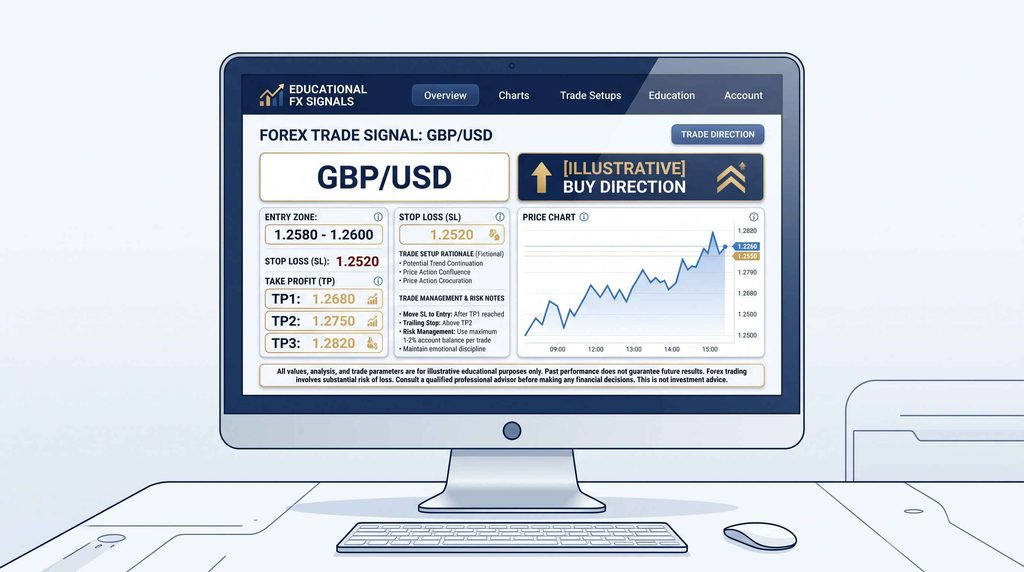
Some traders perform all their market analysis independently. Others use Forex signals as one input in their decision-making process.
A structured Forex signal may include:
- The currency pair.
- Buy or Sell direction.
- Entry price or entry zone.
- Stop Loss.
- Take Profit.
- Trade management instructions.
These details can help a trader understand the proposed setup and assess whether it fits their own trading plan.
However, signals are not guaranteed predictions. A signal can become outdated if the market moves before the trader receives or acts on it.
Before following a signal, understand the planned risk, check the current market price and determine whether the position size is appropriate for your account.
How FXProfitBuilder approaches GBP/USD
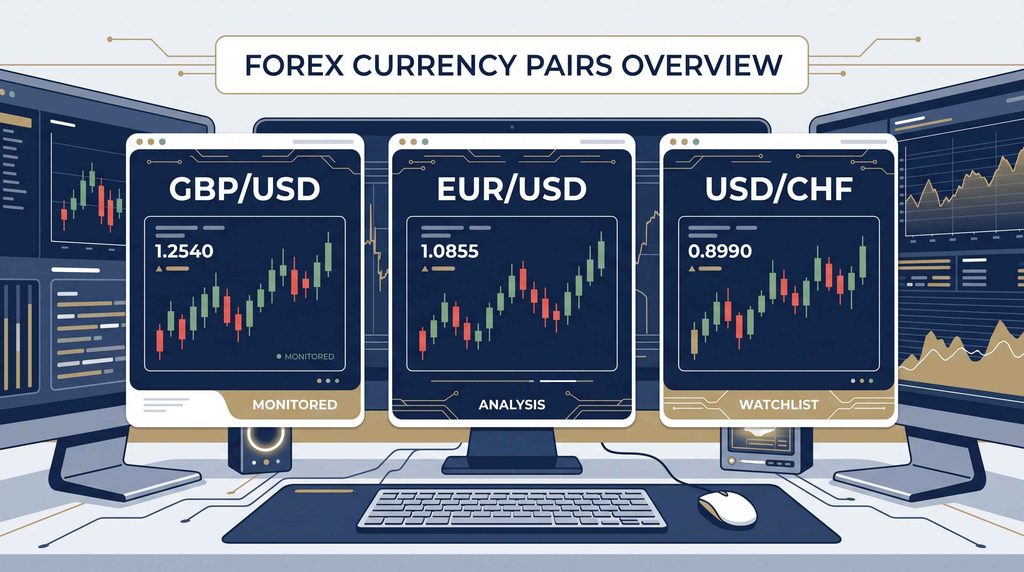
FXProfitBuilder provides Forex signals for three currency pairs:
- EUR/USD
- GBP/USD
- USD/CHF
The company describes its approach as combining volume indicators, support and resistance analysis, and a mathematical model to identify potential trading opportunities. Its signals provide entry and exit guidance and can be followed manually or mechanically.
For traders interested in GBP/USD, it is worth reviewing how the signals are delivered, what trade management guidance is provided, how the methodology is explained and whether the service fits their schedule.
As with any signal provider, review the current service information, pricing and terms before subscribing. A description of a trading methodology is not independent proof of profitability, and no signal service can eliminate market risk.
Risk Management: Why Cable Requires Careful Planning
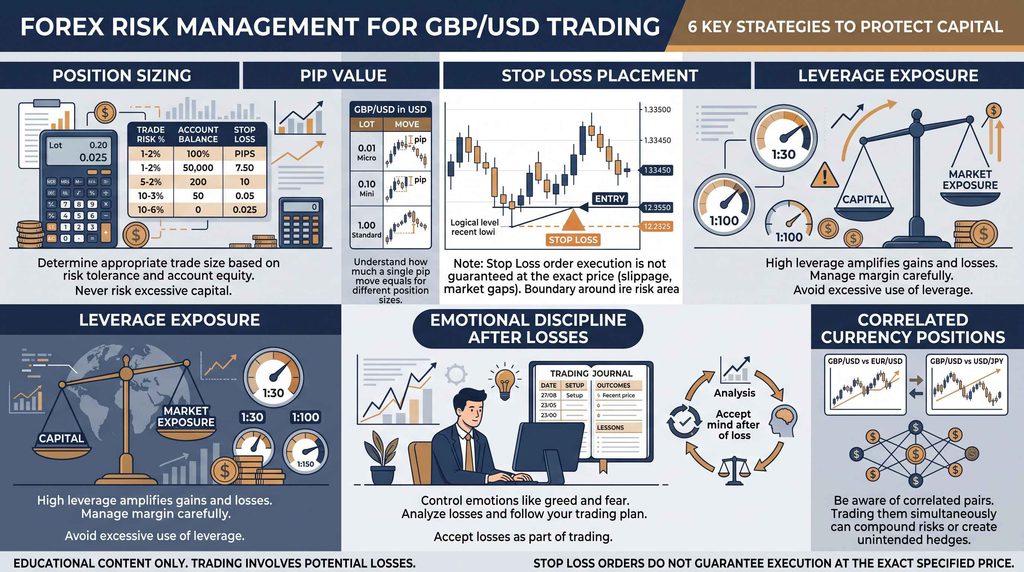
GBP/USD can make sharp moves, particularly around economic news and unexpected political developments.
This means risk management is essential.
1. Choose a Sensible Position Size
Position size determines how much your profit or loss changes for a given price movement.
A larger position magnifies both favourable and unfavourable results. Choose a position size based on your account, Stop Loss distance and predefined risk limit.
Do not increase your position simply because you expect Cable to move strongly.
2. Understand Pip Value
For most GBP/USD quotes, one pip is 0.0001.
For a standard lot of 100,000 GBP, one pip is typically worth about $10 when the profit-and-loss currency is USD. A mini lot of 10,000 GBP is typically worth about $1 per pip, and a micro lot of 1,000 GBP about $0.10 per pip.
These are approximate values. The precise result depends on the position, account currency, broker and contract specifications.
3. Use Stop Losses Thoughtfully
A Stop Loss defines the price at which you intend to exit a losing position.
However, it does not guarantee an exact execution price. During fast markets, gaps or slippage may cause an order to fill at a less favourable price.
Set the Stop Loss according to the trading setup and calculate the position size accordingly.
4. Be Careful With Leverage
Leverage allows traders to control positions larger than the funds they deposit.
This can magnify gains, but it can also magnify losses. A relatively small movement against a leveraged position can have a substantial effect on your account.
Never assume that Cable’s liquidity makes excessive leverage safe.
5. Avoid Revenge Trading
After a loss, traders sometimes increase their position size or enter another trade immediately to recover the money.
This behaviour can turn a manageable loss into a larger problem.
Review your plan, accept that losing trades are part of trading, and avoid making decisions based on frustration.
6. Account for Correlated Positions
GBP/USD and EUR/USD can move in the same direction because both pairs are influenced by the US dollar and broader market conditions.
If you open similar positions in both pairs, you may be taking more combined dollar-related risk than you realise.
Consider the total exposure across all open trades rather than assessing each position in isolation.
Common Mistakes to Avoid When Trading Cable
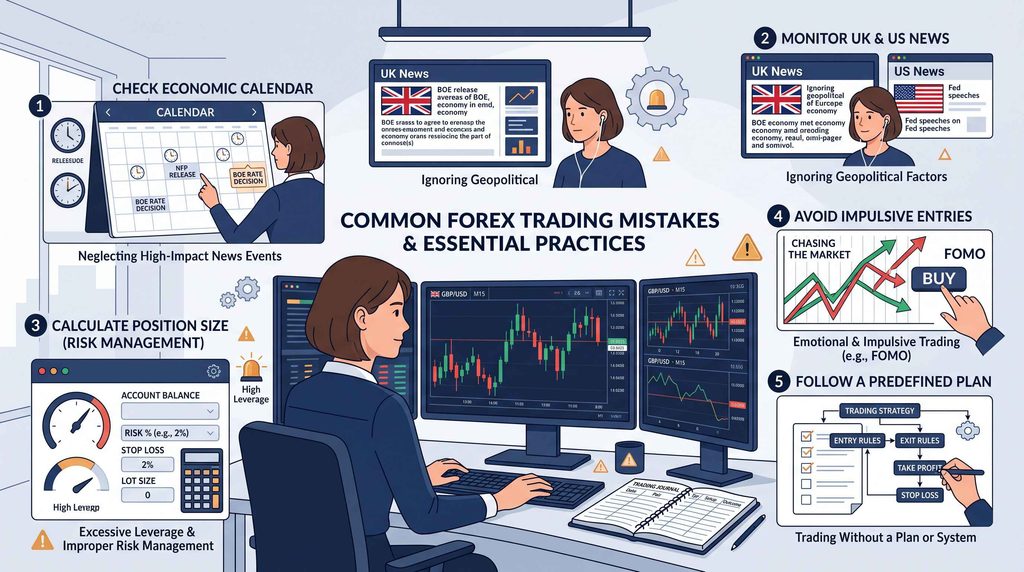
Mistake 1: Assuming Cable Always Moves More Predictably
GBP/USD can be active and liquid, but its movements can be unpredictable.
Do not assume that a strong trend will continue or that a historical support level will always hold.
Mistake 2: Ignoring UK Economic News
Traders who focus only on US announcements can miss important developments affecting sterling.
Monitor both sides of the pair, including Bank of England decisions, UK inflation and employment data.
Mistake 3: Trading Without Checking the Calendar
An upcoming announcement can change the market environment quickly.
Check for major releases before opening a position and decide whether your strategy is suitable for those conditions.
Mistake 4: Using the Same Position Size for Every Setup
Different trades may require different Stop Loss distances.
If you use the same position size regardless of the Stop Loss, the amount at risk can vary significantly.
Calculate position size based on your risk plan rather than using a fixed size automatically.
Mistake 5: Chasing a Sudden Price Movement
When Cable moves sharply, it can be tempting to enter immediately.
But the price may already have moved too far for the original setup to remain attractive.
Wait for your predefined entry conditions instead of trading out of fear of missing an opportunity.
GBP/USD vs EUR/USD: What’s the Difference?
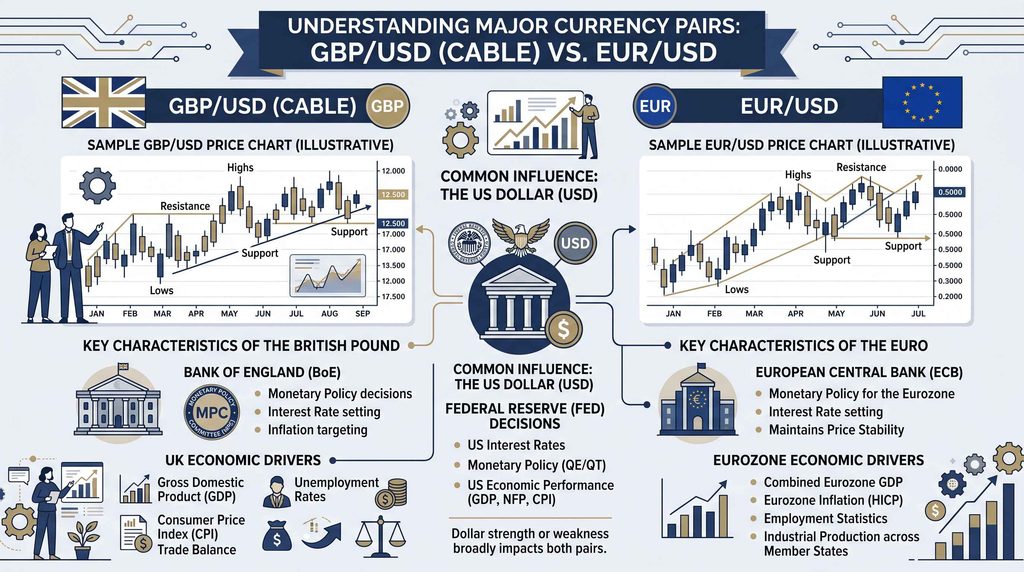
Both are major currency pairs that include the US dollar, but they do not behave identically.
| Feature | GBP/USD (Cable) | EUR/USD |
| Base currency | British pound | Euro |
| Quote currency | US dollar | US dollar |
| Key central bank | Bank of England | European Central Bank |
| US influence | Federal Reserve and US economic data | Federal Reserve and US economic data |
| Other major influences | UK inflation, wages, growth and political developments | Euro-area inflation, growth and ECB policy |
| Price behaviour | Can experience sharp movements around UK-specific news | Often offers deep liquidity and extensive market coverage |
| Key risk | Volatility around UK and US developments | Volatility around euro-area and US developments |
Both pairs can experience sharp movements and changing spreads.
Cable may suit traders who want to focus on the UK–US economic relationship, while EUR/USD may appeal to those who prefer to study the euro area and United States.
Neither pair is automatically easier or more profitable. The right choice depends on your strategy, trading hours and risk tolerance.
Is GBP/USD Suitable for Beginners?
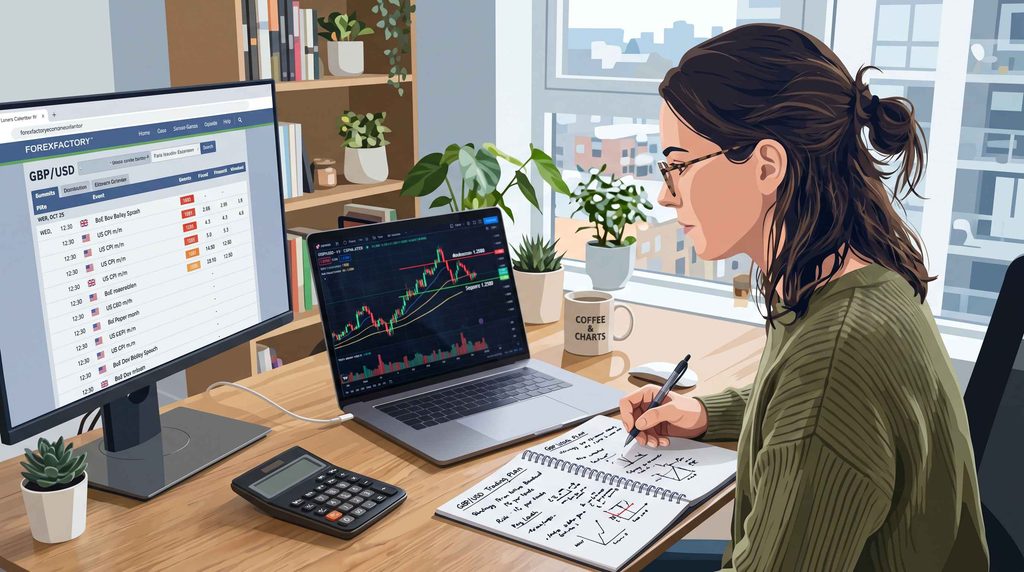
GBP/USD can be useful for learning about Forex, particularly if you want to understand how economic releases, central bank policy and technical analysis interact.
However, its sharp movements can be challenging for inexperienced traders.
If you’re a beginner, consider these steps:
- Learn how currency pairs, pips, spreads and leverage work.
- Understand how UK and US economic announcements affect the market.
- Practise analysing charts on a demo account.
- Create clear entry and exit rules.
- Learn to calculate position size before entering a trade.
- Keep a journal of your decisions and outcomes.
- Avoid risking money you cannot afford to lose.
A demo account can help you practise, but simulated performance does not guarantee similar results with real money.
The goal should be to develop a disciplined process rather than trying to make quick profits from every market movement.
Final Thoughts

GBP/USD, commonly known as Cable, is one of the major Forex currency pairs. Its long history, substantial trading activity and sensitivity to economic news make it a popular market to follow.
The pair’s price reflects the relative outlook for the United Kingdom and United States, including interest rates, inflation, employment, economic growth and political developments.
For traders, understanding these influences can provide a useful framework for analysing possible opportunities. But Cable’s sharp movements also make careful risk management essential.
FXProfitBuilder includes GBP/USD among its three signal pairs, alongside EUR/USD and USD/CHF. Traders considering the service should review the current methodology, signal details and subscription terms to decide whether it fits their needs.
Above all, remember that a popular currency pair is not automatically an easy one to trade. Learn the market, plan each trade, control your position size and accept that losses are possible.
Forex trading carries significant risk, particularly when leverage is involved. No trading strategy or signal service can guarantee profits.
FAQ

1. What is GBP/USD in Forex trading?
GBP/USD is the exchange rate between the British pound and the US dollar. It tells you how many US dollars are needed to buy one British pound.
2. Why is GBP/USD called Cable?
The nickname comes from the nineteenth-century transatlantic telegraph cable used to transmit exchange-rate information between London and New York. The name remains in use among Forex traders.
3. What makes GBP/USD rise or fall?
The pair is influenced by Bank of England and Federal Reserve policy, UK and US inflation, employment, economic growth, political developments and broader market sentiment.
4. When is the best time to trade GBP/USD?
The London session and the London–New York overlap are often active periods. However, the best time depends on your strategy, market conditions and ability to manage risk.
5. Is GBP/USD more volatile than EUR/USD?
GBP/USD can experience larger price swings in some market conditions, particularly around UK-specific news. But volatility varies over time, so traders should compare current conditions rather than assume one pair is always more volatile.
6. How much is one pip in GBP/USD?
One pip is generally 0.0001. For a standard lot of 100,000 GBP, one pip is typically worth about $10 when the profit-and-loss currency is USD. The exact value depends on position size, account currency and contract specifications.
7. Can beginners trade GBP/USD?
Beginners can study and practise GBP/USD, but they should first understand currency pricing, leverage, trading costs and risk management. A demo account can be useful for learning without risking real money.
8. Which economic reports should GBP/USD traders watch?
Important reports include UK inflation, wages, employment and GDP, along with US inflation, nonfarm payrolls, GDP and Federal Reserve announcements.
9. Does FXProfitBuilder provide GBP/USD signals?
Yes. FXProfitBuilder lists GBP/USD among the currency pairs covered by its signals, alongside EUR/USD and USD/CHF. Check the provider’s current website for its latest service information and terms.
10. Can Forex signals guarantee profits when trading GBP/USD?
No. Signals provide trading ideas, not guaranteed outcomes. Prices can move unexpectedly, and losses can occur even when a signal follows a defined methodology.
👉 Start your journey today—subscribe to our forex pip tips service and see the difference for yourself! Sign Up to get Exclusive Offers