Forex Signals for Busy Professionals: Trade in Minutes a Day
Posted On - October 9, 2026 | By - FXProfitBuilder | Categories - Choosing & Buying Signals (High Intent)
Introduction

For many professionals, the biggest challenge with Forex trading isn’t a lack of interest.
It’s time.
Someone working a full-time job may have meetings throughout the day, emails to answer, projects to manage and a long list of responsibilities outside work. Spending several hours every evening analysing charts simply isn’t realistic.
Yet that doesn’t necessarily mean Forex has to be completely off the table.
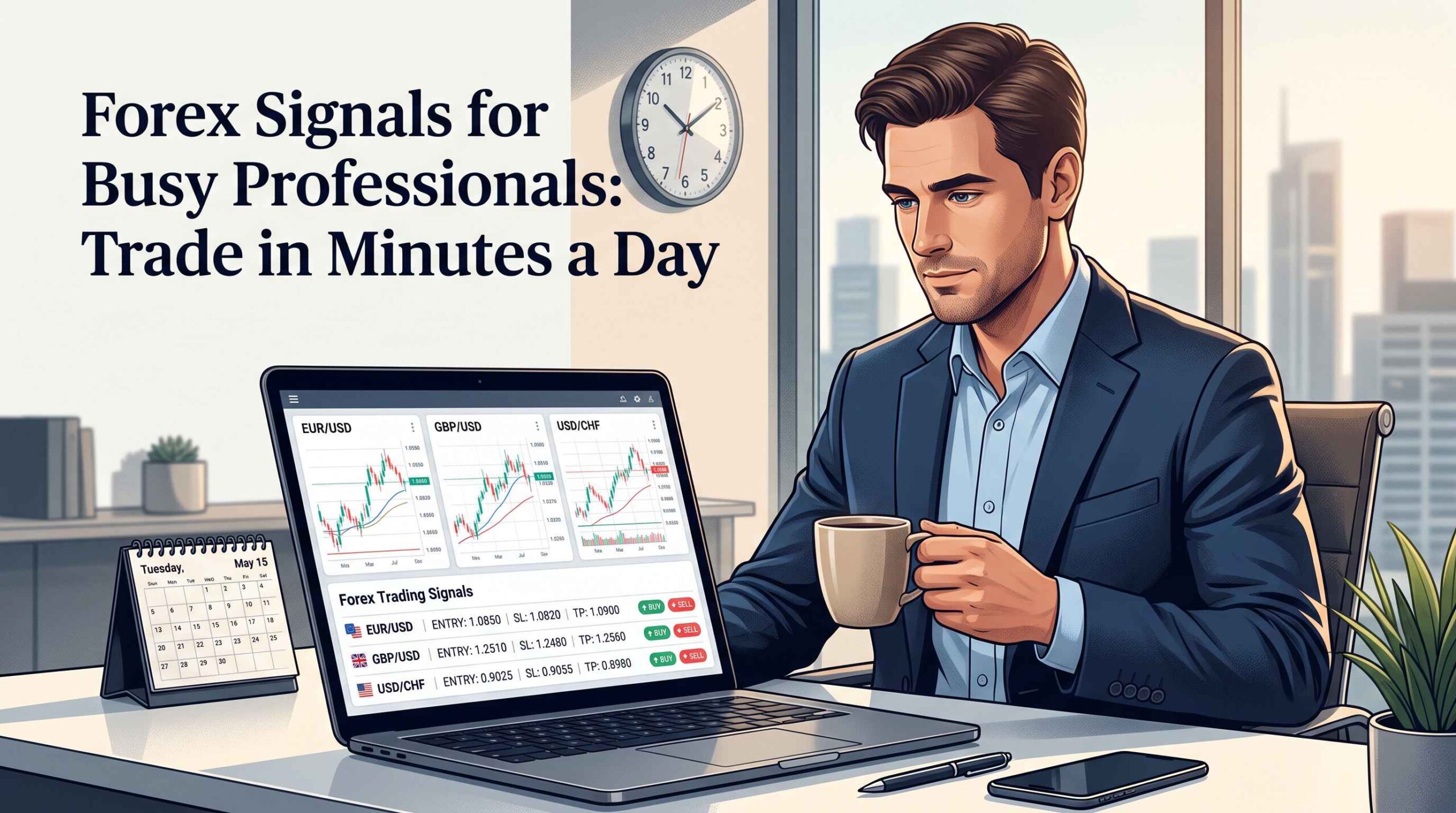
Forex signals for busy professionals can provide a more structured way to follow potential trading opportunities without requiring hours of daily market research.
Instead of opening dozens of charts and trying to identify potential trades from scratch, a trader can receive a signal containing information such as the currency pair, entry level, stop-loss and take-profit target.
That can significantly simplify the research process.
However, “trade in minutes a day” should not be interpreted as a promise of effortless profits. Forex trading carries significant risk, and a signal service cannot guarantee profitable results. The CFTC warns that retail forex trading can result in substantial losses and that traders should only use risk capital they can afford to lose.
The real benefit for a busy professional is efficiency.
Instead of spending hours searching for opportunities, you can potentially spend a short, focused period reviewing available signals and deciding whether they fit your own trading plan.
Why Forex Trading Can Be Difficult for Busy Professionals

Traditional Forex analysis can involve a lot of work.
A trader may need to:
- Monitor multiple currency pairs
- Analyse price charts
- Identify trends
- Study support and resistance
- Review indicators
- Watch economic events
- Find potential entry points
- Calculate position size
- Set stop-loss levels
- Set take-profit levels
- Monitor open trades
For someone who trades full-time, this process can become part of their daily routine.
For someone who already works 8–10 hours a day, it can become unrealistic.
This is why time efficiency matters.
The question isn’t necessarily:
“How can I spend more time trading?”
It can instead be:
“How can I make the time I have available more structured and productive?”
That is where Forex signals can potentially help.
What Are Forex Signals for Busy Professionals?
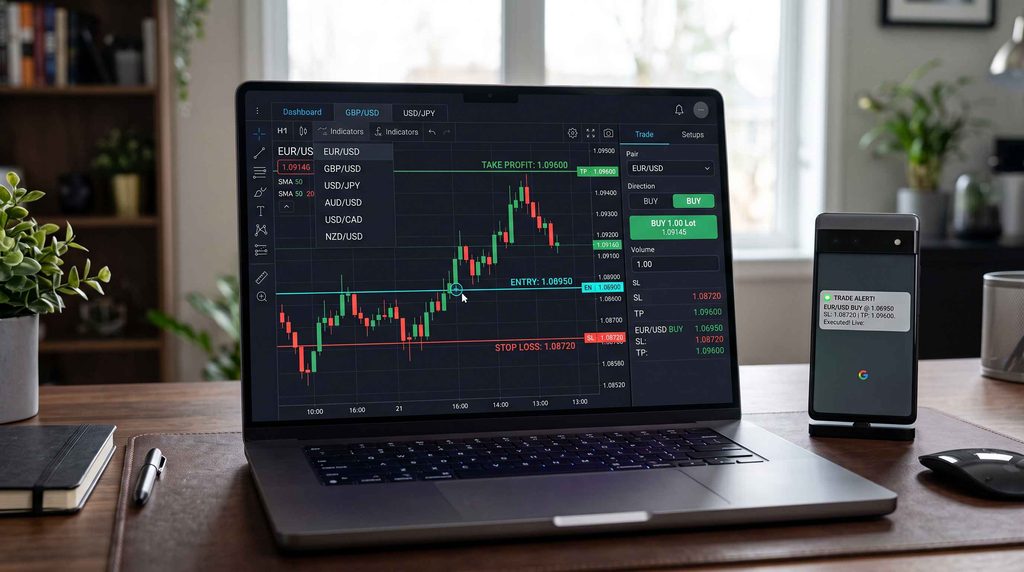
Forex signals are trading alerts that identify potential opportunities in the foreign exchange market.
A typical signal may include:
Currency Pair: EUR/USD
Direction: BUY
Entry: Defined price or range
Stop Loss: Defined level
Take Profit: Defined target
The exact format varies between providers.
Some services also provide:
- Market commentary
- Trade-management instructions
- Risk information
- Educational resources
- Notifications through messaging platforms
- Multiple currency pairs
The advantage is that much of the initial market analysis has already been completed by the signal provider.
The trader can then review the information instead of beginning the analysis from a blank chart.
How Forex Signals Can Save Busy Professionals Time

1. Less Time Searching for Trades
This is the biggest potential advantage.
Imagine opening your trading platform after a busy workday.
Instead of starting with:
“Which of these hundreds of currency pairs should I analyse?”
you may already have a shortlist of potential opportunities.
That doesn’t mean you should automatically enter every trade.
It simply means the initial research process can be more focused.
A few minutes reviewing a structured signal can potentially replace a much longer period of searching through charts.
2. Predefined Entry and Exit Levels
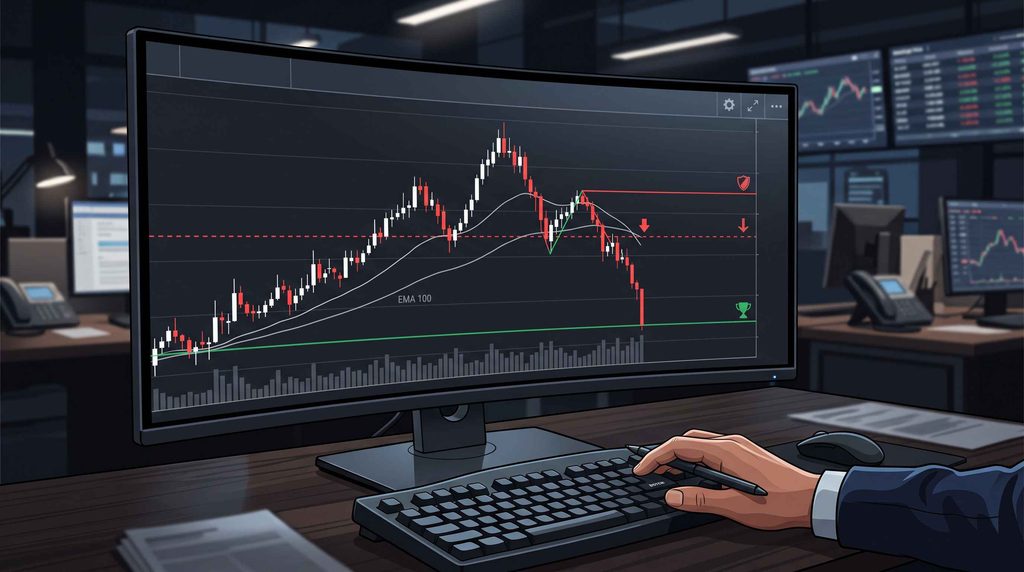
Another major time-saving feature is having predefined trade levels.
Instead of spending time deciding:
- Where should I enter?
- Where should I place my stop loss?
- Where should I take profit?
the signal may already provide those levels.
This creates a simple framework:
Entry → Stop Loss → Take Profit
The trader can then decide whether the opportunity fits their own risk rules.
That can be particularly useful for professionals who don’t have time to perform extensive technical analysis every day.
3. Focus on a Limited Number of Currency Pairs
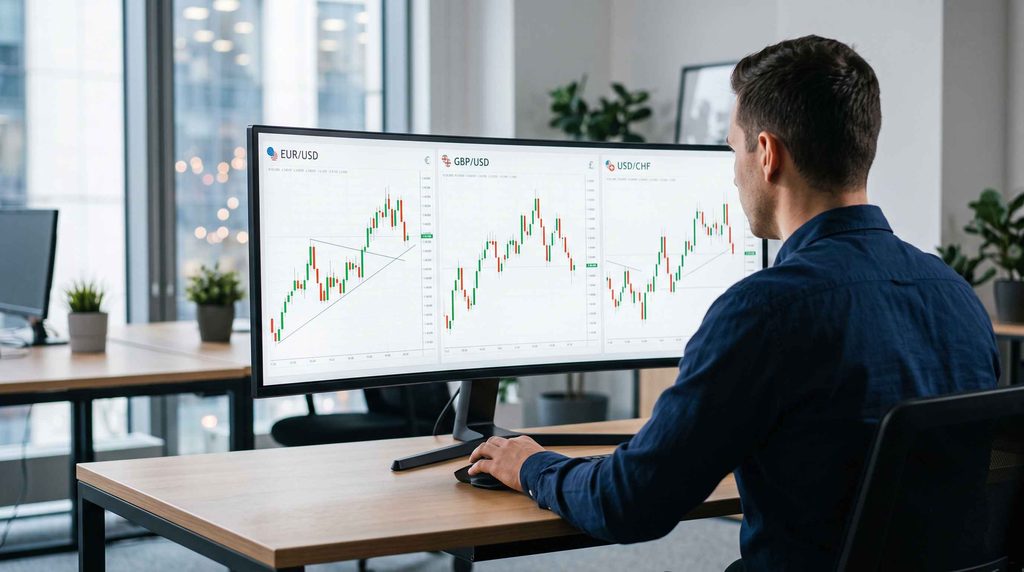
You don’t need to analyse every currency pair in the Forex market.
A focused approach can make the process much easier.
FXProfitBuilder provides signals for three currency pairs:
- EUR/USD
- GBP/USD
- USD/CHF
Instead of constantly scanning the entire market, traders following this approach can concentrate their attention on these selected pairs.
For someone with limited time, reducing the number of markets to monitor can make the routine easier to manage.
A Five-Minute Forex Routine for Busy Professionals

A busy professional doesn’t necessarily need to spend an entire evening trading.
A simple routine might look like this.
Minute 1: Check Your Signals
Review the latest alerts.
Look at the currency pair and direction.
Minute 2: Review the Trade Levels
Check:
- Entry
- Stop Loss
- Take Profit
Make sure you understand the setup.
Minute 3: Check Your Risk
Determine how much money you would potentially risk if the stop loss were reached.
Your position size should be based on your own risk limits rather than simply copying another trader’s trade size.
Minute 4: Check Your Schedule
Ask whether you can realistically monitor or manage the trade if necessary.
If you have an important meeting or cannot monitor the market when your strategy requires it, you may decide not to participate.
Minute 5: Make Your Decision
You have three basic choices:
Trade
Wait
Skip
A signal is an opportunity to evaluate not an instruction that you must follow.
Does Trading in Minutes a Day Really Work?
It can be possible to keep the analysis and decision-making routine short, but this should not be confused with guaranteed or completely hands-off trading.
The amount of time required depends on:
- Trading strategy
- Signal frequency
- Currency pairs
- Market conditions
- Whether trades require active management
- Your broker
- Your own risk-management process
Some trades may require little attention after the initial setup.
Others may require monitoring.
Unexpected market events can also cause rapid price movements.
So a more accurate way to think about the concept is:
Forex signals can potentially reduce the amount of time you spend searching for and analysing trades.
They cannot guarantee that every trading day will require only a few minutes.
Why Busy Professionals Should Avoid Constant Chart Watching

It might sound strange, but watching charts all day isn’t necessarily an advantage.
Constant monitoring can encourage overtrading.
A trader sees a small price movement and thinks:
“Maybe I should enter.”
Then another movement appears.
Then another.
Eventually, the trader is making decisions based on short-term noise rather than a defined strategy.
For someone with a full-time job, this can also create unnecessary stress.
A structured signals approach can provide a reason to check the market at specific times rather than continuously watching every price movement.
Forex Signals Can Reduce Decision Fatigue

Professionals already make hundreds of decisions every day.
At work, they may decide:
- Which task should come first
- Which email requires attention
- Which project needs resources
- Which client needs a response
- Which meeting is most important
Adding dozens of unstructured trading decisions can create additional mental fatigue.
A predefined Forex signal can simplify some of the decision-making process.
Instead of evaluating the entire market, the trader can focus on a specific setup.
The decision becomes:
Does this signal fit my trading rules and risk limits?
rather than:
What should I trade today?
That distinction can make a significant difference to a busy trader’s routine.
How Signals Can Help Reduce Overtrading

Busy professionals may think that more trading activity means more opportunities.
It doesn’t necessarily work that way.
Every trade can involve:
- Spread
- Commission, where applicable
- Market risk
- Execution risk
- Emotional pressure
A structured signal service can encourage traders to wait for predefined setups instead of entering random positions simply because they have a few minutes available.
This can potentially make the trading process more disciplined.
However, signals should not be used as a reason to increase trading frequency.
The objective should be selective and controlled participation, not maximum activity.
Risk Management Still Matters When You’re Busy

This is one area where you should never try to save time.
Before entering any Forex trade, understand:
- How much you are risking
- Where your stop loss is
- How large your position is
- How much leverage is involved
- Whether you can afford the potential loss
The CFTC recommends determining how much risk capital you can afford to use and warns against using money needed for living expenses or savings.
A busy schedule is not a reason to skip risk management.
If anything, professionals should be especially careful because they may not have enough time to react if something unexpected happens.
Don’t Trade During Important Work Meetings

This may sound obvious, but it is worth saying.
If you’re in an important client meeting, presentation or business call, you should not be trying to manage a Forex position at the same time.
If your strategy requires active monitoring, make sure you have the time available before entering.
Alternatively, you may decide that a particular setup doesn’t fit your schedule.
Remember:
Skipping a trade is better than entering a trade you cannot responsibly manage.
Manual vs Mechanical Forex Signals

Busy professionals may also be interested in the difference between manual and mechanical trading.
Manual Trading

You receive the signal and decide whether to place the trade yourself.
This allows you to consider:
- Current market conditions
- Your available time
- Your risk level
- Your account size
- Whether the trade fits your strategy
Manual execution provides flexibility but requires you to be available.
Mechanical Trading
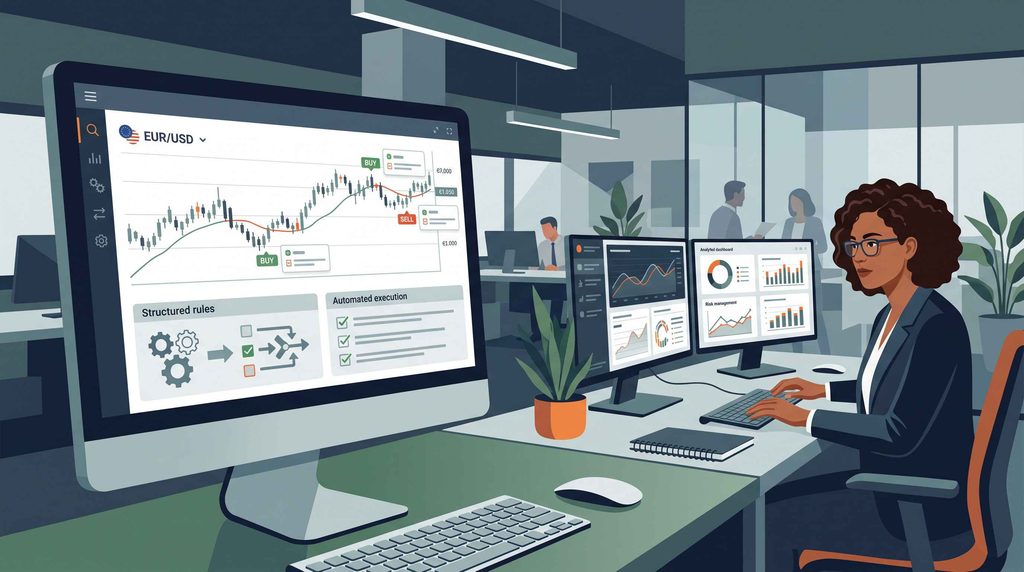
A mechanical approach follows predefined rules for trade execution.
FXProfitBuilder describes its alert system as suitable for manual or mechanical trading.
This can potentially make the process more structured for someone who prefers rules rather than discretionary decisions.
However, mechanical execution doesn’t eliminate risk.
No system can guarantee that a market will move as expected.
Why FXProfitBuilder Can Fit a Time-Conscious Trading Routine

FXProfitBuilder’s signal system is designed around simplifying the process of identifying Forex trading opportunities.
The company states that its signals are developed using tools including:
- Volume indicators
- Support and resistance analysis
- A mathematical model
The system provides defined entry and exit information so that traders don’t necessarily need to perform the entire market analysis themselves.
FXProfitBuilder focuses on three currency pairs:
EUR/USD
GBP/USD
USD/CHF

For a busy professional, that focused approach can make the market easier to follow.
Instead of monitoring dozens of currency pairs, the trader can concentrate on a defined group.
The signals can also be followed manually or mechanically, depending on the user’s preferred approach.
A Simple Daily Workflow With FXProfitBuilder

A professional with limited time could structure their routine around a few simple steps.
Before Work
Check whether any new signals are available.
During a Suitable Break
Review:
- Currency pair
- Entry
- Stop loss
- Take profit
- Risk
Before Entering
Make sure the trade fits your own risk-management rules.
After Entry

Follow your predefined trade-management plan rather than constantly changing decisions because of short-term price movements.
End of Day

Record the trade in a journal.
This entire process can be much more structured than spending hours analysing every available chart.
What Busy Professionals Should Not Expect From Forex Signals

Forex signals can simplify parts of trading, but they don’t make the market predictable.
Don’t expect signals to:
- Guarantee profits
- Eliminate losses
- Predict every market movement
- Remove the need for risk management
- Make every trade successful
- Replace learning completely
- Turn Forex into passive income
- Require zero attention
The CFTC warns consumers to be skeptical of claims of guaranteed profits and easy money in Forex trading.
The FCA also warns about online trading scams that promote high or guaranteed returns.
A signal service should therefore be viewed as a tool for structured decision-making, not a guaranteed income source.
What If You Only Have 10 Minutes a Day?

You can still create a simple routine.
2 Minutes
Check new signals.
2 Minutes
Review entry, stop loss and take profit.
2 Minutes
Calculate your position size and risk.
2 Minutes
Check whether you have enough time to manage the trade.
2 Minutes
Record your decision and move on.
You don’t need to stare at the charts continuously.
The key is having a process.
What If You Have Only 5 Minutes?

Even five minutes can be useful for reviewing information, but don’t force a trade simply because you have a limited amount of time.
A five-minute routine might be:
Check → Review → Risk-check → Decide → Move on
If everything fits your plan, you can consider the trade.
If it doesn’t, skip it.
There will always be another market opportunity.
How to Evaluate a Forex Signals Service as a Busy Professional

Before subscribing, ask these questions:
Is the signal format easy to understand?
You shouldn’t need to spend 20 minutes decoding every alert.
Are notifications convenient?
Choose a delivery method that fits your daily routine.
Are entry and exit levels clearly defined?
Clear information reduces unnecessary analysis.
Are risk-management principles explained?
This is essential.
Which currency pairs are covered?
Make sure they are relevant to you.
How many signals are normally provided?
You want a manageable amount of information.
Is educational material available?
Education can help you understand what you’re following.
Is there a free trial?
A trial can let you experience the service before paying.
Free Trial: A Useful Option for Busy Traders

If you’re considering a signal service, a free trial can be particularly useful when your time is limited.
You can quickly determine whether:
- Signals arrive at convenient times
- The format is easy to understand
- The number of alerts is manageable
- The currency pairs are suitable
- The service fits around your work
- The information is sufficient to make a decision
Rather than committing immediately, you can first test the workflow.
The goal isn’t to make the maximum profit during the trial.
The goal is to determine:
“Can this service realistically fit into my life?”
Common Mistakes Busy Professionals Should Avoid

Trying to Trade During Work
Don’t let Forex interfere with important professional responsibilities.
Taking Every Signal
You don’t have to trade every alert.
Increasing Risk Because You Have Limited Time
Lack of time should never lead to larger positions.
Checking the Market Constantly
A structured strategy should reduce unnecessary monitoring.
Trading With Money You Need
Only risk capital you can afford to lose.
Expecting Passive Income
Signals can reduce research time, but Forex trading remains an active financial activity with risk.
Ignoring Major Market Events
Economic announcements can cause significant volatility.
Daily Forex Signals vs Independent Analysis

| Factor | Independent Analysis | Forex Signals |
| Market research | Trader performs it | Provider performs signal analysis |
| Time required | Potentially high | Potentially lower |
| Chart knowledge | More important | Still useful |
| Entry identification | Trader decides | Signal provides setup |
| Risk management | Trader responsible | Trader still responsible |
| Flexibility | High | Depends on provider |
| Subscription cost | Usually none | May apply |
| Trading risk | Remains | Remains |
| Guaranteed profit | No | No |
Signals don’t remove the responsibility of trading.
They can simply change how much preliminary analysis the trader has to perform.
Who Are Forex Signals Most Useful For?

Forex signals may be particularly relevant to:
Full-Time Employees
People who cannot spend hours analysing charts every day.
Business Owners
Entrepreneurs who want a structured way to monitor potential opportunities without constantly watching the market.
Freelancers and Consultants
Professionals whose schedules change frequently.
Beginners
People who want a more structured starting point while learning Forex.
Experienced Traders With Limited Time
Traders who already understand Forex but don’t want to spend hours scanning the market.
Who Should Avoid Rushing Into Forex Signals?

A signal service may not be suitable if you:
- Expect guaranteed profits
- Cannot afford potential losses
- Are using borrowed money to trade
- Don’t understand basic Forex risks
- Want completely passive income
- Are likely to blindly copy every trade
- Cannot tolerate the possibility of losing your trading capital
The first priority should always be understanding the risk.
Final Thoughts

For busy professionals, the biggest potential advantage of Forex signals isn’t that they make trading effortless.
It’s that they can make the process more efficient.
Instead of spending hours searching through charts, a trader can receive a structured trading idea and spend a few focused minutes reviewing the setup.
That can include:
- Currency pair
- Entry
- Stop loss
- Take profit
- Risk
- Personal availability
FXProfitBuilder focuses its signals on EUR/USD, GBP/USD and USD/CHF and states that its methodology uses volume indicators, support and resistance analysis and a mathematical model. Its alerts can be followed manually or mechanically.
For a professional with limited time, this focused approach can potentially make it easier to incorporate Forex into an existing routine.
But there is an important distinction:
Trading in minutes a day does not mean making money in minutes a day.
Forex remains a high-risk financial market.
The goal should be to create a disciplined routine that fits your schedule, understand every trade you take, control your risk and never treat a signal as a guarantee.
If you can spend a few focused minutes reviewing opportunities while maintaining sensible risk management, Forex signals may offer a more practical approach than trying to analyse the entire market yourself.
FAQ

1. Can busy professionals trade Forex?
Yes, but the amount of time required depends on the strategy. Forex signals can potentially reduce the time spent searching for and analysing trading opportunities.
2. How much time do I need for Forex signals?
There is no fixed amount. A simple signal-review process may take only a few minutes, but some trades and market conditions require additional monitoring.
3. Can Forex signals really save time?
They can potentially reduce the amount of preliminary market research because the provider has already analysed potential setups.
4. Can I trade Forex while working a full-time job?
It may be possible, but you should never allow trading to interfere with your professional responsibilities. If a trade requires monitoring while you’re working, consider whether it actually fits your schedule.
5. What do Forex signals usually include?
Signals commonly include a currency pair, buy or sell direction, entry level, stop-loss level and take-profit target.
6. How many currency pairs should a busy trader follow?
There is no universal number. Focusing on a limited selection can make monitoring easier. FXProfitBuilder provides signals for EUR/USD, GBP/USD and USD/CHF.
7. Do I need to watch Forex charts all day?
No. Many trading strategies do not require continuous chart watching. However, your specific strategy and trade-management requirements determine how much monitoring is appropriate.
8. Can Forex signals guarantee profits?
No. Signals cannot guarantee future trading results. Be cautious of providers promising guaranteed profits or unrealistic returns.
9. Can I use Forex signals manually?
Yes. You can review a signal and manually place the trade if it fits your trading plan and risk limits.
10. Can Forex signals be traded mechanically?
Some signal systems can be used with mechanical rules or execution. FXProfitBuilder states that its alerts can be traded manually or mechanically.
11. Are Forex signals suitable for beginners?
They can provide a structured starting point, but beginners should still learn basic Forex concepts, understand leverage and practise proper risk management.
12. What is the most important thing for a busy Forex trader?
Time efficiency is useful, but risk management should come first. Saving five minutes is never worth taking an unnecessarily large financial risk.
👉 Start your journey today—subscribe to our forex pip tips service and see the difference for yourself! Sign Up to get Exclusive Offers